• Extension cables.

    From Chris Hogg@21:1/5 to All on Wed Jun 25 12:47:06 2025
    I understand it is bad practice to concatenate extension cables.

    Why?

    --

    Chris

    --- SoupGate-Win32 v1.05
    * Origin: fsxNet Usenet Gateway (21:1/5)
  • From Ian@21:1/5 to Chris Hogg on Wed Jun 25 12:56:27 2025
    On 2025-06-25, Chris Hogg <[email protected]> wrote:
    I understand it is bad practice to concatenate extension cables.

    Why?


    Because Americans.

    They don't have fused plugs, so by daisy-chaining extension leads they
    can easily overload the ones closer to the supply and start fires. So
    "over there" it's considered a serious problem.

    Theoretically*, with the 13A (or less) fuse in all UK plugs, is shouldn't
    be possible to overload anything, and the worst that will happen is the
    fuse will blow (or you'll trip on the tangle of wires and kill yourself
    that way instead).

    * I'm not convinced that poundland-specials could cope with a sustained
    load of whatever-it-takes to blow a 13A fuse.

    So, although it's not as bad as American media would have you believe,
    you still need to be careful. 20 wall-warts taking less than 20W max
    each is fine, A kettle, 3-bar electric fire, and toaster may be pushing
    it, even on a single extension lead.


    --
    Ian

    "Tamahome!!!" - "Miaka!!!"

    --- SoupGate-Win32 v1.05
    * Origin: fsxNet Usenet Gateway (21:1/5)
  • From Andy Bennett@21:1/5 to Chris Hogg on Wed Jun 25 13:45:30 2025
    On 25/06/2025 12:47, Chris Hogg wrote:
    I understand it is bad practice to concatenate extension cables.

    Why?


    Ohms law

    --- SoupGate-Win32 v1.05
    * Origin: fsxNet Usenet Gateway (21:1/5)
  • From Theo@21:1/5 to Ian on Wed Jun 25 14:23:07 2025
    Ian <${send-direct-email-to-news1021-at-jusme-dot-com-if-you-must}@jusme.com> wrote:
    On 2025-06-25, Chris Hogg <[email protected]> wrote:
    I understand it is bad practice to concatenate extension cables.

    Why?


    Because Americans.

    They don't have fused plugs, so by daisy-chaining extension leads they
    can easily overload the ones closer to the supply and start fires. So
    "over there" it's considered a serious problem.

    Indeed.

    Theoretically*, with the 13A (or less) fuse in all UK plugs, is shouldn't
    be possible to overload anything, and the worst that will happen is the
    fuse will blow (or you'll trip on the tangle of wires and kill yourself
    that way instead).

    Trouble is many extension leads have 0.75mm2 or 1mm2 cable. That's fine
    because they calculate the voltage drop across the length of cable provided
    and ensure it's within limits - longer cables could be 1.5mm2 to compensate. When you chain them together you chain together the voltage drops, with the result that the voltage at the far end could be sagging under load.

    That may not be a problem if the devices at the far end will adapt to the voltage, but you could see load-dependent brown-outs if you connected an incandescent lamp or say a motor whose speed or torque depended on the mains voltage.

    (also, you don't want to exceed the thermal limits of the cables. Having a daisy chain won't change that, unless you put them all together so they
    combine their heat)

    Theo

    --- SoupGate-Win32 v1.05
    * Origin: fsxNet Usenet Gateway (21:1/5)
  • From Chris Hogg@21:1/5 to All on Wed Jun 25 14:24:57 2025
    On Wed, 25 Jun 2025 13:45:30 +0100, Andy Bennett <[email protected]>
    wrote:

    On 25/06/2025 12:47, Chris Hogg wrote:
    I understand it is bad practice to concatenate extension cables.

    Why?


    Ohms law

    Can you be a bit more explicit?

    --

    Chris

    --- SoupGate-Win32 v1.05
    * Origin: fsxNet Usenet Gateway (21:1/5)
  • From mm0fmf@21:1/5 to Chris Hogg on Wed Jun 25 16:37:11 2025
    On 25/06/2025 14:24, Chris Hogg wrote:
    On Wed, 25 Jun 2025 13:45:30 +0100, Andy Bennett <[email protected]>
    wrote:

    On 25/06/2025 12:47, Chris Hogg wrote:
    I understand it is bad practice to concatenate extension cables.

    Why?


    Ohms law

    Can you be a bit more explicit?


    Sure, V = IR.

    --- SoupGate-Win32 v1.05
    * Origin: fsxNet Usenet Gateway (21:1/5)
  • From NY@21:1/5 to All on Wed Jun 25 17:28:54 2025
    On 25/06/2025 16:37, mm0fmf wrote:
    On 25/06/2025 14:24, Chris Hogg wrote:
    On Wed, 25 Jun 2025 13:45:30 +0100, Andy Bennett <[email protected]>
    wrote:

    On 25/06/2025 12:47, Chris Hogg wrote:
    I understand it is bad practice to concatenate extension cables.

    Why?


    Ohms law

    Can you be a bit more explicit?


    Sure, V = IR.


    So the longer the cable, the more resistance in the wires and therefore
    the more voltage dropped across it.

    Fair enough. But it is any worse to daisy-chain two 20-metre extension
    cables than to use a 40-metre extension cable?

    I've committed the cardinal sin of daisy-chaining three extension reels
    - 40 and two 20s - to run our garden shredder at the bottom of the
    garden close to where I'm stripping branches off fallen or pruned trees,
    so I don't have to lug all the branches up to nearer the house and shred
    them on the gravel drive.

    --- SoupGate-Win32 v1.05
    * Origin: fsxNet Usenet Gateway (21:1/5)
  • From NY@21:1/5 to Andy Burns on Wed Jun 25 17:40:26 2025
    On 25/06/2025 17:37, Andy Burns wrote:
    NY wrote:

    So the longer the cable, the more resistance in the wires and
    therefore the more voltage dropped across it.

    Fair enough. But it is any worse to daisy-chain two 20-metre extension
    cables than to use a 40-metre extension cable?

    The 40m extension is more likely to come as 2.5mm^2 cable and the 20m extensions more likely as 1.5mm^2 ... unless from Amazon ...


    The outside diameters of all three cables that I have are very similar, suggesting that they are all 1.5 mm^2 or all 2.5 mm^2.

    --- SoupGate-Win32 v1.05
    * Origin: fsxNet Usenet Gateway (21:1/5)
  • From Theo@21:1/5 to [email protected] on Wed Jun 25 17:56:16 2025
    NY <[email protected]> wrote:
    On 25/06/2025 17:37, Andy Burns wrote:
    NY wrote:

    So the longer the cable, the more resistance in the wires and
    therefore the more voltage dropped across it.

    Fair enough. But it is any worse to daisy-chain two 20-metre extension
    cables than to use a 40-metre extension cable?

    The 40m extension is more likely to come as 2.5mm^2 cable and the 20m extensions more likely as 1.5mm^2 ... unless from Amazon ...


    The outside diameters of all three cables that I have are very similar, suggesting that they are all 1.5 mm^2 or all 2.5 mm^2.

    PVC filling is cheaper than copper... but the mm2 should be written on the outside.

    Theo

    --- SoupGate-Win32 v1.05
    * Origin: fsxNet Usenet Gateway (21:1/5)
  • From The Natural Philosopher@21:1/5 to All on Wed Jun 25 18:07:16 2025
    On 25/06/2025 17:28, NY wrote:

    I've committed the cardinal sin of daisy-chaining three extension reels
    - 40 and two 20s - to run our garden shredder at the bottom of the
    garden close to where I'm stripping branches off fallen or pruned trees,
    so I don't have to lug all the branches up to nearer the house and shred
    them on the gravel drive.
    It will just be lower power, thats all

    --
    In todays liberal progressive conflict-free education system, everyone
    gets full Marx.

    --- SoupGate-Win32 v1.05
    * Origin: fsxNet Usenet Gateway (21:1/5)
  • From Joe@21:1/5 to [email protected] on Wed Jun 25 18:08:41 2025
    On Wed, 25 Jun 2025 17:28:54 +0100
    NY <[email protected]> wrote:

    On 25/06/2025 16:37, mm0fmf wrote:
    On 25/06/2025 14:24, Chris Hogg wrote:
    On Wed, 25 Jun 2025 13:45:30 +0100, Andy Bennett <[email protected]>
    wrote:

    On 25/06/2025 12:47, Chris Hogg wrote:
    I understand it is bad practice to concatenate extension cables.

    Why?


    Ohms law

    Can you be a bit more explicit?


    Sure, V = IR.


    So the longer the cable, the more resistance in the wires and
    therefore the more voltage dropped across it.

    Fair enough. But it is any worse to daisy-chain two 20-metre
    extension cables than to use a 40-metre extension cable?

    Yes, because you have an additional plug, socket and fuse in the path,
    all of which might have poor or loose connections, and fuses have
    resistance, as they must in order to function. All additional points of
    failure and potential overheating.


    I've committed the cardinal sin of daisy-chaining three extension
    reels
    - 40 and two 20s - to run our garden shredder at the bottom of the
    garden close to where I'm stripping branches off fallen or pruned
    trees, so I don't have to lug all the branches up to nearer the house
    and shred them on the gravel drive.

    OK for temporary use, as long as the cables are fully unreeled. A
    shredder is a fairly powerful beast. The problems really arise in
    amateur workshops, offices and such, where several extensions get
    chained, and often sit for years on the floor behind benches or desks,
    where they will not be inspected regularly. In a business, they will be inspected and PAT tested every year or two.

    --
    Joe

    --- SoupGate-Win32 v1.05
    * Origin: fsxNet Usenet Gateway (21:1/5)
  • From Andy Burns@21:1/5 to All on Wed Jun 25 17:37:05 2025
    NY wrote:

    So the longer the cable, the more resistance in the wires and therefore
    the more voltage dropped across it.

    Fair enough. But it is any worse to daisy-chain two 20-metre extension
    cables than to use a 40-metre extension cable?

    The 40m extension is more likely to come as 2.5mm^2 cable and the 20m extensions more likely as 1.5mm^2 ... unless from Amazon ...

    --- SoupGate-Win32 v1.05
    * Origin: fsxNet Usenet Gateway (21:1/5)
  • From John Rumm@21:1/5 to Chris Hogg on Thu Jun 26 11:48:34 2025
    On 25/06/2025 12:47, Chris Hogg wrote:

    I understand it is bad practice to concatenate extension cables.

    Why?

    The main concern is that inclusion of extra plug/socket connections
    combined with the extra cable resistance could result in raising the
    earth loop impedance to a point were you could no longer rely on it
    being low enough to clear a fault quickly[1].

    There is a secondary concern that many extension cable makers will spec
    the thinnest flex that they can get away with taking into account the
    length. Using several may result in excessive voltage drop at the point
    of use - especially for higher power loads. For mainly resistive loads
    this may just result in lower performance / less power at the appliance.
    For something like a mower with an induction motor, it could result in
    motor damage since it can draw more current that it was designed to, and overheat.

    [1] So if something goes wrong (say you partially chop through you hedge trimmer cable, and end up with it snared in the blade and shorted) the
    fault current that flows needs to be large enough to blow the fuse
    before the cable melts or catches fire. (you can play about with the
    adiabatic equation to see what effect extra extension lead resistance
    can have)


    --
    Cheers,

    John.

    /=================================================================\
    | Internode Ltd - http://www.internode.co.uk | |-----------------------------------------------------------------|
    | John Rumm - john(at)internode(dot)co(dot)uk | \=================================================================/

    --- SoupGate-Win32 v1.05
    * Origin: fsxNet Usenet Gateway (21:1/5)
  • From Tricky Dicky@21:1/5 to John Rumm on Thu Jun 26 11:34:11 2025
    John Rumm <[email protected]> wrote:
    On 25/06/2025 12:47, Chris Hogg wrote:

    I understand it is bad practice to concatenate extension cables.

    Why?

    The main concern is that inclusion of extra plug/socket connections
    combined with the extra cable resistance could result in raising the
    earth loop impedance to a point were you could no longer rely on it
    being low enough to clear a fault quickly[1].

    There is a secondary concern that many extension cable makers will spec
    the thinnest flex that they can get away with taking into account the
    length. Using several may result in excessive voltage drop at the point
    of use - especially for higher power loads. For mainly resistive loads
    this may just result in lower performance / less power at the appliance.
    For something like a mower with an induction motor, it could result in
    motor damage since it can draw more current that it was designed to, and overheat.

    [1] So if something goes wrong (say you partially chop through you hedge trimmer cable, and end up with it snared in the blade and shorted) the
    fault current that flows needs to be large enough to blow the fuse
    before the cable melts or catches fire. (you can play about with the adiabatic equation to see what effect extra extension lead resistance
    can have)


    Manufacturers of things like fan heaters tend to issue dire warnings about using extensions on their appliances owing to the heat effect in cables.
    Yet they often provide such short leads that it is difficult to plug in a heater and position it to get maximum effect. The answer is to provide
    larger cables but I suppose when you are working to a price that becomes a problem yet for end users adding an extension as inappropriate as it is
    often the only solution.

    I had one of those Stanley workshop fan heaters and there was always
    detectable warmth in the cable and moulded plug. When it eventually failed
    the moulded plug almost melted and I suspected there was a dodgy connection within but it is one of those things that’s impossible to check.

    --- SoupGate-Win32 v1.05
    * Origin: fsxNet Usenet Gateway (21:1/5)
  • From Chris Hogg@21:1/5 to [email protected] on Thu Jun 26 13:04:55 2025
    On Thu, 26 Jun 2025 11:48:34 +0100, John Rumm
    <[email protected]> wrote:

    On 25/06/2025 12:47, Chris Hogg wrote:

    I understand it is bad practice to concatenate extension cables.

    Why?

    The main concern is that inclusion of extra plug/socket connections
    combined with the extra cable resistance could result in raising the
    earth loop impedance to a point were you could no longer rely on it
    being low enough to clear a fault quickly[1].

    There is a secondary concern that many extension cable makers will spec
    the thinnest flex that they can get away with taking into account the
    length. Using several may result in excessive voltage drop at the point
    of use - especially for higher power loads. For mainly resistive loads
    this may just result in lower performance / less power at the appliance.
    For something like a mower with an induction motor, it could result in
    motor damage since it can draw more current that it was designed to, and >overheat.

    [1] So if something goes wrong (say you partially chop through you hedge >trimmer cable, and end up with it snared in the blade and shorted) the
    fault current that flows needs to be large enough to blow the fuse
    before the cable melts or catches fire. (you can play about with the >adiabatic equation to see what effect extra extension lead resistance
    can have)

    A comprehensible explanation - thanks John.

    --

    Chris

    --- SoupGate-Win32 v1.05
    * Origin: fsxNet Usenet Gateway (21:1/5)
  • From nib@21:1/5 to John Rumm on Thu Jun 26 13:59:43 2025
    On 2025-06-26 11:48, John Rumm wrote:
    On 25/06/2025 12:47, Chris Hogg wrote:

    I understand it is bad practice to concatenate extension cables.

    Why?

    The main concern is that inclusion of extra plug/socket connections
    combined with the extra cable resistance could result in raising the
    earth loop impedance to a point were you could no longer rely on it
    being low enough to clear a fault quickly[1].

    There is a secondary concern that many extension cable makers will spec
    the thinnest flex that they can get away with taking into account the
    length. Using several may result in excessive voltage drop at the point
    of use - especially for higher power loads. For mainly resistive loads
    this may just result in lower performance / less power at the appliance.
    For something like a mower with an induction motor, it could result in
    motor damage since it can draw more current that it was designed to, and overheat.

    [1] So if something goes wrong (say you partially chop through you hedge trimmer cable, and end up with it snared in the blade and shorted) the
    fault current that flows needs to be large enough to blow the fuse
    before the cable melts or catches fire. (you can play about with the adiabatic equation to see what effect extra extension lead resistance
    can have)


    I spent some time playing with extension cables when I had the EV before
    the proper charger. The variability between different 13A plugs and
    sockets was quite marked, some staying quite cool and others getting
    worryingly warm for something you need to leave running unattended for
    hours. I was testing using an old 3kW fan heater. I was surprised also
    at how much warmer a cable would get just coiled on the floor, not even
    wound on a reel.

    I ended up making my own lead with chunky 2.5 mm^2 cable, which is a bit
    of a squeeze in some plugs, an old MK plug of the type where you wind
    the conductor around a post and then clamp down with a nut, and a single plastic trailing 13A socket where I was lucky first time. Plugged into a
    new RCD-protected wall socket that all ran cool.

    The 2.5 cable also stayed reasonably cool when lightly coiled on the
    floor rather than stretched out.

    The only non-ideal element was the 13A plug moulded on to the charger
    which would always get warm, especially around the L pin, though pin,
    fuse and fuse holder looked clean.

    nib

    --- SoupGate-Win32 v1.05
    * Origin: fsxNet Usenet Gateway (21:1/5)
  • From RJH@21:1/5 to nib on Thu Jun 26 13:15:31 2025
    On 26 Jun 2025 at 13:59:43 BST, nib wrote:

    On 2025-06-26 11:48, John Rumm wrote:
    On 25/06/2025 12:47, Chris Hogg wrote:

    I understand it is bad practice to concatenate extension cables.

    Why?

    The main concern is that inclusion of extra plug/socket connections
    combined with the extra cable resistance could result in raising the
    earth loop impedance to a point were you could no longer rely on it
    being low enough to clear a fault quickly[1].

    There is a secondary concern that many extension cable makers will spec
    the thinnest flex that they can get away with taking into account the
    length. Using several may result in excessive voltage drop at the point
    of use - especially for higher power loads. For mainly resistive loads
    this may just result in lower performance / less power at the appliance.
    For something like a mower with an induction motor, it could result in
    motor damage since it can draw more current that it was designed to, and
    overheat.

    [1] So if something goes wrong (say you partially chop through you hedge
    trimmer cable, and end up with it snared in the blade and shorted) the
    fault current that flows needs to be large enough to blow the fuse
    before the cable melts or catches fire. (you can play about with the
    adiabatic equation to see what effect extra extension lead resistance
    can have)


    I spent some time playing with extension cables when I had the EV before
    the proper charger. The variability between different 13A plugs and
    sockets was quite marked, some staying quite cool and others getting worryingly warm for something you need to leave running unattended for
    hours. I was testing using an old 3kW fan heater. I was surprised also
    at how much warmer a cable would get just coiled on the floor, not even
    wound on a reel.

    I ended up making my own lead with chunky 2.5 mm^2 cable, which is a bit
    of a squeeze in some plugs, an old MK plug of the type where you wind
    the conductor around a post and then clamp down with a nut, and a single plastic trailing 13A socket where I was lucky first time. Plugged into a
    new RCD-protected wall socket that all ran cool.

    The 2.5 cable also stayed reasonably cool when lightly coiled on the
    floor rather than stretched out.

    The only non-ideal element was the 13A plug moulded on to the charger
    which would always get warm, especially around the L pin, though pin,
    fuse and fuse holder looked clean.


    Isn't a warm plug - especially a moulded plug - equally likely to be a poor/loose connection at the socket?


    --
    Cheers, Rob, Sheffield UK

    "There is no housing shortage in Lincoln today - just a
    rumour that is put about by people who have nowhere to
    live." -- G.L. Murfin, Mayor of Lincoln

    --- SoupGate-Win32 v1.05
    * Origin: fsxNet Usenet Gateway (21:1/5)
  • From The Natural Philosopher@21:1/5 to RJH on Thu Jun 26 14:31:55 2025
    On 26/06/2025 14:15, RJH wrote:
    On 26 Jun 2025 at 13:59:43 BST, nib wrote:

    On 2025-06-26 11:48, John Rumm wrote:
    On 25/06/2025 12:47, Chris Hogg wrote:

    I understand it is bad practice to concatenate extension cables.

    Why?

    The main concern is that inclusion of extra plug/socket connections
    combined with the extra cable resistance could result in raising the
    earth loop impedance to a point were you could no longer rely on it
    being low enough to clear a fault quickly[1].

    There is a secondary concern that many extension cable makers will spec
    the thinnest flex that they can get away with taking into account the
    length. Using several may result in excessive voltage drop at the point
    of use - especially for higher power loads. For mainly resistive loads
    this may just result in lower performance / less power at the appliance. >>> For something like a mower with an induction motor, it could result in
    motor damage since it can draw more current that it was designed to, and >>> overheat.

    [1] So if something goes wrong (say you partially chop through you hedge >>> trimmer cable, and end up with it snared in the blade and shorted) the
    fault current that flows needs to be large enough to blow the fuse
    before the cable melts or catches fire. (you can play about with the
    adiabatic equation to see what effect extra extension lead resistance
    can have)


    I spent some time playing with extension cables when I had the EV before
    the proper charger. The variability between different 13A plugs and
    sockets was quite marked, some staying quite cool and others getting
    worryingly warm for something you need to leave running unattended for
    hours. I was testing using an old 3kW fan heater. I was surprised also
    at how much warmer a cable would get just coiled on the floor, not even
    wound on a reel.

    I ended up making my own lead with chunky 2.5 mm^2 cable, which is a bit
    of a squeeze in some plugs, an old MK plug of the type where you wind
    the conductor around a post and then clamp down with a nut, and a single
    plastic trailing 13A socket where I was lucky first time. Plugged into a
    new RCD-protected wall socket that all ran cool.

    The 2.5 cable also stayed reasonably cool when lightly coiled on the
    floor rather than stretched out.

    The only non-ideal element was the 13A plug moulded on to the charger
    which would always get warm, especially around the L pin, though pin,
    fuse and fuse holder looked clean.


    Isn't a warm plug - especially a moulded plug - equally likely to be a poor/loose connection at the socket?


    Certainly can be...
    --
    “Ideas are inherently conservative. They yield not to the attack of
    other ideas but to the massive onslaught of circumstance"

    - John K Galbraith

    --- SoupGate-Win32 v1.05
    * Origin: fsxNet Usenet Gateway (21:1/5)
  • From Joe@21:1/5 to nib on Thu Jun 26 14:40:32 2025
    On Thu, 26 Jun 2025 13:59:43 +0100
    nib <[email protected]> wrote:


    The only non-ideal element was the 13A plug moulded on to the charger
    which would always get warm, especially around the L pin, though pin,
    fuse and fuse holder looked clean.


    General tip, squeeze the fuseholder contacts together a bit whenever
    you open up a plug, whatever type of contact it is, it will lose
    tension over time.

    Also do as you have done, check the state of fuse and contacts, I've
    often seen partly oxidised fuse end caps. Generally when a plug gets
    warm, it's something fuse-related.

    Note that if the cable grip is over-tightened, the pressure can break
    wire strands inside over time, possibly leading to local heating. I've
    seen at least three 'non-working' plugs where all the strands could be
    pulled out of one of the wires, the break being under the cable grip.

    --
    Joe

    --- SoupGate-Win32 v1.05
    * Origin: fsxNet Usenet Gateway (21:1/5)
  • From nib@21:1/5 to RJH on Thu Jun 26 14:50:45 2025
    On 2025-06-26 14:15, RJH wrote:
    On 26 Jun 2025 at 13:59:43 BST, nib wrote:

    On 2025-06-26 11:48, John Rumm wrote:
    On 25/06/2025 12:47, Chris Hogg wrote:

    I understand it is bad practice to concatenate extension cables.

    Why?

    The main concern is that inclusion of extra plug/socket connections
    combined with the extra cable resistance could result in raising the
    earth loop impedance to a point were you could no longer rely on it
    being low enough to clear a fault quickly[1].

    There is a secondary concern that many extension cable makers will spec
    the thinnest flex that they can get away with taking into account the
    length. Using several may result in excessive voltage drop at the point
    of use - especially for higher power loads. For mainly resistive loads
    this may just result in lower performance / less power at the appliance. >>> For something like a mower with an induction motor, it could result in
    motor damage since it can draw more current that it was designed to, and >>> overheat.

    [1] So if something goes wrong (say you partially chop through you hedge >>> trimmer cable, and end up with it snared in the blade and shorted) the
    fault current that flows needs to be large enough to blow the fuse
    before the cable melts or catches fire. (you can play about with the
    adiabatic equation to see what effect extra extension lead resistance
    can have)


    I spent some time playing with extension cables when I had the EV before
    the proper charger. The variability between different 13A plugs and
    sockets was quite marked, some staying quite cool and others getting
    worryingly warm for something you need to leave running unattended for
    hours. I was testing using an old 3kW fan heater. I was surprised also
    at how much warmer a cable would get just coiled on the floor, not even
    wound on a reel.

    I ended up making my own lead with chunky 2.5 mm^2 cable, which is a bit
    of a squeeze in some plugs, an old MK plug of the type where you wind
    the conductor around a post and then clamp down with a nut, and a single
    plastic trailing 13A socket where I was lucky first time. Plugged into a
    new RCD-protected wall socket that all ran cool.

    The 2.5 cable also stayed reasonably cool when lightly coiled on the
    floor rather than stretched out.

    The only non-ideal element was the 13A plug moulded on to the charger
    which would always get warm, especially around the L pin, though pin,
    fuse and fuse holder looked clean.


    Isn't a warm plug - especially a moulded plug - equally likely to be a poor/loose connection at the socket?


    Can't be completely sure, but a plug that gets hot in several sockets, including some sockets that run cool with other plugs, has to be suspect.

    nib

    --- SoupGate-Win32 v1.05
    * Origin: fsxNet Usenet Gateway (21:1/5)
  • From Joe@21:1/5 to RJH on Thu Jun 26 14:44:17 2025
    On Thu, 26 Jun 2025 13:15:31 -0000 (UTC)
    RJH <[email protected]> wrote:


    Isn't a warm plug - especially a moulded plug - equally likely to be a poor/loose connection at the socket?


    Can be, but I wouldn't have said 'equally'. That entry hole on the
    socket will usually look slightly (or sometimes very) discoloured
    compared to the others,

    --
    Joe

    --- SoupGate-Win32 v1.05
    * Origin: fsxNet Usenet Gateway (21:1/5)
  • From NY@21:1/5 to nib on Thu Jun 26 15:55:29 2025
    On 26/06/2025 13:59, nib wrote:
    I spent some time playing with extension cables when I had the EV before
    the proper charger. The variability between different 13A plugs and
    sockets was quite marked, some staying quite cool and others getting worryingly warm for something you need to leave running unattended for
    hours. I was testing using an old 3kW fan heater. I was surprised also
    at how much warmer a cable would get just coiled on the floor, not even
    wound on a reel.

    The only non-ideal element was the 13A plug moulded on to the charger
    which would always get warm, especially around the L pin, though pin,
    fuse and fuse holder looked clean.
    I remember my parents' three-bar electric fire began to emit "a funny
    smell" when it was on three bars for a while. I investigated with my multimeter.

    There was no measurable resistance between the live wire in the plug and
    one end of the heating element, nor between the neutral wire and the
    other end of the element.

    I noticed that the live pin was getting too hot to touch, and this
    happened in a variety of sockets, so it *probably* wasn't high
    resistance contact between socket and pin. It turned out to be poor
    contact between the live-wire side of the fuse and the fuse itself,
    between spring clip and circular barrel of fuse - I measured about 5
    ohms which is 13^2 * 5 = 845W being dissipated in that bad junction. :-(

    --- SoupGate-Win32 v1.05
    * Origin: fsxNet Usenet Gateway (21:1/5)
  • From Peter Able@21:1/5 to All on Thu Jun 26 16:34:33 2025
    On 26/06/2025 15:55, NY wrote:
    On 26/06/2025 13:59, nib wrote:
    I spent some time playing with extension cables when I had the EV
    before the proper charger. The variability between different 13A plugs
    and sockets was quite marked, some staying quite cool and others
    getting worryingly warm for something you need to leave running
    unattended for hours. I was testing using an old 3kW fan heater. I was
    surprised also at how much warmer a cable would get just coiled on the
    floor, not even wound on a reel.

    The only non-ideal element was the 13A plug moulded on to the charger
    which would always get warm, especially around the L pin, though pin,
    fuse and fuse holder looked clean.
    I remember my parents' three-bar electric fire began to emit "a funny
    smell" when it was on three bars for a while. I investigated with my multimeter.

    There was no measurable resistance between the live wire in the plug and
    one end of the heating element, nor between the neutral wire and the
    other end of the element.

    I noticed that the live pin was getting too hot to touch, and this
    happened in a variety of sockets, so it *probably* wasn't high
    resistance contact between socket and pin. It turned out to be poor
    contact between the live-wire side of the fuse and the fuse itself,
    between spring clip and circular barrel of fuse - I measured about 5
    ohms which is 13^2 * 5 = 845W being dissipated in that bad junction. :-(

    Hardly. In the case you are postulating, the volt-drop across the
    fuse-end would be 65 volts so the load would receive about 165 volts.
    What sort of 13A-socket-compatible load would draw 13 amps at 165 volts?

    Interesting anecdote - shame about the dodgy digits ;}}

    --
    PA
    --

    --- SoupGate-Win32 v1.05
    * Origin: fsxNet Usenet Gateway (21:1/5)
  • From Spike@21:1/5 to nib on Thu Jun 26 17:17:28 2025
    nib <[email protected]> wrote:

    I spent some time playing with extension cables when I had the EV before
    the proper charger. The variability between different 13A plugs and
    sockets was quite marked, some staying quite cool and others getting worryingly warm for something you need to leave running unattended for
    hours. I was testing using an old 3kW fan heater. I was surprised also
    at how much warmer a cable would get just coiled on the floor, not even
    wound on a reel.

    Quality granny chargers have a heat sensor in the 13A plug, and can dial
    down the current or shut it off altogether. They also tend to have B-type
    RCD protection built into the control unit.

    --
    Spike

    --- SoupGate-Win32 v1.05
    * Origin: fsxNet Usenet Gateway (21:1/5)
  • From Joe@21:1/5 to Peter Able on Thu Jun 26 18:42:43 2025
    On Thu, 26 Jun 2025 16:34:33 +0100
    Peter Able <[email protected]> wrote:

    On 26/06/2025 15:55, NY wrote:
    On 26/06/2025 13:59, nib wrote:
    I spent some time playing with extension cables when I had the EV
    before the proper charger. The variability between different 13A
    plugs and sockets was quite marked, some staying quite cool and
    others getting worryingly warm for something you need to leave
    running unattended for hours. I was testing using an old 3kW fan
    heater. I was surprised also at how much warmer a cable would get
    just coiled on the floor, not even wound on a reel.

    The only non-ideal element was the 13A plug moulded on to the
    charger which would always get warm, especially around the L pin,
    though pin, fuse and fuse holder looked clean.
    I remember my parents' three-bar electric fire began to emit "a
    funny smell" when it was on three bars for a while. I investigated
    with my multimeter.

    There was no measurable resistance between the live wire in the
    plug and one end of the heating element, nor between the neutral
    wire and the other end of the element.

    I noticed that the live pin was getting too hot to touch, and this
    happened in a variety of sockets, so it *probably* wasn't high
    resistance contact between socket and pin. It turned out to be poor
    contact between the live-wire side of the fuse and the fuse itself,
    between spring clip and circular barrel of fuse - I measured about
    5 ohms which is 13^2 * 5 = 845W being dissipated in that bad
    junction. :-(

    Hardly. In the case you are postulating, the volt-drop across the
    fuse-end would be 65 volts so the load would receive about 165 volts.
    What sort of 13A-socket-compatible load would draw 13 amps at 165
    volts?

    Interesting anecdote - shame about the dodgy digits ;}}


    The actual resistance of a bad contact is completely undefined, and will
    be affected by slight movement, vibration, temperature change etc. So he
    could be right at the time of measurement, but incorrect while power
    had been drawn. It's also common for the displayed resistance to depend
    on the current being drawn e.g. at 0.1mA it could be 5 Ohms, and much
    less when a higher current has affected some of the corrosion. Ohmmeters
    for electrical testing (e.g. PAT testers) will usually source many Amps
    to avoid this issue when checking earth resistance.

    --
    Joe

    --- SoupGate-Win32 v1.05
    * Origin: fsxNet Usenet Gateway (21:1/5)
  • From Joe@21:1/5 to Pamela on Sat Jun 28 16:35:25 2025
    On Sat, 28 Jun 2025 16:07:48 +0100
    Pamela <[email protected]> wrote:


    I once had a Netgear powerline adapter (a.k.a. mains wifi extender)
    which wouldn't work properly if one of the two adapters was plugged
    into a short trailing mains socket.


    That's not an electrical power or resistance issue, it's because the
    signal being transmitted has a very high frequency which does not
    travel well in power cables, and particularly not through plugs and
    sockets. I have a pair of powerline devices which work through the
    particular extension cable I used to use at one end, but the
    instructions simply say not to use them at all.

    Transmission will depend on lots of things about the house wiring, the
    shape of the cabling, how many spurs, and other things. All the things
    that need to be done carefully in high frequency transmission lines are completely wrong in electrical wiring. It's a wonder they work at all.

    --
    Joe

    --- SoupGate-Win32 v1.05
    * Origin: fsxNet Usenet Gateway (21:1/5)
  • From The Natural Philosopher@21:1/5 to Joe on Sat Jun 28 17:41:42 2025
    On 28/06/2025 16:35, Joe wrote:
    On Sat, 28 Jun 2025 16:07:48 +0100
    Pamela <[email protected]> wrote:


    I once had a Netgear powerline adapter (a.k.a. mains wifi extender)
    which wouldn't work properly if one of the two adapters was plugged
    into a short trailing mains socket.


    That's not an electrical power or resistance issue, it's because the
    signal being transmitted has a very high frequency which does not
    travel well in power cables, and particularly not through plugs and
    sockets. I have a pair of powerline devices which work through the
    particular extension cable I used to use at one end, but the
    instructions simply say not to use them at all.

    I used those things, Sketchy at best, totally useless at worst

    Transmission will depend on lots of things about the house wiring, the
    shape of the cabling, how many spurs, and other things. All the things
    that need to be done carefully in high frequency transmission lines are completely wrong in electrical wiring. It's a wonder they work at all.

    Mostly, they don't IME

    --
    "When a true genius appears in the world, you may know him by this sign,
    that the dunces are all in confederacy against him."

    Jonathan Swift.

    --- SoupGate-Win32 v1.05
    * Origin: fsxNet Usenet Gateway (21:1/5)
  • From Paul@21:1/5 to Ian on Tue Jul 1 23:12:10 2025
    On Wed, 6/25/2025 8:56 AM, Ian wrote:
    On 2025-06-25, Chris Hogg <[email protected]> wrote:
    I understand it is bad practice to concatenate extension cables.

    Why?


    Because Americans.

    They don't have fused plugs, so by daisy-chaining extension leads they
    can easily overload the ones closer to the supply and start fires. So
    "over there" it's considered a serious problem.

    Theoretically*, with the 13A (or less) fuse in all UK plugs, is shouldn't
    be possible to overload anything, and the worst that will happen is the
    fuse will blow (or you'll trip on the tangle of wires and kill yourself
    that way instead).

    * I'm not convinced that poundland-specials could cope with a sustained
    load of whatever-it-takes to blow a 13A fuse.

    So, although it's not as bad as American media would have you believe,
    you still need to be careful. 20 wall-warts taking less than 20W max
    each is fine, A kettle, 3-bar electric fire, and toaster may be pushing
    it, even on a single extension lead.


    But Americans don't do this, of course.

    This is one of the reasons the triple output cords had the
    fitting removed, and an extension has just one hole on the
    end. Indicating to the user, the intention of powering one load.
    They used to encourage abuse, by putting a three hole plug on the
    end of 50 or 100 foot cords.

    For example, when I mow the lawn with my electric lawn mower, that
    is the only load.

    I actually concatenate cords on purpose. I *need* the voltage
    drop, because the mains is typically 122VAC (when it was supposed to be
    on the order of 113VAC nominal). Adding some voltage drop,
    helps avoid overheating the motor of the appliances.

    For example, one day, I was running the string trimmer on the
    end of my very nice (low impedance) yellow cord. I could smell
    something. Holding the motor area of the string trimmer
    near my nose, I was smelling overheating motor.

    By replacing the yellow low-impedance cord, with some old
    red ones, the string trimmer stopped smelling of overheat.

    Electric motors can overheat with too much voltage, and
    can also overheat on too little voltage ("lugging"). You need
    to study the conditions you are applying, to get the best
    life from the items.

    My electric lawn mower is now *35 years old*. And one
    of the two brushes has been replaced (they did not wear
    at the same rate, the other brush having lots of wear left).

    When people here create giant collections of cords,
    they are for wall adapters, where there is no danger
    at all of exceeding the current carrying capacity
    of the equipment. You would be lucky if the load in such
    cases was an ampere or two.

    Only people who work out of pickup trucks, seem to have
    no sense of ampacity. For example, when I got a new furnace,
    the installer had a pipe cutter in the back of his truck,
    and I suspect that was drawing 20 amps from one of my
    external outlets. It didn't trip anything... but the
    lights were dimming every time he finished a black-pipe end
    (cut thread on it). These are the iron (black) pipes legacy installs
    use for gas connections.

    When I run the heaters on the roof, there are two of them.
    I run separate extension cords for each one (a red chain, and
    the prized yellow one). Each cord is plugged into a different
    outlet box. You don't plug both of the chains into the same
    duplex box. This puts the two cords on separate breakers,
    and they're running at maybe 40% capacity.

    Even when you take care, no matter what country you're in,
    you check for ohmic connector failures. Check the outlet temperature,
    for signs there is excessive ohmic loss in the box area. I replace
    duplex outlets with "severe service" ones, if I detect a thermal issue.
    That type has a slightly higher spring pressure on the contacts, and
    not much else of note (costs a buck or two more). All made in Mexico.

    Paul

    --- SoupGate-Win32 v1.05
    * Origin: fsxNet Usenet Gateway (21:1/5)
  • From Paul@21:1/5 to Joe on Tue Jul 1 23:39:25 2025
    On Sat, 6/28/2025 11:35 AM, Joe wrote:
    On Sat, 28 Jun 2025 16:07:48 +0100
    Pamela <[email protected]> wrote:


    I once had a Netgear powerline adapter (a.k.a. mains wifi extender)
    which wouldn't work properly if one of the two adapters was plugged
    into a short trailing mains socket.


    That's not an electrical power or resistance issue, it's because the
    signal being transmitted has a very high frequency which does not
    travel well in power cables, and particularly not through plugs and
    sockets. I have a pair of powerline devices which work through the
    particular extension cable I used to use at one end, but the
    instructions simply say not to use them at all.

    Transmission will depend on lots of things about the house wiring, the
    shape of the cabling, how many spurs, and other things. All the things
    that need to be done carefully in high frequency transmission lines are completely wrong in electrical wiring. It's a wonder they work at all.


    The PLC isn't a simple scheme.

    https://www.electronicdesign.com/technologies/communications/article/21798737/electronic-design-understanding-modern-digital-modulation-techniques

    "Currently, OFDM is the most popular form of digital modulation.
    It is used in Wi-Fi LANs, WiMAX broadband wireless,
    Long Term Evolution (LTE) 4G cellular systems,
    digital subscriber line (DSL) systems,
    and in most power-line communications (PLC) applications.
    "

    https://en.wikipedia.org/wiki/HomePlug

    "Newer versions of HomePlug support the use of Ethernet in bus topology
    via OFDM modulation, which enables several distinct data carriers to
    coexist in the same wire. Also, HomePlug's OFDM technology can turn off
    (mask) any sub-carriers that overlap previously allocated radio spectrum
    in a given geographic region, thus preventing interference.

    In North America, for instance, HomePlug AV only uses 917 of 1155 sub-carriers.[9]
    "

    The massive number of sub-carriers, similar to how DSL works, is how
    an impaired frequency is ignored, on a less than ideal transmission
    structure. Unless there is systematic interference (a broadband noise
    source), some of the channels should work and give somewhat of the
    rated bandwidth. For example, if you were welding with a legacy welder,
    on the same circuit as a PLC, that would suffer a bit from the experience.

    Similarly, there is a possibility of a defect on an ATX PC power supply,
    which blasts right through the ATX entry filter items and you end up
    with "noise on mains". That can disable other equipment sharing the
    same mains. I had that happen here, on an Antec (ChannelWell) power
    supply, where opening the unit showed no visible evidence of a
    failure in the switching section. Not using that ATX supply,
    all the other equipment went back to functioning OK.

    PLC works best, if there are mains transformers or filters, to isolate
    sections of line from one another (filtering between home owners sharing
    a phase).

    Paul

    --- SoupGate-Win32 v1.05
    * Origin: fsxNet Usenet Gateway (21:1/5)
  • From John Rumm@21:1/5 to Ian on Thu Jul 3 19:48:35 2025
    On 25/06/2025 13:56, Ian wrote:
    On 2025-06-25, Chris Hogg <[email protected]> wrote:
    I understand it is bad practice to concatenate extension cables.

    Why?


    Because Americans.

    They don't have fused plugs, so by daisy-chaining extension leads they

    Most places don't have fused plugs, so it is not just an American issue.

    (Americans do have some additional problems to contend with; like half
    the voltage, so twice the current and four times the power loss in the
    cable, plus some fairly shonky standard plugs and sockets)

    can easily overload the ones closer to the supply and start fires. So
    "over there" it's considered a serious problem.

    Theoretically*, with the 13A (or less) fuse in all UK plugs, is shouldn't
    be possible to overload anything, and the worst that will happen is the
    fuse will blow (or you'll trip on the tangle of wires and kill yourself
    that way instead).

    * I'm not convinced that poundland-specials could cope with a sustained
    load of whatever-it-takes to blow a 13A fuse.

    So, although it's not as bad as American media would have you believe,
    you still need to be careful. 20 wall-warts taking less than 20W max
    each is fine, A kettle, 3-bar electric fire, and toaster may be pushing
    it, even on a single extension lead.


    --
    Cheers,

    John.

    /=================================================================\
    | Internode Ltd - http://www.internode.co.uk | |-----------------------------------------------------------------|
    | John Rumm - john(at)internode(dot)co(dot)uk | \=================================================================/

    --- SoupGate-Win32 v1.05
    * Origin: fsxNet Usenet Gateway (21:1/5)
  • From Paul@21:1/5 to All on Thu Jul 3 22:26:13 2025
    On Thu, 6/26/2025 10:55 AM, NY wrote:
    On 26/06/2025 13:59, nib wrote:
    I spent some time playing with extension cables when I had the EV before the proper charger. The variability between different 13A plugs and sockets was quite marked, some staying quite cool and others getting worryingly warm for something you need to
    leave running unattended for hours. I was testing using an old 3kW fan heater. I was surprised also at how much warmer a cable would get just coiled on the floor, not even wound on a reel.

    The only non-ideal element was the 13A plug moulded on to the charger which would always get warm, especially around the L pin, though pin, fuse and fuse holder looked clean.
    I remember my parents' three-bar electric fire began to emit "a funny smell" when it was on three bars for a while. I investigated with my multimeter.

    There was no measurable resistance between the live wire in the plug and one end of the heating element, nor between the neutral wire and the other end of the element.

    I noticed that the live pin was getting too hot to touch, and this happened in a variety of sockets, so it *probably* wasn't high resistance contact between socket and pin. It turned out to be poor contact between the live-wire side of the fuse and the
    fuse itself, between spring clip and circular barrel of fuse - I measured about 5 ohms which is 13^2 * 5 = 845W being dissipated in that bad junction. :-(

    I tested my multimeter here, the <cough> good one.

    On ohms, the 200 ohm range, it measures 5.2 ohms
    with the leads shorted together and no ohmic gadget
    in the path. You must measure this value and
    subtract it from all actual measurements made on that
    range. That's with standard blunt needle tip probes
    (a bad way to be doing this measurement). The digital meter,
    has no zeroing capability.

    For low impedance measurements, there are lots of
    little details that matter. Thermocouple effects from
    dissimilar metals, might matter, if the amplitude of
    what you're measuring is small enough.

    If you're a smart guy, you could test your craft
    on a manganin shunt resistor, some of which
    are calibrated to 0.25% and have four fasteners
    for doing a four point measurement of the resistance.
    (Input current on the big nuts, output voltage on the small screws)
    "This would separate the men from the boys, when checking the ohms"
    You would use the small screws, if bodging a measurement with
    a cheap multimeter.

    https://www.allelcoelec.com/upfile/images/51/20240812140556242.jpg

    Those lose their calibration, if you abuse them the right way.
    While their tempco is very low, there are still things
    you can do to those, to ruin them for metrology. Check appnote.
    The tempco is usually on the order of 50ppm, considerably
    lower than the tempco of copper (which is just awful).

    *******

    In the old days, with analog meters, there may have been
    a "zero knob" which could be used to zero out
    the effects of the leads. As before, with great care, because
    you're measuring a quantity they weren't really intended for.

    You can make a lab bench constant current source fairly
    easily, if you need a higher probe current to add some
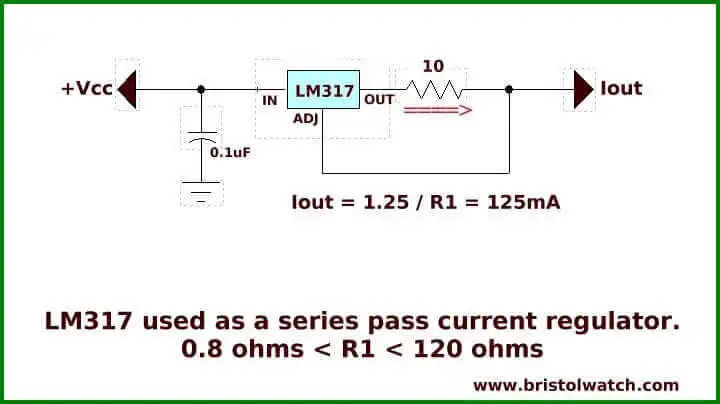
    drama to your measurement. The LM317 needs a heatsink,
    the resistor also needs a power rating and free air. I have
    one of these in the kitchen, running the LED lighting :-)
    (half an amp)

    https://www.bristolwatch.com/ccs/webp/lm317b.webp

    One cartridge fuse holder manufacturer, claims the contact
    resistance is 0.005 ohms. But there is no statement about
    repeat-ability and how many fuse insertions you can do,
    before that impressively low value degrades and the
    cartridge contact is ohmic. That's the surround-cap type,
    not the two-finger-contact type (snapin fuse).

    Since the fusing characteristic is temperature sensitive, if
    you had actually suffered an ohmic connection, the fuse would
    have blown, long ago. Fuses must be derated for higher temperature applications. Even whether ambient air can get at the thing and
    reduce the temperature, that could matter. I suspect this is
    one reason that Polyfuses aren't used in laptops (no air flow
    in the area the fuses are placed). Laptops use silicon fuses
    (an eight pin chip).

    Zero the meter and try another measurement. On a digital
    meter, subtract the test leads value from the measurement.
    As my poor result shows, the lead value is significant
    and unrealistic. The leads should NOT be five ohms.

    Paul

    --- SoupGate-Win32 v1.05
    * Origin: fsxNet Usenet Gateway (21:1/5)