Hello, anyone know anything about this, specifically other than changing passwords, how to protect yourself?
Apparently it's a "datastealer" thing (I've no idea) so are these
covered in the standard Winows Security scans?
What about Linux - does that need anti-virus scans and whatnot? (Hoping
The Natural Philosopher responds to that bit)
Hello, anyone know anything about this, specifically other than changing passwords, how to protect yourself?
Apparently it's a "datastealer" thing (I've no idea) so are these covered in the standard Winows Security scans?
What about Linux - does that need anti-virus scans and whatnot? (Hoping The Natural Philosopher responds to that bit)
Thanks all.
Hello, anyone know anything about this, specifically other than changing passwords, how to protect yourself?
Apparently it's a "datastealer" thing (I've no idea) so are these
covered in the standard Winows Security scans?
What about Linux - does that need anti-virus scans and whatnot? (Hoping
The Natural Philosopher responds to that bit)
Thanks all.
What about Linux - does that need anti-virus scans and whatnot? (Hoping The Natural Philosopher responds to that bit)
A Black Hat, sent him a fake email with what looked like a PDF attachment. You know, one of these tricks. The email, naturally, says "GoDaddy Domain Renewal".
bill.pdf.exe
On 19/06/2025 22:18, David Paste wrote:
Hello, anyone know anything about this, specifically other than changing
passwords, how to protect yourself?
Apparently it's a "datastealer" thing (I've no idea) so are these
covered in the standard Winows Security scans?
What about Linux - does that need anti-virus scans and whatnot? (Hoping
The Natural Philosopher responds to that bit)
Thanks all.
When I ran Windows (NT, XP, 7) I used antivirus programs. Never found anything.
I've been running Linux (Ubuntu for a couple of years, Mint for 8+). I don't use an antivirus program. This thread is three years old, but is worth a read:
<https://forums.linuxmint.com/viewtopic.php?t=368337>
On 20/06/2025 10:35, Paul wrote:
A Black Hat, sent him a fake email with what looked like a PDF
attachment.
You know, one of these tricks. The email, naturally, says "GoDaddy
Domain Renewal".
bill.pdf.exe
Which wouldn't run on linux...
and who is actually stupid enough to click on a .exe file?
On 20/06/2025 10:35, Paul wrote:
A Black Hat, sent him a fake email with what looked like a PDF
attachment. You know, one of these tricks. The email, naturally,
says "GoDaddy Domain Renewal".
bill.pdf.exe
Which wouldn't run on linux...
and who is actually stupid enough to click on a .exe file?
Hello, anyone know anything about this, specifically other than changing passwords, how to protect yourself?
Apparently it's a "datastealer" thing (I've no idea) so are these
covered in the standard Winows Security scans?
What about Linux - does that need anti-virus scans and whatnot? (Hoping
The Natural Philosopher responds to that bit)
On 20/06/2025 10:35, Paul wrote:
A Black Hat, sent him a fake email with what looked like a PDF
attachment.
You know, one of these tricks. The email, naturally, says "GoDaddy
Domain Renewal".
bill.pdf.exe
Which wouldn't run on linux...
and who is actually stupid enough to click on a .exe file?
On 20/06/2025 10:41, The Natural Philosopher wrote:M$soft 'our users are too stupid to understand shit, so lets make it
On 20/06/2025 10:35, Paul wrote:some e-mail programs hide the ".exe" .....
A Black Hat, sent him a fake email with what looked like a PDF
attachment.
You know, one of these tricks. The email, naturally, says "GoDaddy
Domain Renewal".
bill.pdf.exe
Which wouldn't run on linux...
and who is actually stupid enough to click on a .exe file?
Dave
On 19/06/2025 22:18, David Paste wrote:
Hello, anyone know anything about this, specifically other than
changing passwords, how to protect yourself?
You are better protected if you:
Use unique randomly generated passwords for every site / account / login etc.;
Never reuse credentials;
Enable 2FA where it is available;
Delete accounts on services where they are no longer needed;
Take great care to not get phished, and not allow session stealing[1]
malware onto your platforms and possibly also force segregation between malware vectors and computers that are logged into sensitive or
particularly valuable online resources[2].
[1] Normally when you login to a site, that site will jump through
whatever security process is required to confirm you have access, and
then set cookies in the web browser to cache the results of that authentication. That saves you having to re-authenticated with every
single click on the site - it "remembers" that you are authenticated. So session stealing malware will attempt to grab those cookies and
exfiltrate them. It allows an attacker to make it look like not only are
they you, but also that "you" have already passed authentication and are
logged in - on *their* computer.
[2] A risk is that in addition to being logged into the "valuable" web
site, the user will use the same computer for other work - say for
example handling email. That can be dangerous, since it is a vector for malware delivery (either directly, or by social engineering). So by
keeping those activities running in their own separate VMs (or on
separate physical machines) you can lower the risk.
Apparently it's a "datastealer" thing (I've no idea) so are these
covered in the standard Winows Security scans?
A data stealer can be the actual malware that lifts info from an
individual end user's computer, but could also be something that lifts
large bocks of data from databases or other online storage "bins" that
have been left unprotected. Sadly something that is all too common.
Someone develops a web site that depends on a back end database for
storing user data, login credentials etc, and hosts that on a cloud
platform like AWS. They *should* setup robust security to control who
has access to it, but frequently don't because they have implemented
their "security" in the web application, forgetting that bad actors
might choose to just ignore their web app, and try taking directly to
the database sever itself, or perhaps even the file system that hosts
its database file.
Needless to say a compromised database can yield millions or billions of login credentials (or at least partial ones) in one hit.
Stolen lists also get placed on popular hacker forums etc (known as "pastes"), and those will often get aggregated into other collections
and made available to those looking for some mischief.
What about Linux - does that need anti-virus scans and whatnot?
(Hoping The Natural Philosopher responds to that bit)
Many hacked web resources are running on linux platforms; so the
platform itself is not invulnerable to poor security practice.
On the desktop it is a less popular target, due to lack market share,
but there are sill risks.
(plus most Mac and Linix users are in denial!)
The biggest risk is that there will be a web site out there that you
signed up for, that has been hacked since. There will also be data aggregators that held information about you that have been hacked and
your personal data lifted. Alas there is nothing you can do directly to
stop that loss, all you can do it make what is lost less "re-useable".
It can be quite informative to slap an email address into:
https://haveibeenpwned.com/
and it will tell you which known data breaches include that address. You
can also check how often particular passwords turn up:
"Oh no — pwned!
This password has been seen 21,690,062 times before in data breaches! "
Can you guess the password I entered?
(and yes the site is legit, but don't take my word for it!)
Loads more info on breaches etc here:
https://haveibeenpwned.com/FAQs
On 20/06/2025 10:41, The Natural Philosopher wrote:
On 20/06/2025 10:35, Paul wrote:some e-mail programs hide the ".exe" .....
A Black Hat, sent him a fake email with what looked like a PDF
attachment.
You know, one of these tricks. The email, naturally, says "GoDaddy
Domain Renewal".
bill.pdf.exe
Which wouldn't run on linux...
and who is actually stupid enough to click on a .exe file?
On 20/06/2025 10:35, Paul wrote:
A Black Hat, sent him a fake email with what looked like a PDF attachment. >> You know, one of these tricks. The email, naturally, says "GoDaddy Domain Renewal".
bill.pdf.exe
Which wouldn't run on linux...
and who is actually stupid enough to click on a .exe file?
On 19/06/2025 22:18, David Paste wrote:
Hello, anyone know anything about this, specifically other than
changing passwords, how to protect yourself?
Apparently it's a "datastealer" thing (I've no idea) so are these
covered in the standard Winows Security scans?
What about Linux - does that need anti-virus scans and whatnot?
(Hoping The Natural Philosopher responds to that bit)
I would hope that people likely to be affected would be warned by the suppliers of the relevant software to change their passwords.
I don't suppose they will, though.
On 20/06/2025 10:35, Paul wrote:
A Black Hat, sent him a fake email with what looked like a PDF
attachment.
You know, one of these tricks. The email, naturally, says "GoDaddy
Domain Renewal".
bill.pdf.exe
Which wouldn't run on linux...
and who is actually stupid enough to click on a .exe file?
John Rumm wrote:
On 19/06/2025 22:18, David Paste wrote:
Hello, anyone know anything about this, specifically other than
changing passwords, how to protect yourself?
It can be quite informative to slap an email address into:I would love to check some of my passwords but don't have sufficient
https://haveibeenpwned.com/
and it will tell you which known data breaches include that address.
You can also check how often particular passwords turn up:
"Oh no — pwned!
This password has been seen 21,690,062 times before in data breaches! "
Can you guess the password I entered?
(and yes the site is legit, but don't take my word for it!)
Loads more info on breaches etc here:
https://haveibeenpwned.com/FAQs
trust that this wouldn't lead to a problem (despite what they say).
On Fri, 20 Jun 2025 15:45:18 +0100
Max Demian <[email protected]> wrote:
On 19/06/2025 22:18, David Paste wrote:
Hello, anyone know anything about this, specifically other than
changing passwords, how to protect yourself?
Apparently it's a "datastealer" thing (I've no idea) so are these
covered in the standard Winows Security scans?
What about Linux - does that need anti-virus scans and whatnot?
(Hoping The Natural Philosopher responds to that bit)
I would hope that people likely to be affected would be warned by the
suppliers of the relevant software to change their passwords.
I don't suppose they will, though.
I'd be interested to know which idiots still store their users'
credentials in plaintext form, or else what kind of hashing they use
which is of insufficient strength. Even with the computer power being assembled today for AI, cracking 16 billion decently strong hashes must
be an end-of-the-universe job, or at least it should be.
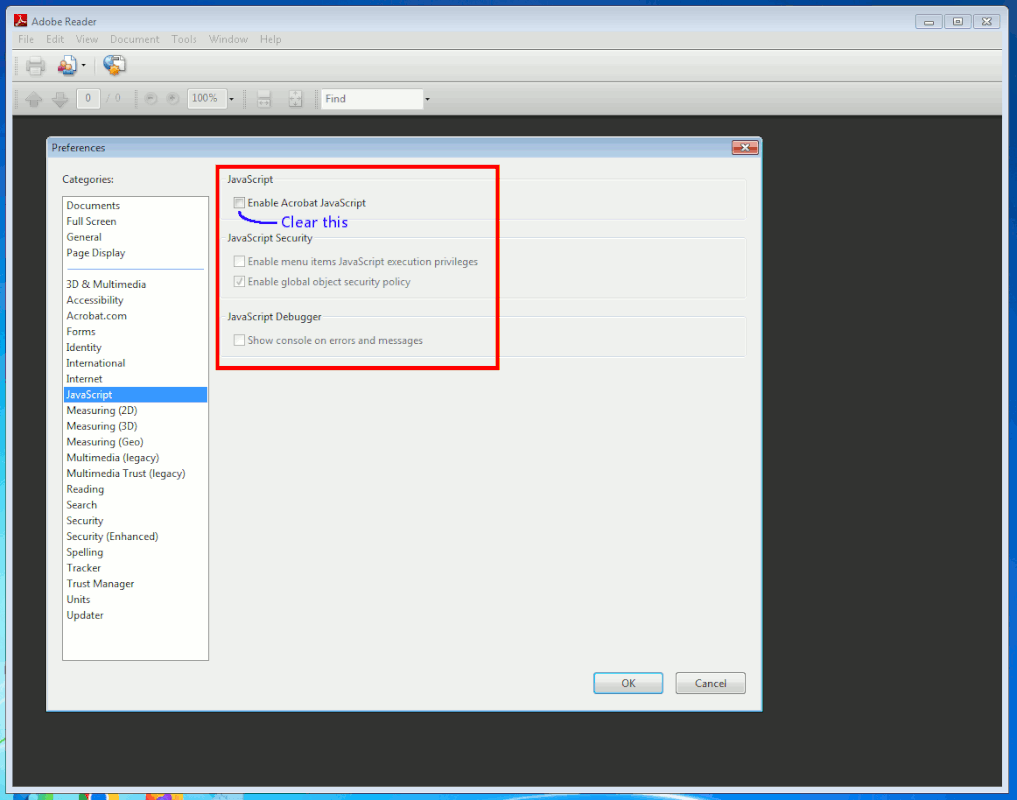
Computer users should know, that PDF has Javascript.
I'd be interested to know which idiots still store their users'Exactly.
credentials in plaintext form, or else what kind of hashing they use
which is of insufficient strength.
On 20/06/2025 10:41, The Natural Philosopher wrote:
On 20/06/2025 10:35, Paul wrote:
A Black Hat, sent him a fake email with what looked like a PDF
attachment.
You know, one of these tricks. The email, naturally, says "GoDaddy
Domain Renewal".
bill.pdf.exe
Which wouldn't run on linux...
and who is actually stupid enough to click on a .exe file?
All the people who run windows and hide the file extension :)
On 20/06/2025 10:35, Paul wrote:
A Black Hat, sent him a fake email with what looked like a PDF attachment. >> You know, one of these tricks. The email, naturally, says "GoDaddy Domain Renewal".
bill.pdf.exe
Which wouldn't run on linux...
and who is actually stupid enough to click on a .exe file?
On Fri, 20 Jun 2025 10:41:32 +0100, The Natural Philosopher <[email protected]d> wrote:
On 20/06/2025 10:35, Paul wrote:
A Black Hat, sent him a fake email with what looked like a PDF attachment. >>> You know, one of these tricks. The email, naturally, says "GoDaddy Domain Renewal".
bill.pdf.exe
Which wouldn't run on linux...
and who is actually stupid enough to click on a .exe file?
The innocents who trust the OS even though the extension is by default hidden. What OS would be stupid enough to do that?
On 20/06/2025 18:33, Paul wrote:
Computer users should know, that PDF has Javascript.
No. PDF does not have javascript
On Sat, 6/21/2025 8:01 AM, The Natural Philosopher wrote:
On 20/06/2025 18:33, Paul wrote:
Computer users should know, that PDF has Javascript.
No. PDF does not have javascript
On 20/06/2025 10:41, The Natural Philosopher wrote:
On 20/06/2025 10:35, Paul wrote:
A Black Hat, sent him a fake email with what looked like a PDF attachment. >>> You know, one of these tricks. The email, naturally, says "GoDaddy Domain Renewal".
bill.pdf.exe
Which wouldn't run on linux...
and who is actually stupid enough to click on a .exe file?
All the people who run windows and hide the file extension :)
M$soft 'our users are too stupid to understand shit, so lets make it
easier to hack them'
On 20/06/2025 20:06, Joe wrote:
I'd be interested to know which idiots still store their users'Exactly.
credentials in plaintext form, or else what kind of hashing they use
which is of insufficient strength.
Programmers today are ArtStudents™. Not software engineers. They are
lazy sloppy, vain and driven by management who wants the job done at
minimal cost.
On Fri, 6/20/2025 5:41 AM, The Natural Philosopher wrote:
On 20/06/2025 10:35, Paul wrote:
A Black Hat, sent him a fake email with what looked like a PDF attachment. >> You know, one of these tricks. The email, naturally, says "GoDaddy Domain Renewal".
bill.pdf.exe
Which wouldn't run on linux...
and who is actually stupid enough to click on a .exe file?
The Windows OS default setting, is to hide extensions
bill # These files have different icons, but bill.pdf is not shown
bill # Whereas this one could be a white rectangle of an icon and is bill.exe
On 21/06/2025 13:03, The Natural Philosopher wrote:
On 20/06/2025 20:06, Joe wrote:
I'd be interested to know which idiots still store their users'Exactly.
credentials in plaintext form, or else what kind of hashing they use
which is of insufficient strength.
Programmers today are ArtStudents™. Not software engineers. They are
lazy sloppy, vain and driven by management who wants the job done at
minimal cost.
My feeling is that so much software is now bloatware - lets add 100
unrelated functions to something that was simple and worked and then
wonder why there are so many bugs and vulnerabilities.
On 21/06/2025 13:24, AnthonyL wrote:
On Fri, 20 Jun 2025 10:41:32 +0100, The Natural Philosopher
<[email protected]d> wrote:
On 20/06/2025 10:35, Paul wrote:
A Black Hat, sent him a fake email with what looked like a PDF
attachment.
You know, one of these tricks. The email, naturally, says "GoDaddy
Domain Renewal".
bill.pdf.exe
Which wouldn't run on linux...
and who is actually stupid enough to click on a .exe file?
The innocents who trust the OS even though the extension is by default
hidden. What OS would be stupid enough to do that?
Users do anything these days.
$ curl http://www.somewebsite.com | bash
On 21/06/2025 13:01, The Natural Philosopher wrote:
On 20/06/2025 18:33, Paul wrote:
Computer users should know, that PDF has Javascript.
No. PDF does not have javascript
That comes as a bit of a shock - does that mean that the invoice
pro-forma PDFs that I created that use embedded javascript to do all the sums, were just a figment of my imagination?
On 21/06/2025 20:17, John Rumm wrote:
On 21/06/2025 13:01, The Natural Philosopher wrote:
On 20/06/2025 18:33, Paul wrote:
Computer users should know, that PDF has Javascript.
No. PDF does not have javascript
That comes as a bit of a shock - does that mean that the invoice pro-
forma PDFs that I created that use embedded javascript to do all the
sums, were just a figment of my imagination?
You can get PDF viewers that do not support or run Javascript in PDF
files.
I gave up on Adobe PDF Reader years ago due to its massive,
bloated footprint and never ending security issues. Worse was any Adobe update was enormous and took forever to run. On top of all of that it
would run JS in a PDF making it a real security issue.
I've been using evince on Linux and Windows as my primary PDF viewer for
most of the last 10 years. Works the same on Windows and Linux and is
immune to most of the Adobe poison and crap. There are some files that
don't render for which I use Sumatra PDF.
Ditch Adobe and breathe freely.
On 20/06/2025 18:33, Paul wrote:
Computer users should know, that PDF has Javascript.
No. PDF does not have javascript
On 21/06/2025 20:17, John Rumm wrote:No. It means that they were not standard PDFs,
On 21/06/2025 13:01, The Natural Philosopher wrote:
On 20/06/2025 18:33, Paul wrote:
Computer users should know, that PDF has Javascript.
No. PDF does not have javascript
That comes as a bit of a shock - does that mean that the invoice
pro-forma PDFs that I created that use embedded javascript to do all
the sums, were just a figment of my imagination?
You can get PDF viewers that do not support or run Javascript in PDF
files. I gave up on Adobe PDF Reader years ago due to its massive,
bloated footprint and never ending security issues. Worse was any Adobe update was enormous and took forever to run. On top of all of that it
would run JS in a PDF making it a real security issue.
I've been using evince on Linux and Windows as my primary PDF viewer for
most of the last 10 years. Works the same on Windows and Linux and is
immune to most of the Adobe poison and crap. There are some files that
don't render for which I use Sumatra PDF.
Ditch Adobe and breathe freely.
On 21/06/2025 20:49, mm0fmf wrote:
On 21/06/2025 20:17, John Rumm wrote:No. It means that they were not standard PDFs,
On 21/06/2025 13:01, The Natural Philosopher wrote:
On 20/06/2025 18:33, Paul wrote:
Computer users should know, that PDF has Javascript.
No. PDF does not have javascript
That comes as a bit of a shock - does that mean that the invoice pro-
forma PDFs that I created that use embedded javascript to do all the
sums, were just a figment of my imagination?
Exactly
You can get PDF viewers that do not support or run Javascript in PDF
files. I gave up on Adobe PDF Reader years ago due to its massive,
bloated footprint and never ending security issues. Worse was any
Adobe update was enormous and took forever to run. On top of all of
that it would run JS in a PDF making it a real security issue.
I've been using evince on Linux and Windows as my primary PDF viewerAmen
for most of the last 10 years. Works the same on Windows and Linux and
is immune to most of the Adobe poison and crap. There are some files
that don't render for which I use Sumatra PDF.
Ditch Adobe and breathe freely.
On 21/06/2025 20:17, John Rumm wrote:On top of all of that it would run JS in a PDF making it a real security issue.
On 21/06/2025 13:01, The Natural Philosopher wrote:
On 20/06/2025 18:33, Paul wrote:
Computer users should know, that PDF has Javascript.
No. PDF does not have javascript
That comes as a bit of a shock - does that mean that the invoice pro-forma PDFs that I created that use embedded javascript to do all the sums, were just a figment of my imagination?
You can get PDF viewers that do not support or run Javascript in PDF files. I gave up on Adobe PDF Reader years ago due to its massive, bloated footprint and never ending security issues. Worse was any Adobe update was enormous and took forever to run.
I've been using evince on Linux and Windows as my primary PDF viewer for most of the last 10 years. Works the same on Windows and Linux and is immune to most of the Adobe poison and crap. There are some files that don't render for which I use SumatraPDF.
Ditch Adobe and breathe freely.
Paul <[email protected]d> wrote:
On Fri, 6/20/2025 5:41 AM, The Natural Philosopher wrote:
On 20/06/2025 10:35, Paul wrote:
A Black Hat, sent him a fake email with what looked like a PDF attachment. >>>> You know, one of these tricks. The email, naturally, says "GoDaddy Domain Renewal".
bill.pdf.exe
Which wouldn't run on linux...
and who is actually stupid enough to click on a .exe file?
The Windows OS default setting, is to hide extensions
bill # These files have different icons, but bill.pdf is not shown
bill # Whereas this one could be a white rectangle of an icon and is bill.exe
There's nothing to stop bill.exe containing its icon that happens to be identical to the Windows PDF file icon...
They seem to understand their customers pretty well. That's why 2/3rdsSure companies sell lots of phones, but people working in offices tend
of computers (as opposed to 'phones) run their stuff.
<https://en.wikipedia.org/wiki/Usage_share_of_operating_systems>
On 21/06/2025 20:49, mm0fmf wrote:
On 21/06/2025 20:17, John Rumm wrote:No. It means that they were not standard PDFs,
On 21/06/2025 13:01, The Natural Philosopher wrote:
On 20/06/2025 18:33, Paul wrote:
Computer users should know, that PDF has Javascript.
No. PDF does not have javascript
That comes as a bit of a shock - does that mean that the invoice pro-
forma PDFs that I created that use embedded javascript to do all the
sums, were just a figment of my imagination?
Check whether ISO 32000-2 agrees with you on that. They call itJohn Rumm wrote:No. It means that they were not standard PDFs
does that mean that the invoice pro-
forma PDFs that I created that use embedded javascript to do all the
sums, were just a figment of my imagination?
On 20/06/2025 18:33, Paul wrote:
Computer users should know, that PDF has Javascript.
No. PDF does not have javascript
The Natural Philosopher wrote:
On 20/06/2025 18:33, Paul wrote:
Computer users should know, that PDF has Javascript.
No. PDF does not have javascript
Unfortunately it does ...
On 22/06/2025 16:55, Andy Burns wrote:
The Natural Philosopher wrote:Its a proprietary Adobe extension.
On 20/06/2025 18:33, Paul wrote:
Computer users should know, that PDF has Javascript.
No. PDF does not have javascript
Unfortunately it does ...
I dont think any linux readers support it.
Maybe in browser rendering does.
On 20/06/2025 09:54, The Natural Philosopher wrote:
On 20/06/2025 03:05, Paul wrote:
What about Linux - does that need anti-virus scans and whatnot?
(Hoping The Natural Philosopher responds to that bit)
Obviously its technically possible to design a virus for linux, but
each distro is different enough to make it hard, and there are not
that many Linux desktops out there to make it that worth while.
I've never used a virus scanner on any linux and as far as I know not
caught any malware.
As far as passwords go I have a two tier approach. Passwords that it
would be inconvenient to have hacked but not in any way disastrous are
stored in browser.
Very sensitive passwords (to do with money) are kept *only* in my
master password application, that requires a password to decrypt it.
Thanks. Is a master password application safer than not having one and writing the p/w down on a piece of paper? I know that someone can break
in and steal that paper, but it is unlikely, whereas a M.P.A. could
still technically be cracked, yes? Or is it that a case of extraordinary diminishing returns and not worthwhile for a skint pleb? (I'm assuming
that)
I exported my password store from google...
On 22/06/2025 16:55, Andy Burns wrote:
The Natural Philosopher wrote:Its a proprietary Adobe extension.
On 20/06/2025 18:33, Paul wrote:
Computer users should know, that PDF has Javascript.
No. PDF does not have javascript
Unfortunately it does ...
I dont think any linux readers support it.
Maybe in browser rendering does.
On Sun, 6/22/2025 2:28 PM, The Natural Philosopher wrote:
On 22/06/2025 16:55, Andy Burns wrote:
The Natural Philosopher wrote:Its a proprietary Adobe extension.
On 20/06/2025 18:33, Paul wrote:
Computer users should know, that PDF has Javascript.
No. PDF does not have javascript
Unfortunately it does ...
I dont think any linux readers support it.
Maybe in browser rendering does.
https://stackoverflow.com/questions/31930224/fillable-pdf-forms-in-libreoffice
"Well, the problem is is that I'm on linux
and no pdf editor does the calculations added with acrobat :(
"
https://support.mozilla.org/en-US/questions/1333222
about:config
pdfjs.enableScripting BOOLEAN True
A little of this, a little of that.
Paul
| Sysop: | Keyop |
|---|---|
| Location: | Huddersfield, West Yorkshire, UK |
| Users: | 741 |
| Nodes: | 16 (2 / 14) |
| Uptime: | 102:17:00 |
| Calls: | 12,460 |
| Calls today: | 2 |
| Files: | 15,197 |
| Messages: | 6,538,017 |