• Re: [OT] Analog amplifier to EEE PC 901

    From Paul@21:1/5 to pinnerite on Fri May 9 14:59:59 2025
    XPost: alt.os.linux.mint

    On Fri, 5/9/2025 1:47 PM, pinnerite wrote:
    I am currently restoring a 50 year old Technics Hi-Fi system.

    I am just waiting for three drive belts from Spain for the cassette
    recorder module.

    I would like to digitise some of my old recordings. The room housing
    the Hi-Fi system has no connection to the LAN. This means sending the
    analog audio by Wi-Fi over to my work machine.

    I would like to make use of my old EEE PC 901 netbook as the Wi-Fi
    trasmitter provided that I could pump the audio into that.

    The the output from the amplifier is either from dual RCA sockets or a
    1/4" headphone socket.

    The input to the netbook can only be to one of three USB sockets or a
    3.5mm mic socket.

    Is it feasible?


    You should tune up the Technics, with a brand new tape.
    You don't want to ruin an archive tape, if the capstan isn't
    working properly.

    My recorder started eating cassette tapes, and you don't want
    to discover a transport problem, using a tape with valuable content.

    When using Audacity on the EEE 901, you can create a swept frequency
    of constant amplitude, from 20Hz to 20KHz. When you play this back
    later from the Technics, record it in Audacity and compare the
    amplitude of what is played back. This will determine whether there is systematic error (equalization not right) or a dirty head.

    the EEE 901 microphone input, should be able to work with
    a 70mV signal (some modern microphone) but it won't be good
    enough for a 2mV signal directly from a photo cartridge for example.
    The Technics will be line level (1 volt). Check your VU meter
    in Audacity, to see if the signal is too much. Once the
    controls are set, you can do your calibration run for
    determining relative flatness of response. Being a cassette, I would
    expect some rolloff over 10KHz.

    You don't have to use the EEE 901 over Wifi. It would be a
    pain in the ass, running from one room to the other and
    checking on stuff. Instead, plug a 32GB SD card into the SD
    card slot, and dump the Audacity clip to the SD. Now, you
    can stay in the room with the Technics, run the EEE 901
    from battery (no hum loop) and record to SD.

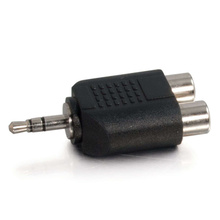
    You'll need a dual RCA/Cinch Left and Right female to 3.5mm male adapter.

    https://resources.legrand.us/220th_sm_kIWva7AqJM81.jpg?1625706457

    ( https://www.cablestogo.com/adapters-docks-and-hubs/audio-video/audio-adapters-and-accessories/3-5mm-stereo-male-to-dual-rca-female-audio-adapter-taa-compliant/p/cg-40645 )

    That can be plugged into the microphone hole on the EEE 901.

    You can also *test* the EEE 901 is working properly, by running
    a 3.5mm male to male cable, from your fancy desktop line-out to the
    EEE 901 microphone in. And verify that Audacity on the EEE 901
    is seeing analog signal presented by the desktop. You know how
    often these projects are let down, by the computer end not
    functioning correctly.

    The EEE 901 can probably manage 48KHz digitization. I would
    not expect 96KHz or 192KHz. The low pass filter on PC audio
    is not correct for the 192KHz choice anyway. I've verified
    this by connecting two 192KHz machines together and being
    disappointed with the response on the recorder side. The 96KHz
    choice would likely work OK... if the EEE 901 had it. But I would
    expect 48KHz or 44.1KHz are the only options, and the 48KHz might
    cause the fewest issues.

    I would *carefully* wind the archive tape forward and back.
    The Winding option does not engage the capstan. And this is
    just to ensure the tape is not stuck to itself. Stay in the
    room, keep a finger on the Stop button while you do this.
    Slow down when you get to the end. The leader-detection
    might not be working properly. You are looking for evidence
    the tape is "fit" for an actual EEE 901 run. My ruined tapes
    say "Hi".

    Good luck,

    Paul

    --- SoupGate-Win32 v1.05
    * Origin: fsxNet Usenet Gateway (21:1/5)
  • From Joe@21:1/5 to Paul on Fri May 9 21:45:50 2025
    XPost: alt.os.linux.mint

    On Fri, 9 May 2025 14:59:59 -0400
    Paul <[email protected]d> wrote:

    On Fri, 5/9/2025 1:47 PM, pinnerite wrote:
    I am currently restoring a 50 year old Technics Hi-Fi system.

    I am just waiting for three drive belts from Spain for the cassette recorder module.

    I would like to digitise some of my old recordings. The room housing
    the Hi-Fi system has no connection to the LAN. This means sending
    the analog audio by Wi-Fi over to my work machine.

    I would like to make use of my old EEE PC 901 netbook as the Wi-Fi trasmitter provided that I could pump the audio into that.

    The the output from the amplifier is either from dual RCA sockets
    or a 1/4" headphone socket.

    The input to the netbook can only be to one of three USB sockets or
    a 3.5mm mic socket.

    Is it feasible?


    <lots o good stuff snipped>


    You'll need a dual RCA/Cinch Left and Right female to 3.5mm male
    adapter.

    https://resources.legrand.us/220th_sm_kIWva7AqJM81.jpg?1625706457

    ( https://www.cablestogo.com/adapters-docks-and-hubs/audio-video/audio-adapters-and-accessories/3-5mm-stereo-male-to-dual-rca-female-audio-adapter-taa-compliant/p/cg-40645
    )

    That can be plugged into the microphone hole on the EEE 901.


    From personal experience of entirely amateur dabbling, I've never found
    either a desktop or laptop to have A/D converters with a decent signal
    to noise ratio. It's all that digital stuff whizzing around in the box.

    I've found even a no-name Chinese USB sound dongle costing a pound or
    two to have better dynamic range, as after all, the built-in sound
    stuff is expecting to deal with very cheap microphones in a domestic environment, which is hardly going to need much in the way of S/N ratio.

    I certainly can't recommend anything, but I'd expect a named USB audio
    adaptor to do a much better job than the laptop, something like
    a low-end device from Creative Labs. Better advice would be available
    from professionals, or at least serious amateurs, in sound recording.
    There must be that kind of advice sloshing about the Net.

    --
    Joe
    --
    Joe

    --- SoupGate-Win32 v1.05
    * Origin: fsxNet Usenet Gateway (21:1/5)
  • From Paul@21:1/5 to Joe on Fri May 9 17:20:43 2025
    XPost: alt.os.linux.mint

    On Fri, 5/9/2025 4:45 PM, Joe wrote:
    On Fri, 9 May 2025 14:59:59 -0400
    Paul <[email protected]d> wrote:

    On Fri, 5/9/2025 1:47 PM, pinnerite wrote:
    I am currently restoring a 50 year old Technics Hi-Fi system.

    I am just waiting for three drive belts from Spain for the cassette
    recorder module.

    I would like to digitise some of my old recordings. The room housing
    the Hi-Fi system has no connection to the LAN. This means sending
    the analog audio by Wi-Fi over to my work machine.

    I would like to make use of my old EEE PC 901 netbook as the Wi-Fi
    trasmitter provided that I could pump the audio into that.

    The the output from the amplifier is either from dual RCA sockets
    or a 1/4" headphone socket.

    The input to the netbook can only be to one of three USB sockets or
    a 3.5mm mic socket.

    Is it feasible?


    <lots o good stuff snipped>


    You'll need a dual RCA/Cinch Left and Right female to 3.5mm male
    adapter.

    https://resources.legrand.us/220th_sm_kIWva7AqJM81.jpg?1625706457

    (
    https://www.cablestogo.com/adapters-docks-and-hubs/audio-video/audio-adapters-and-accessories/3-5mm-stereo-male-to-dual-rca-female-audio-adapter-taa-compliant/p/cg-40645
    )

    That can be plugged into the microphone hole on the EEE 901.


    From personal experience of entirely amateur dabbling, I've never found either a desktop or laptop to have A/D converters with a decent signal
    to noise ratio. It's all that digital stuff whizzing around in the box.

    I've found even a no-name Chinese USB sound dongle costing a pound or
    two to have better dynamic range, as after all, the built-in sound
    stuff is expecting to deal with very cheap microphones in a domestic environment, which is hardly going to need much in the way of S/N ratio.

    I certainly can't recommend anything, but I'd expect a named USB audio adaptor to do a much better job than the laptop, something like
    a low-end device from Creative Labs. Better advice would be available
    from professionals, or at least serious amateurs, in sound recording.
    There must be that kind of advice sloshing about the Net.


    The EEE 901 can float on its battery, and record a tape.
    That should break the hum loop.

    The problem with running a USB to audio, isn't the conversion
    as such, it's the hard ground at the remote end, versus the
    hard ground on the Technics. If the laptop was in the other room,
    then it could power the USB extended cable run and the USB to Audio
    on the end. The recording end would then float. Using your desktop
    and an extension USB cable, would be a hard ground. Using a hum-breaker-box, cuts off everything above 10KHz or so (function of transformer quality).

    You could attach the USB to audio adapter to the EEE 901 and
    record in the same room, to the SD card slot.

    Many possibilities. Just keep in mind where the ground is, or isn't :-)

    I expect the audio quality of an old tape, to be pretty bad. The
    noise floor on my worst audio device here, would be nothing
    compared to what is going to come off the tape. But, we'll see
    what Alan discovers after the thorough Technics cleaning (head
    cleaner tape or whatever he has used in the past for maintenance).

    I would think a quick test with the EEE 901 directly, would
    determine whether this project is worth doing or not. I gave
    up on an old collection of tape, as it looks like all of them
    will "wrap around the capstan" before I finish.

    The condition of the tape, and what to do with/to the tape, is
    going to be more of an issue, than bits of the rest of it.
    You have time to adjust the recording end, if the source
    quality is present. Just plugging headphones into the
    Technics would tell you whether the tape is a write-off.

    Paul

    --- SoupGate-Win32 v1.05
    * Origin: fsxNet Usenet Gateway (21:1/5)
  • From Paul@21:1/5 to pinnerite on Fri May 9 22:15:14 2025
    XPost: alt.os.linux.mint

    On Fri, 5/9/2025 5:34 PM, pinnerite wrote:
    On Fri, 9 May 2025 21:45:50 +0100
    Joe <[email protected]> wrote:

    On Fri, 9 May 2025 14:59:59 -0400
    Paul <[email protected]d> wrote:

    On Fri, 5/9/2025 1:47 PM, pinnerite wrote:
    I am currently restoring a 50 year old Technics Hi-Fi system.

    I am just waiting for three drive belts from Spain for the cassette
    recorder module.

    I would like to digitise some of my old recordings. The room housing
    the Hi-Fi system has no connection to the LAN. This means sending
    the analog audio by Wi-Fi over to my work machine.

    I would like to make use of my old EEE PC 901 netbook as the Wi-Fi
    trasmitter provided that I could pump the audio into that.

    The the output from the amplifier is either from dual RCA sockets
    or a 1/4" headphone socket.

    The input to the netbook can only be to one of three USB sockets or
    a 3.5mm mic socket.

    Is it feasible?


    <lots o good stuff snipped>


    You'll need a dual RCA/Cinch Left and Right female to 3.5mm male
    adapter.

    https://resources.legrand.us/220th_sm_kIWva7AqJM81.jpg?1625706457

    (
    https://www.cablestogo.com/adapters-docks-and-hubs/audio-video/audio-adapters-and-accessories/3-5mm-stereo-male-to-dual-rca-female-audio-adapter-taa-compliant/p/cg-40645
    )

    That can be plugged into the microphone hole on the EEE 901.


    Sadly the mic socket on the 901 is mono!


    But you have a USB port for a USB Audio Adapter.

    Sound Blaster Play 3

    https://www.scan.co.uk/products/creative-sound-blaster-play!-3-usb-usb-a-dac-amp-and-external-sound-card-24-bit-96khz-sbx-pro-studio

    Still needs a dual RCA/Cinch to 3.5mm male adapter. The male adapter
    goes into the Sound Blaster microphone jack.

    Paul

    --- SoupGate-Win32 v1.05
    * Origin: fsxNet Usenet Gateway (21:1/5)
  • From Edmund@21:1/5 to pinnerite on Sat May 10 12:38:30 2025
    XPost: alt.os.linux.mint

    On 5/9/25 19:47, pinnerite wrote:
    I am currently restoring a 50 year old Technics Hi-Fi system.

    I am just waiting for three drive belts from Spain for the cassette
    recorder module.

    I would like to digitise some of my old recordings. The room housing
    the Hi-Fi system has no connection to the LAN. This means sending the
    analog audio by Wi-Fi over to my work machine.

    I would like to make use of my old EEE PC 901 netbook as the Wi-Fi
    trasmitter provided that I could pump the audio into that.

    The the output from the amplifier is either from dual RCA sockets or a
    1/4" headphone socket.

    The input to the netbook can only be to one of three USB sockets or a
    3.5mm mic socket.

    Is it feasible?


    You have a very complicated/weird way/idea or way of expressing yourself.
    If you want to digitise some recording, all you have to do is digitise
    it. What do you mean by "sending analoge by wifi???"
    Does your cassette deck have a WiFI on board? I doubt it.
    If your - EEE PC 901 netbook - what ever that is, only has MONO mic
    plug, you won't get stereo duh.... BTW MIC is no Line in.
    So get another computer/ laptop with line in and you are good.
    Of course a USB acd can be used but these are NOT better then the
    usually build in DAC ACD's. IMH.


    --
    -------------

    Godspeed for Assange
    Amnesty for Snowden
    Rehabilitation for heroes

    Edmund

    --- SoupGate-Win32 v1.05
    * Origin: fsxNet Usenet Gateway (21:1/5)
  • From The Natural Philosopher@21:1/5 to Edmund on Sat May 10 11:58:56 2025
    XPost: alt.os.linux.mint

    On 10/05/2025 11:38, Edmund wrote:
    On 5/9/25 19:47, pinnerite wrote:
    I am currently restoring a 50 year old Technics Hi-Fi system.

    I am just waiting for three drive belts from Spain for the cassette
    recorder module.

    I would like to digitise some of my old recordings. The room housing
    the Hi-Fi system has no connection to the LAN. This means sending the
    analog audio by Wi-Fi over to my work machine.

    I would like to make use of my old EEE PC 901 netbook as the Wi-Fi
    trasmitter provided that I could pump the audio into that.

    The the output from the amplifier is either from dual RCA sockets or a
    1/4" headphone socket.

    The input to the netbook can only be to one of three USB sockets or a
    3.5mm mic socket.

    Is it feasible?


    You have a very complicated/weird way/idea or way of expressing yourself.
    If you want to digitise some recording, all you have to do is digitise
    it. What do you mean by "sending analoge by wifi???"
    Does your cassette deck have a WiFI on board? I doubt it.
    If your - EEE PC 901 netbook - what ever that is, only has MONO mic
    plug, you won't get stereo duh.... BTW MIC is no Line in.
    So get another computer/ laptop with line in and you are good.
    Of course a USB acd can be used but these are NOT better then the
    usually build in DAC ACD's. IMH.

    both will be better than a cassette tape...


    --
    There is something fascinating about science. One gets such wholesale
    returns of conjecture out of such a trifling investment of fact.

    Mark Twain

    --- SoupGate-Win32 v1.05
    * Origin: fsxNet Usenet Gateway (21:1/5)
  • From The Nomad@21:1/5 to pinnerite on Sat May 10 16:06:12 2025
    XPost: alt.os.linux.mint

    On Sat, 10 May 2025 17:01:34 +0100, pinnerite <[email protected]> wrote:

    On Fri, 9 May 2025 22:15:14 -0400 Paul <[email protected]d> wrote:

    On Fri, 5/9/2025 5:34 PM, pinnerite wrote:
    On Fri, 9 May 2025 21:45:50 +0100 Joe <[email protected]> wrote:

    On Fri, 9 May 2025 14:59:59 -0400 Paul <[email protected]d>
    wrote:

    On Fri, 5/9/2025 1:47 PM, pinnerite wrote:
    I am currently restoring a 50 year old Technics Hi-Fi system.

    I am just waiting for three drive belts from Spain for the
    cassette recorder module.

    I would like to digitise some of my old recordings. The room
    housing the Hi-Fi system has no connection to the LAN. This means
    sending the analog audio by Wi-Fi over to my work machine.

    I would like to make use of my old EEE PC 901 netbook as the Wi-Fi
    trasmitter provided that I could pump the audio into that.

    The the output from the amplifier is either from dual RCA sockets
    or a 1/4" headphone socket.

    The input to the netbook can only be to one of three USB sockets
    or a 3.5mm mic socket.

    Is it feasible?


    <lots o good stuff snipped>


    You'll need a dual RCA/Cinch Left and Right female to 3.5mm male
    adapter.

    https://resources.legrand.us/220th_sm_kIWva7AqJM81.jpg?1625706457

    (
    https://www.cablestogo.com/adapters-docks-and-hubs/audio-video/ audio-adapters-and-accessories/3-5mm-stereo-male-to-dual-rca-female-audio- adapter-taa-compliant/p/cg-40645
    )

    That can be plugged into the microphone hole on the EEE 901.


    Sadly the mic socket on the 901 is mono!


    But you have a USB port for a USB Audio Adapter.

    Sound Blaster Play 3

    https://www.scan.co.uk/products/creative-sound-blaster-play!-3-usb- usb-a-dac-amp-and-external-sound-card-24-bit-96khz-sbx-pro-studio

    Still needs a dual RCA/Cinch to 3.5mm male adapter. The male adapter
    goes into the Sound Blaster microphone jack.

    Paul


    It needs a Mac or Windows for its software. :(

    No!

    *nix will be fine

    Avpx


    --
    "Pets are always a great help in times of stress. And in times of
    starvation too, o'course."
    (Small Gods)
    Sat 11575 Sep 17:05:01 BST 1993
    17:05:01 up 3 days, 5:38, 1 user, load average: 2.23, 1.56, 1.11

    --- SoupGate-Win32 v1.05
    * Origin: fsxNet Usenet Gateway (21:1/5)
  • From Monsieur@21:1/5 to pinnerite on Sat May 10 18:18:10 2025
    XPost: alt.os.linux.mint

    pinnerite wrote:


    Why is it so hard to grasp. The recordings are on compact cassettes.
    The cassette player although 50 years old has had very little use,
    having been in storage for most of its life.

    The 901 was one of the earliest netbooks (Aus).
    As I own both I am hoping to be able to transfer the analog recording
    over wifi to my fairly powerful work machine. That's it. No need to be offended.


    Here's how I do it. I bought a cheap portable cassette player from
    Amazon (or even Aliexpress, it doesn't matter, they're all from the same manufacturer anyway, they just put different brand names on them).

    https://www.amazon.co.uk/DIGITNOW-Portable-Cassette-Converter-Capture-BR602/dp/B01IAEIC20

    I plug it in a usb-port, press record in Audacity and then press play on
    the cassette player. Done.

    Note: I always fast forward and rewind the tape before recording.

    --- SoupGate-Win32 v1.05
    * Origin: fsxNet Usenet Gateway (21:1/5)
  • From Paul@21:1/5 to pinnerite on Sat May 10 13:20:21 2025
    XPost: alt.os.linux.mint

    On Sat, 5/10/2025 12:01 PM, pinnerite wrote:
    On Fri, 9 May 2025 22:15:14 -0400
    Paul <[email protected]d> wrote:

    On Fri, 5/9/2025 5:34 PM, pinnerite wrote:
    On Fri, 9 May 2025 21:45:50 +0100
    Joe <[email protected]> wrote:

    On Fri, 9 May 2025 14:59:59 -0400
    Paul <[email protected]d> wrote:

    On Fri, 5/9/2025 1:47 PM, pinnerite wrote:
    I am currently restoring a 50 year old Technics Hi-Fi system.

    I am just waiting for three drive belts from Spain for the cassette >>>>>> recorder module.

    I would like to digitise some of my old recordings. The room housing >>>>>> the Hi-Fi system has no connection to the LAN. This means sending
    the analog audio by Wi-Fi over to my work machine.

    I would like to make use of my old EEE PC 901 netbook as the Wi-Fi >>>>>> trasmitter provided that I could pump the audio into that.

    The the output from the amplifier is either from dual RCA sockets
    or a 1/4" headphone socket.

    The input to the netbook can only be to one of three USB sockets or >>>>>> a 3.5mm mic socket.

    Is it feasible?


    <lots o good stuff snipped>


    You'll need a dual RCA/Cinch Left and Right female to 3.5mm male
    adapter.

    https://resources.legrand.us/220th_sm_kIWva7AqJM81.jpg?1625706457

    (
    https://www.cablestogo.com/adapters-docks-and-hubs/audio-video/audio-adapters-and-accessories/3-5mm-stereo-male-to-dual-rca-female-audio-adapter-taa-compliant/p/cg-40645
    )

    That can be plugged into the microphone hole on the EEE 901.


    Sadly the mic socket on the 901 is mono!


    But you have a USB port for a USB Audio Adapter.

    Sound Blaster Play 3

    https://www.scan.co.uk/products/creative-sound-blaster-play!-3-usb-usb-a-dac-amp-and-external-sound-card-24-bit-96khz-sbx-pro-studio

    Still needs a dual RCA/Cinch to 3.5mm male adapter. The male adapter
    goes into the Sound Blaster microphone jack.

    Paul


    It needs a Mac or Windows for its software. :(


    So far, I cannot locate any first hand proof it works.
    But there's an awful lot of "detected' in the list,
    so the driver showed up at some point.

    https://linux-hardware.org/index.php?id=usb:041e-324d

    The reason I didn't select Play 4, is there appeared to be
    a little too much automation involved. The Play 3 is a bit
    simpler and more likely to work as a basic DAC/ADC for
    stereo.

    We are working at a distinct disadvantage now with search
    engines. I'm pretty sure the information I need is out there,
    the trick is getting the search engines to work.

    Paul

    --- SoupGate-Win32 v1.05
    * Origin: fsxNet Usenet Gateway (21:1/5)
  • From Paul@21:1/5 to pinnerite on Sat May 10 21:50:06 2025
    XPost: alt.os.linux.mint

    On Sat, 5/10/2025 4:52 PM, pinnerite wrote:
    On Sat, 10 May 2025 18:18:10 +0200
    Monsieur <[email protected]d> wrote:

    pinnerite wrote:


    Why is it so hard to grasp. The recordings are on compact cassettes.
    The cassette player although 50 years old has had very little use,
    having been in storage for most of its life.

    The 901 was one of the earliest netbooks (Aus).
    As I own both I am hoping to be able to transfer the analog recording
    over wifi to my fairly powerful work machine. That's it. No need to be
    offended.


    Here's how I do it. I bought a cheap portable cassette player from
    Amazon (or even Aliexpress, it doesn't matter, they're all from the same
    manufacturer anyway, they just put different brand names on them).

    https://www.amazon.co.uk/DIGITNOW-Portable-Cassette-Converter-Capture-BR602/dp/B01IAEIC20

    I plug it in a usb-port, press record in Audacity and then press play on
    the cassette player. Done.

    Note: I always fast forward and rewind the tape before recording.


    I tried thata few years ago but the result was awful.
    That is why I am restoring a high end cassette record/player.
    (The replacedment drive belts and capstan arrived from Spain today).

    As forwarding and rewinding to ensure even tension, I always did so too.
    I intend to use Audacity too, once I get the raw output from the
    cassette player to my work machine.

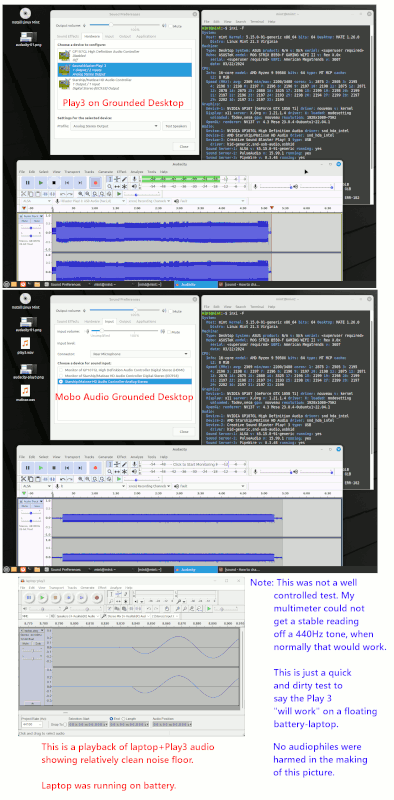
    Here are some test results. Using the laptop on battery and
    disconnected from mains, was key to getting a better noise floor.
    But the Play3 is not the Prince of Audio by any means.
    It's worth exactly what you pay for it. A RealTek would
    be as good.

    [Picture]

    https://i.postimg.cc/dQkFVhM9/Creative-SB-Play3-Test.gif

    That's not a well controlled test, The noise floor might be
    on the order of 40dB above spec. But, when the recording was
    played through my shitty speakers, the result was "not offensive".
    I expect if I played real audio content, and did a more
    realistic test, I might have other opinions. But this
    was just a quick test to see how much better floating the
    laptop is, and it did make a difference.

    Instead of the "hum" you might have expected as the noise
    floor, instead I was greeted by a "fluttering" sound. That
    that sank out of sight when I made the laptop recording.
    I have no idea where the flutting sound comes from,
    I *did* notice a correlation with USB mouse noise. Moving
    the mouse, was creating tiny spikes on the VU meter, and
    that was when the sending machine, was not sending a waveform.

    Paul

    --- SoupGate-Win32 v1.05
    * Origin: fsxNet Usenet Gateway (21:1/5)
  • From Edmund@21:1/5 to pinnerite on Sun May 11 12:34:51 2025
    XPost: alt.os.linux.mint

    On 5/10/25 17:57, pinnerite wrote:
    On Sat, 10 May 2025 12:38:30 +0200
    Edmund <[email protected]> wrote:

    On 5/9/25 19:47, pinnerite wrote:
    I am currently restoring a 50 year old Technics Hi-Fi system.

    I am just waiting for three drive belts from Spain for the cassette
    recorder module.

    I would like to digitise some of my old recordings. The room housing
    the Hi-Fi system has no connection to the LAN. This means sending the
    analog audio by Wi-Fi over to my work machine.

    I would like to make use of my old EEE PC 901 netbook as the Wi-Fi
    trasmitter provided that I could pump the audio into that.

    The the output from the amplifier is either from dual RCA sockets or a
    1/4" headphone socket.

    The input to the netbook can only be to one of three USB sockets or a
    3.5mm mic socket.

    Is it feasible?


    You have a very complicated/weird way/idea or way of expressing yourself.
    If you want to digitise some recording, all you have to do is digitise
    it. What do you mean by "sending analoge by wifi???"
    Does your cassette deck have a WiFI on board? I doubt it.
    If your - EEE PC 901 netbook - what ever that is, only has MONO mic
    plug, you won't get stereo duh.... BTW MIC is no Line in.
    So get another computer/ laptop with line in and you are good.
    Of course a USB acd can be used but these are NOT better then the
    usually build in DAC ACD's. IMH.

    Why is it so hard to grasp. The recordings are on compact cassettes.
    The cassette player although 50 years old has had very little use,
    having been in storage for most of its life.

    The 901 was one of the earliest netbooks (Aus).
    As I own both I am hoping to be able to transfer the analog recording
    over wifi to my fairly powerful work machine. That's it. No need to be offended.

    Alan

    Analog over WiFi???? Once your analog recording is digitized, it is
    digital.


    --
    -------------

    Godspeed for Assange
    Amnesty for Snowden
    Rehabilitation for heroes

    Edmund

    --- SoupGate-Win32 v1.05
    * Origin: fsxNet Usenet Gateway (21:1/5)
  • From The Natural Philosopher@21:1/5 to Edmund on Sun May 11 11:44:41 2025
    XPost: alt.os.linux.mint

    On 11/05/2025 11:34, Edmund wrote:
    Alan

    Analog over WiFi???? Once your analog recording is digitized, it is
    digital.


    And once your digital gets to wifi, it is 'analogued' again, re
    converted back to digital which is itself a collection of analogue components...based on the discrete (digital) movement of electrons and
    holes...


    --
    You can get much farther with a kind word and a gun than you can with a
    kind word alone.

    Al Capone

    --- SoupGate-Win32 v1.05
    * Origin: fsxNet Usenet Gateway (21:1/5)
  • From Andy Burns@21:1/5 to pinnerite on Sun May 11 13:04:25 2025
    XPost: alt.os.linux.mint

    pinnerite wrote:

    I am currently restoring a 50 year old Technics Hi-Fi system.

    I am just waiting for three drive belts from Spain for the cassette
    recorder module.

    I would like to digitise some of my old recordings. The room housing
    the Hi-Fi system has no connection to the LAN. This means sending the
    analog audio by Wi-Fi over to my work machine.
    search for a Us sound card with stereo line level inputs, here's one,
    there are probably better ones around

    <https://www.amazon.co.uk/dp/B079CBGDST>

    --- SoupGate-Win32 v1.05
    * Origin: fsxNet Usenet Gateway (21:1/5)
  • From Edmund@21:1/5 to The Natural Philosopher on Sun May 11 15:02:09 2025
    XPost: alt.os.linux.mint

    On 5/11/25 12:44, The Natural Philosopher wrote:
    On 11/05/2025 11:34, Edmund wrote:
    Alan

    Analog over WiFi???? Once your analog recording is digitized, it is
    digital.


    And once your digital gets to wifi, it is 'analogued' again,


    WiFi is analog?? Source?

    --- SoupGate-Win32 v1.05
    * Origin: fsxNet Usenet Gateway (21:1/5)
  • From Paul@21:1/5 to Edmund on Sun May 11 14:08:37 2025
    XPost: alt.os.linux.mint

    On Sun, 5/11/2025 9:02 AM, Edmund wrote:
    On 5/11/25 12:44, The Natural Philosopher wrote:
    On 11/05/2025 11:34, Edmund wrote:
    Alan

    Analog over WiFi???? Once your analog recording is digitized, it is digital.


    And once your digital gets to wifi, it is 'analogued' again,


    WiFi is analog?? Source?


    It is a radio frequency signal at 2.4 GHz (unlicensed band, power limited).

    There are electrical wiggles (analog) coming from CMOS and BiPolar
    radio amplifiers driving matched antennas. E-field waves are released,
    which propagate through space (analog) and are detected by antennas
    at the other end. The radio frequency signal is recovered, and
    the "intelligence" in the wiggle signal is extracted. At that point
    it has become digital again.

    The following example isn't how Wifi works -- it is just to show the
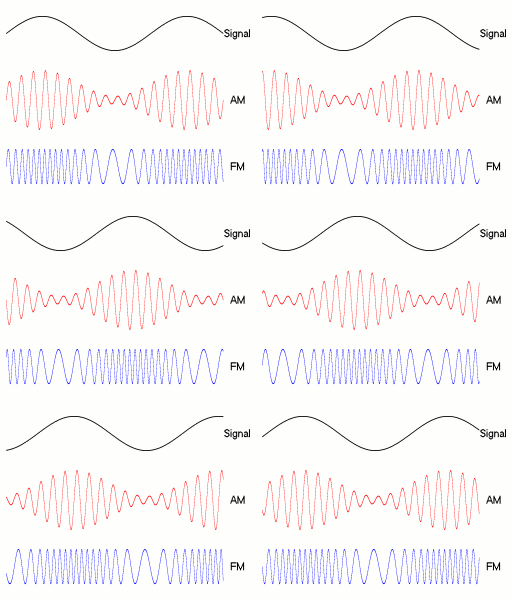
    analog component to a radio transmission. So you can see it is analog and needs some sort of processing. This is one of the simpler forms of modulation,
    and has existed for some decades. These signals have a strong carrier component. The transmitters are in the kilowatts range for these.
    Whereas your Wifi is ballpark 1 watt or so (bursty).

    https://upload.wikimedia.org/wikipedia/commons/a/a4/Amfm3-en-de.gif

    Some radio schemes are complicated enough, they exist mainly
    in the popular literature in their logical form. The logical form
    explaining how the processing is going to work. This is because,
    if they were to show you the wiggles, the wiggles have no observable proportionality to the digital content they are supposed to be carrying.
    You would not be able to guess how many ones or zeros were contained
    in the modulation scheme. (I-Q constellations being an example)

    Wifi can have a very large channel width. This implies lots of
    wiggling and lots of tricks. TV is 6MHz wide, Wifi is wider than
    that and carrying data at much higher rates. Even if I recorded
    30 seconds of wiggling, gave it to you and sent you away with
    a pencil to decode it, you'd never be able to do it with a pencil.
    But with things such as MathCAD, you could do it in a reasonable
    period of time. Some of the schemes, were evaluated with desktop
    math packages, before being turned into silicon implementation.

    You can also do it with "Software Defined Radio" or SDR, but again,
    some encoding/modulation schemes are so complicated, it is hard
    for a software person to write sufficient code for the post-processing. Something like a HackRF has a sufficiently high input frequency range,
    to capture signals at 2.4GHz or 5GHz. It uses ADC (analog to digital converters) when receiving a signal. The sampling rate
    ("20 million samples per second") determine the Nyquist limited
    bandwidth. 20 million samples, would be 10MHz and the channel bandwidth
    of TV is 6MHz. This means a digital TV signal (which is analog
    as it flies through the air), can be properly converted back
    to digital and then software processes that signal to recover the
    MPEG encoded TV.

    https://greatscottgadgets.com/hackrf/one/

    But depending on how wide the transmitted channel is, even a device like
    that is not enough, and an even higher ADC rate is required. Suddenly
    the "general purpose receiver" you were hoping to build, goes
    from $25 to $10,000 and this is outside the range of hobbyist
    budget. There are export restrictions on ADCs, in case you were
    wondering why you could not pick up a gadget for $100 at
    the computer store, armed to the teeth with capability.
    ADC (easily) go up to 1GHz for example, and by combining
    multiple of them and carefully controlling the clock phase,
    equipping them with large high speed memories, you can build
    radar detection apparatus ("for targeting stuff"). It's
    still analog as it goes through the air.

    Whether reception is implemented in silicon chips, or whether
    it is emulated in the SDR hardware/software chain, it is
    dauntingly complex stuff. Not many people have the maths
    knowledge to do it.

    So yes, at some point in your computer, there are digital
    things alright, but many of the things the computer connects
    to, are in the analog domain. And there can be a dizzying
    number of domain changes (analog-digital-analog-digital...)
    until it is made useful to you.

    Scroll through this. You don't have to read it. Just look
    at the couple of examples of wiggles.

    https://www.tek.com/en/documents/primer/wi-fi-overview-80211-physical-layer-and-transmitter-measurements

    Paul

    --- SoupGate-Win32 v1.05
    * Origin: fsxNet Usenet Gateway (21:1/5)
  • From Paul@21:1/5 to Andy Burns on Sun May 11 14:59:12 2025
    XPost: alt.os.linux.mint

    On Sun, 5/11/2025 8:04 AM, Andy Burns wrote:
    pinnerite wrote:

    I am currently restoring a 50 year old Technics Hi-Fi system.

    I am just waiting for three drive belts from Spain for the cassette
    recorder module.

    I would like to digitise some of my old recordings. The room housing
    the Hi-Fi system has no connection to the LAN. This means sending the
    analog audio by Wi-Fi over to my work machine.
    search for a Us sound card with stereo line level inputs, here's one, there are probably better ones around

    <https://www.amazon.co.uk/dp/B079CBGDST>

    The items for sale, are delightfully free of specs.

    Some applications will work better than others.
    The higher the quality of vinyl recording player,
    the less likely one of these cheap gadgets has
    sufficient gain for the job. (This is because inside
    one of those, is a single chip, and little else.
    The gain, is whatever the main chip can manage,
    and it was never designed for magnetic cartridges.
    A purpose built device, would have a gain stage
    in front of the chip.)

    Excess capability in devices is nice for "research"
    purposes. My paper scanner may record at 1200 DPI, but
    I never scan over 300 DPI. But when I want to investigate
    what someone has been telling me (that higher DPI
    doesn't help overall), then my equipment is up to
    the task of running at a higher rate to prove or
    disprove the theory.

    My first paper scanner, came with slide templates and
    a transparency adapter. But the people were out of
    their freaking minds. The scanned slides were as
    grainy as hell (not the right sampling rate). I
    wasn't expecting miracles -- I was impressed by
    their negative compensation, the colours on
    some negative scans were good. But the ugly results
    were not keepers. At least the scanner could display
    the "principles" of scanning film, but it could
    not actually realize useful output while doing so.
    This is why we have those shoebox shaped film scanners.

    In this example, are some specs. A start at it. This
    is how we bootstrap into being forewarned.

    https://www.startech.com/en-us/cards-adapters/icusbaudio2d

    96KHz / 24-bit Hi-Fi USB Audio (Picture shows 44.1, 48, 96)
    Cmedia CM6533
    4 position TRRS headset with Mic supported <=== Like the SB Play3, this means you need a LineOut adapter :-/
    This declaration does not ruin the Mic hole, which is TRS.
    TRS stands for Tip-Ring-Sleeve (at 3.5mm in this case).
    At least you can record with it! Most home users
    don't have TRRS to TRS adapter cables handy.

    Now we can look up all the missing specs.

    https://www.cmedia.com.tw/products/USB_AUDIO_CODEC/CM6533

    -16dB to +45dB microphone gain (good but a little short of 2mV phono cartridge)

    It has an internal regulator for the analog supply voltage.
    Dirty 5V from USB bus, clean 3.3V, but as it turns out, there
    are better ways to make a clean 3.3V than that, and if you
    want an exceptional noise floor, you'll need a buck converter
    and a couple stages of analog supply filtering to notch
    the fundamental. Even a battery has a noise spectrum, so
    you can't necessarily get a better result with just a battery.

    Since it is USB, you wold never really expect a good noise
    floor, but... if someone does the work, who knows what you
    could manage. One of the problems fifteen years ago with
    computer audio, is the engineers weren't running RightMark
    to see how good their workmanship was ("mouse noise injected
    into audio recording"). They had no clue what the actual
    specs were for their audio. But they listened to the feedback,
    and corrected the situation (there are still occasional slip-ups,
    moat is missing).

    Paul

    --- SoupGate-Win32 v1.05
    * Origin: fsxNet Usenet Gateway (21:1/5)
  • From Edmund@21:1/5 to Paul on Sun May 11 21:42:25 2025
    XPost: alt.os.linux.mint

    On 5/11/25 20:08, Paul wrote:
    On Sun, 5/11/2025 9:02 AM, Edmund wrote:
    On 5/11/25 12:44, The Natural Philosopher wrote:
    On 11/05/2025 11:34, Edmund wrote:
    Alan

    Analog over WiFi???? Once your analog recording is digitized, it is digital.


    And once your digital gets to wifi, it is 'analogued' again,


    WiFi is analog?? Source?


    It is a radio frequency signal at 2.4 GHz (unlicensed band, power limited).

    There are electrical wiggles (analog) coming from CMOS and BiPolar
    radio amplifiers driving matched antennas. E-field waves are released,
    which propagate through space (analog) and are detected by antennas
    at the other end. The radio frequency signal is recovered, and
    the "intelligence" in the wiggle signal is extracted. At that point
    it has become digital again.

    The following example isn't how Wifi works -- it is just to show the
    analog component to a radio transmission. So you can see it is analog and needs
    some sort of processing. This is one of the simpler forms of modulation,
    and has existed for some decades. These signals have a strong carrier component. The transmitters are in the kilowatts range for these.
    Whereas your Wifi is ballpark 1 watt or so (bursty).

    https://upload.wikimedia.org/wikipedia/commons/a/a4/Amfm3-en-de.gif

    Some radio schemes are complicated enough, they exist mainly
    in the popular literature in their logical form. The logical form
    explaining how the processing is going to work. This is because,
    if they were to show you the wiggles, the wiggles have no observable proportionality to the digital content they are supposed to be carrying.
    You would not be able to guess how many ones or zeros were contained
    in the modulation scheme. (I-Q constellations being an example)

    Wifi can have a very large channel width. This implies lots of
    wiggling and lots of tricks. TV is 6MHz wide, Wifi is wider than
    that and carrying data at much higher rates. Even if I recorded
    30 seconds of wiggling, gave it to you and sent you away with
    a pencil to decode it, you'd never be able to do it with a pencil.
    But with things such as MathCAD, you could do it in a reasonable
    period of time. Some of the schemes, were evaluated with desktop
    math packages, before being turned into silicon implementation.

    You can also do it with "Software Defined Radio" or SDR, but again,
    some encoding/modulation schemes are so complicated, it is hard
    for a software person to write sufficient code for the post-processing. Something like a HackRF has a sufficiently high input frequency range,
    to capture signals at 2.4GHz or 5GHz. It uses ADC (analog to digital converters) when receiving a signal. The sampling rate
    ("20 million samples per second") determine the Nyquist limited
    bandwidth. 20 million samples, would be 10MHz and the channel bandwidth
    of TV is 6MHz. This means a digital TV signal (which is analog
    as it flies through the air), can be properly converted back
    to digital and then software processes that signal to recover the
    MPEG encoded TV.

    https://greatscottgadgets.com/hackrf/one/

    But depending on how wide the transmitted channel is, even a device like
    that is not enough, and an even higher ADC rate is required. Suddenly
    the "general purpose receiver" you were hoping to build, goes
    from $25 to $10,000 and this is outside the range of hobbyist
    budget. There are export restrictions on ADCs, in case you were
    wondering why you could not pick up a gadget for $100 at
    the computer store, armed to the teeth with capability.
    ADC (easily) go up to 1GHz for example, and by combining
    multiple of them and carefully controlling the clock phase,
    equipping them with large high speed memories, you can build
    radar detection apparatus ("for targeting stuff"). It's
    still analog as it goes through the air.

    Whether reception is implemented in silicon chips, or whether
    it is emulated in the SDR hardware/software chain, it is
    dauntingly complex stuff. Not many people have the maths
    knowledge to do it.

    So yes, at some point in your computer, there are digital
    things alright, but many of the things the computer connects
    to, are in the analog domain. And there can be a dizzying
    number of domain changes (analog-digital-analog-digital...)
    until it is made useful to you.

    Scroll through this. You don't have to read it. Just look
    at the couple of examples of wiggles.

    https://www.tek.com/en/documents/primer/wi-fi-overview-80211-physical-layer-and-transmitter-measurements

    Paul

    I didn't ask you and WiFi transmit Digital.
    How it is done is not the point, it is digital.


    --
    -------------

    Godspeed for Assange
    Amnesty for Snowden
    Rehabilitation for heroes

    Edmund

    --- SoupGate-Win32 v1.05
    * Origin: fsxNet Usenet Gateway (21:1/5)
  • From Mike Easter@21:1/5 to Edmund on Sun May 11 14:20:41 2025
    XPost: alt.os.linux.mint

    Edmund wrote:
    The Natural Philosopher wrote:
    Edmund wrote:

    Analog over WiFi???? Once your analog recording is digitized, it is
    digital.

    And once your digital gets to wifi, it is 'analogued' again,

    WiFi is analog?? Source?

    The carrier wave is analog. The modulated data info is digital.


    --
    Mike Easter

    --- SoupGate-Win32 v1.05
    * Origin: fsxNet Usenet Gateway (21:1/5)
  • From vallor@21:1/5 to Edmund on Mon May 12 10:12:52 2025
    XPost: alt.os.linux.mint

    On Sun, 11 May 2025 21:42:25 +0200, Edmund <[email protected]> wrote in <vvquj1$k07g$[email protected]>:

    On 5/11/25 20:08, Paul wrote:
    [... excellent brain dump snipped ...]
    Scroll through this. You don't have to read it. Just look at the couple
    of examples of wiggles.

    https://www.tek.com/en/documents/primer/wi-fi-overview-80211-physical- layer-and-transmitter-measurements

    Paul

    I didn't ask you and WiFi transmit Digital. How it is done is not the
    point, it is digital.

    Why are you being rude? He posted that to help you understand.

    --
    -v System76 Thelio Mega v1.1 x86_64 NVIDIA RTX 3090 Ti
    OS: Linux 6.14.6 Release: Mint 22.1 Mem: 258G
    "Avoid temporary variables and strange women."

    --- SoupGate-Win32 v1.05
    * Origin: fsxNet Usenet Gateway (21:1/5)
  • From Edmund@21:1/5 to vallor on Mon May 12 12:58:12 2025
    XPost: alt.os.linux.mint

    On 5/12/25 12:12, vallor wrote:
    On Sun, 11 May 2025 21:42:25 +0200, Edmund <[email protected]> wrote in <vvquj1$k07g$[email protected]>:

    On 5/11/25 20:08, Paul wrote:
    [... excellent brain dump snipped ...]
    Scroll through this. You don't have to read it. Just look at the couple
    of examples of wiggles.

    https://www.tek.com/en/documents/primer/wi-fi-overview-80211-physical-
    layer-and-transmitter-measurements

    Paul

    I didn't ask you and WiFi transmit Digital. How it is done is not the
    point, it is digital.

    Why are you being rude? He posted that to help you understand.

    Yeah I see it, it doesn't sound friendly, but it was not intended to be
    rude and especially not towards someone as helpful as Paul. I just
    wanted the source of The Natural Philosopher for his claims.
    Sorry Paul!


    --
    -------------

    Godspeed for Assange
    Amnesty for Snowden
    Rehabilitation for heroes

    Edmund

    --- SoupGate-Win32 v1.05
    * Origin: fsxNet Usenet Gateway (21:1/5)
  • From Joe@21:1/5 to Mike Easter on Mon May 12 13:38:23 2025
    XPost: alt.os.linux.mint

    On Sun, 11 May 2025 14:20:41 -0700
    Mike Easter <[email protected]d> wrote:

    Edmund wrote:
    The Natural Philosopher wrote:
    Edmund wrote:

    Analog over WiFi???? Once your analog recording is digitized, it
    is digital.

    And once your digital gets to wifi, it is 'analogued' again,

    WiFi is analog?? Source?

    The carrier wave is analog. The modulated data info is digital.


    It is parsed by humans as being digital. It is conceptually digital.
    Nothing is truly digital until you are working at atomic level or with individual photons. The digital signal will have threshold levels
    specified for correct interpretation of 0s and 1s, and a maximum timing
    jitter specified. All those things are analogue values.

    I once had to fix a problem in a TV digital effects unit, which turned
    out to be an IC having been sourced from the wrong manufacturer. It had
    an (unspecified) input impedance which was too far mismatched from the
    PCB lines feeding it, resulting in a huge reflection that messed up the
    timing of the 'digital' pulses. That's an analogue problem.

    --
    Joe

    --- SoupGate-Win32 v1.05
    * Origin: fsxNet Usenet Gateway (21:1/5)
  • From Paul@21:1/5 to Edmund on Mon May 12 09:55:14 2025
    XPost: alt.os.linux.mint

    On Mon, 5/12/2025 6:58 AM, Edmund wrote:
    On 5/12/25 12:12, vallor wrote:
    On Sun, 11 May 2025 21:42:25 +0200, Edmund <[email protected]> wrote in
    <vvquj1$k07g$[email protected]>:

    On 5/11/25 20:08, Paul wrote:
    [... excellent brain dump snipped ...]
    Scroll through this. You don't have to read it. Just look at the couple >>>> of examples of wiggles.

    https://www.tek.com/en/documents/primer/wi-fi-overview-80211-physical-
    layer-and-transmitter-measurements

         Paul

    I didn't ask you and WiFi transmit Digital. How it is done is not the
    point, it is digital.

    Why are you being rude?  He posted that to help you understand.

    Yeah I see it, it doesn't sound friendly, but it was not intended to be rude and especially not towards someone as helpful as Paul. I just wanted the source
    of The Natural Philosopher for his claims.
    Sorry Paul!

    Rather than analog and digital, everything is analog, and we choose
    to apply a "digital-overlay" or a digital interpretation to the things
    we are seeing.

    On this page, you can see some almost-ideal behaviors, and the "digital-overlay" is easy to justify when you look at the results.
    This isn't the first logic family, but it's one of the cleanest.

    https://wiki.analog.com/university/courses/electronics/electronics-lab-28

    Other situations are more complicated. Look at Figure 1 here for example.
    The four pairs on your GbE Ethernet cable to the router, look like that.
    How would you write down the logic values for such a waveform ?

    https://www.edn.com/what-pam5-means-to-you/

    When the stairstep signals are drawn over top of one another, they
    look like the representation on the right of this picture. There is a
    beautiful color representation of the right-hand picture, but every
    time I go to present that to people, I have trouble finding it again. (Tektronix equipment frequently renders eyes, in color.)
    The picture here is an eye diagram, and the eye on the right is very open.
    Some Tek equipment, can tell you "whether your signal is compliant with
    the standard", using that representation. There is a pulse template, and the waveform is not allowed to touch the template, to be "compliant".

    https://www.5gtechnologyworld.com/wp-content/uploads/2023/10/How-does-4D-PAM5-work-in-Gigabit-Ethernet-Fig-2.jpg

    Now, is that digital logic or what ?

    Now, let's do a 4096 I-Q constellation. Is it still digital, or is it
    looking just a wee bit analog ? At one time, they were not going to do
    4096 QAM, because they didn't think it would work. But... they did
    it anyway. On the next version of Wifi, the plan is to "consolidate,
    and make the Wifi more reliable" <snicker>. OK then.

    https://www.rcrwireless.com/20220315/featured/1k-qam-vs-4k-qam-why-it-matters-for-wi-fi-7

    "...Wi-Fi 7, which uses 4096-QAM, it gets increasingly harder to transmit and receive data error-free."

    No shit.

    Those dots are decision points. The signal does not need very much low
    speed wander, for the voltage value to move from one decision point
    to another, then you get a receive error. And if you are lucky,
    an error correction mechanism can fix it for you.

    If you looked at that signal in the time domain, it would look just
    awful. There's a reason the instruments put up the constellation
    display, rather than the oscilloscope type display.

    OK, this is the oscilloscope display of a low-QAM (Quadrature Amplitude Modulation) signal.
    Can you extract the ones and zeros from this correctly ?
    Now, let us connect the instrument to the 4096 constellation,
    and you get your pencil out and try that one. Good luck with that.

    https://www.weissworks.dev/blog/2021/vis-com_modulation/

    The reason you conclude that weissworks one is digital, or "likely to be digital",
    is the order of the QAM is pretty low. When you get enough levels
    in the diagram, now the bumps are hard to tell apart from one another.
    One 64 units high, might not be distinguishable from one 63 units high.
    It could be the same issue, when measuring the phase between the waveforms.
    At that point, someone could be snowing you. It could be they have
    connected a random number generator to the thing. Is it digital ?
    We're not really sure. And it would take a lot of processing to find out.

    There are actually a lot of PHYs now, where your "calibrated eyeball"
    is useless.

    The first time I looked at LVDS on a scope at 622, I thought it was snowing. Yet the chippage received the signal perfectly. The rep and I had a good
    laugh, about what we were seeing on the screen, and the inability of
    humans to recognize a good time. So yes, that was digital, because
    our data was coming in, error free. All I really needed was a better trigger, to make the display usable. I think later on, I got one of those
    properly triggered, and it still bobbed around a bit on the screen.
    But at least it was looking a bit more trapezoidal then.

    https://media.cheggcdn.com/media%2F0ac%2F0ac66255-b2fb-413a-b118-879d81accdaf%2Fimage

    Paul

    --- SoupGate-Win32 v1.05
    * Origin: fsxNet Usenet Gateway (21:1/5)
  • From Mike Easter@21:1/5 to Edmund on Mon May 12 10:55:54 2025
    XPost: alt.os.linux.mint

    Edmund wrote:
    Well that sums it up I guess, so WiFi IS digital, that is the whole
    point here.

    To me, wifi is 'radio' which is analog. Radio is modulated in various
    ways for various purposes and it is but a small part of a huge
    electromagnetic spectrum which is analog.

    How you put the data into some part of the electromagnetic spectrum
    depends on whether you are trying to communicate to other parts of the
    solar system or nearby.

    --
    Mike Easter

    --- SoupGate-Win32 v1.05
    * Origin: fsxNet Usenet Gateway (21:1/5)
  • From Edmund@21:1/5 to Mike Easter on Mon May 12 20:20:06 2025
    XPost: alt.os.linux.mint

    On 5/12/25 19:55, Mike Easter wrote:
    Edmund wrote:
    Well that sums it up I guess, so WiFi IS digital, that is the whole
    point here.

    To me, wifi is 'radio' which is analog.

    You can find black white but that doesn't make it so.

    Radio is modulated in various
    ways for various purposes and it is but a small part of a huge electromagnetic spectrum which is analog.

    All the transfered WiFi data is digital that is why we call it digital.
    making this an endless war of words, fine I don't care.


    --
    -------------

    Godspeed for Assange
    Amnesty for Snowden
    Rehabilitation for heroes

    Edmund

    --- SoupGate-Win32 v1.05
    * Origin: fsxNet Usenet Gateway (21:1/5)
  • From Mike Easter@21:1/5 to Edmund on Mon May 12 12:46:56 2025
    XPost: alt.os.linux.mint

    Edmund wrote:
    Mike Easter wrote:
    Edmund wrote:
    Well that sums it up I guess, so WiFi IS digital, that is the whole
    point here.

    To me, wifi is 'radio' which is analog.

    You can find black white but that doesn't make it so.

    Radio is modulated in various ways for various purposes and it is but
    a small part of a huge electromagnetic spectrum which is analog.

    All the transfered WiFi data is digital that is why we call it digital. making this an endless war of words, fine I don't care.

    In these types of discussion, I'm not trying to say you are 'wrong'
    about how you want to think about it, but I'm explaining how I think
    about it and how I see it.

    The analog is 'fundamental' mechanism to wifi radio, the digital data is 'tacked onto' it.

    You basically have transmitter and receiver radios and an appropriate frequency. Whatever else you have/do is another 'subject'.

    Wifi and cellphones use DSP to convert digital data into radio waves by modulation, while radio/TV (usually) don't.

    Modulating a radio wave doesn't make it 'not a radio wave'.


    --
    Mike Easter

    --- SoupGate-Win32 v1.05
    * Origin: fsxNet Usenet Gateway (21:1/5)
  • From Andrew@21:1/5 to Paul on Mon May 12 20:58:24 2025
    XPost: alt.os.linux.mint

    On 09/05/2025 19:59, Paul wrote:
    On Fri, 5/9/2025 1:47 PM, pinnerite wrote:
    I am currently restoring a 50 year old Technics Hi-Fi system.

    I am just waiting for three drive belts from Spain for the cassette
    recorder module.

    I would like to digitise some of my old recordings. The room housing
    the Hi-Fi system has no connection to the LAN. This means sending the
    analog audio by Wi-Fi over to my work machine.

    I would like to make use of my old EEE PC 901 netbook as the Wi-Fi
    trasmitter provided that I could pump the audio into that.

    The the output from the amplifier is either from dual RCA sockets or a
    1/4" headphone socket.

    The input to the netbook can only be to one of three USB sockets or a
    3.5mm mic socket.

    Is it feasible?


    You should tune up the Technics, with a brand new tape.
    You don't want to ruin an archive tape, if the capstan isn't
    working properly.

    My recorder started eating cassette tapes, and you don't want
    to discover a transport problem, using a tape with valuable content.

    Good luck,

    Paul

    Indeed. The Panasonic RX-ES27 Radio/CD/tape recorder/player that
    was bought for Dads 80th birthday in 2003 is now with me but he
    never played cassettes and the spindle that the pinchwheel
    compresses the tape into had developed some rust. I have cleaned
    it off with some fine wet'n'dry cloth and am contemplating sleeving
    it with a short length of heat shrink tubing. This might protect
    any tapes but they would play slightly faster. For speech (mostly
    old language cassettes and stuff like Tony Hancock or "I'm sorry
    I haven't a clue") this may not matter.

    It's a good system, and ebay prices seem to vary between £40 and
    £100. It was £120 new in 2003. It has a remote control and a
    servo-controlled tape deck so you can Fast Fwd and Reverse without
    getting up to press clunky buttons.

    --- SoupGate-Win32 v1.05
    * Origin: fsxNet Usenet Gateway (21:1/5)
  • From The Natural Philosopher@21:1/5 to Edmund on Tue May 13 18:47:58 2025
    XPost: alt.os.linux.mint

    On 11/05/2025 20:42, Edmund wrote:
    didn't ask you and WiFi transmit Digital.
    How it is done is not the point, it is digital.

    It is done using analogue techniques.

    What is digital anyway? More electrons for a 1 than a 0. Analog. Or
    digital. Depending on whether you are measuring volts or counting electrons.

    WiFi is simply transmission of a digital signal over an analogue channel

    As is broadband (ADSL/VDSL) and fibre. (god knows what - SONET?)

    Stop being such an ArtStudent...

    --
    Gun Control: The law that ensures that only criminals have guns.

    --- SoupGate-Win32 v1.05
    * Origin: fsxNet Usenet Gateway (21:1/5)
  • From The Natural Philosopher@21:1/5 to Edmund on Tue May 13 18:42:11 2025
    XPost: alt.os.linux.mint

    On 11/05/2025 14:02, Edmund wrote:
    On 5/11/25 12:44, The Natural Philosopher wrote:
    On 11/05/2025 11:34, Edmund wrote:
    Alan

    Analog over WiFi???? Once your analog recording is digitized, it is
    digital.


    And once your digital gets to wifi, it is 'analogued' again,


    WiFi is analog?? Source?


    Its radio innit.

    "Basic Modulation Types

    WiFi technology uses several modulation types, including Binary Phase
    Shift Keying (BPSK), Quadrature Phase Shift Keying (QPSK), and
    higher-order QAM. BPSK and QPSK are relatively simple, offering
    robustness at the expense of data rates. QAM, on the other hand, offers
    higher data rates but is more prone to noise.
    Advanced Modulation Techniques

    More advanced WiFi standards, such as 802.11n (WiFi 4), 802.11ac (WiFi
    5), and 802.11ax (WiFi 6), employ more complex modulation schemes, such
    as 64-QAM, 256-QAM, and even 1024-QAM in WiFi 6. These schemes allow for
    higher data rates but demand better signal quality.
    Understanding QAM in Simple Terms

    In QAM, the WiFi signal changes both its phase (like turning around at different points while walking) and its amplitude (like changing the
    volume of your voice). These two changes happen at the same time, which
    is like singing a song while dancing; you're doing two things at once!
    The number before QAM (like 64 in 64-QAM) tells you how many different combinations of amplitude and phase changes you can make. In our
    dance-and-sing analogy, a higher number would mean you have more dance
    steps and song notes to combine.

    How Speed Depends on Modulation

    Bits per Symbol and Data Rate

    The choice of modulation directly impacts the WiFi speed because
    different modulations can transmit different amounts of data per symbol.
    The higher the number of bits per symbol, the higher the data rate. For instance, BPSK transmits 1 bit/symbol, QPSK transmits 2 bits/symbol,
    while 64-QAM can transmit 6 bits/symbol, and 256-QAM can transmit 8 bits/symbol.
    Trade-Off with Signal Quality

    While more complex modulation schemes can increase the data rate, they
    also require better signal quality to avoid errors. If the signal
    quality isn't sufficient, the WiFi system may need to switch to a less
    complex modulation, reducing the speed. So, while modulation directly
    impacts speed, this relationship is also influenced by other factors
    such as signal strength, noise, and interference.
    Conclusion

    Modulation techniques are fundamental to WiFi technology, impacting both
    its data rate and signal robustness. While the trend has been towards
    more complex modulations to achieve higher data rates, there's an
    inherent trade-off with signal quality and robustness. As a result,
    effective use of modulation requires careful consideration of both the capabilities of the hardware and the quality of the wireless environment."


    --
    Gun Control: The law that ensures that only criminals have guns.

    --- SoupGate-Win32 v1.05
    * Origin: fsxNet Usenet Gateway (21:1/5)
  • From The Natural Philosopher@21:1/5 to Edmund on Tue May 13 18:50:25 2025
    XPost: alt.os.linux.mint

    On 12/05/2025 11:58, Edmund wrote:
    On 5/12/25 12:12, vallor wrote:
    On Sun, 11 May 2025 21:42:25 +0200, Edmund <[email protected]> wrote in
    <vvquj1$k07g$[email protected]>:

    On 5/11/25 20:08, Paul wrote:
    [... excellent brain dump snipped ...]
    Scroll through this. You don't have to read it. Just look at the couple >>>> of examples of wiggles.

    https://www.tek.com/en/documents/primer/wi-fi-overview-80211-physical-
    layer-and-transmitter-measurements

         Paul

    I didn't ask you and WiFi transmit Digital. How it is done is not the
    point, it is digital.

    Why are you being rude?  He posted that to help you understand.

    Yeah I see it, it doesn't sound friendly, but it was not intended to be
    rude and especially not towards someone as helpful as Paul. I just
    wanted the source of The Natural Philosopher for his claims.
    Sorry Paul!


    Obviously my years of experience at University plus designing radios and analogue circuits to transmit both analogue and digital data.
    In these matters I don't need to 'refer to an authority', I *am* the
    fucking authority.


    --
    Outside of a dog, a book is a man's best friend. Inside of a dog it's
    too dark to read.

    Groucho Marx

    --- SoupGate-Win32 v1.05
    * Origin: fsxNet Usenet Gateway (21:1/5)
  • From The Natural Philosopher@21:1/5 to Edmund on Tue May 13 18:52:31 2025
    XPost: alt.os.linux.mint

    On 12/05/2025 17:17, Edmund wrote:
    On 5/12/25 15:55, Paul wrote:
    On Mon, 5/12/2025 6:58 AM, Edmund wrote:
    On 5/12/25 12:12, vallor wrote:
    On Sun, 11 May 2025 21:42:25 +0200, Edmund <[email protected]>
    wrote in
    <vvquj1$k07g$[email protected]>:

    On 5/11/25 20:08, Paul wrote:
    [... excellent brain dump snipped ...]
    Scroll through this. You don't have to read it. Just look at the
    couple
    of examples of wiggles.

    https://www.tek.com/en/documents/primer/wi-fi-overview-80211-physical- >>>> layer-and-transmitter-measurements

          Paul

    I didn't ask you and WiFi transmit Digital. How it is done is not the >>>>> point, it is digital.

    Why are you being rude?  He posted that to help you understand.

    Yeah I see it, it doesn't sound friendly, but it was not intended to
    be rude
    and especially not towards someone as helpful as Paul. I just wanted
    the source
    of The Natural Philosopher for his claims.
    Sorry Paul!

    Rather than analog and digital, everything is analog, and we choose
    to apply a "digital-overlay" or a digital interpretation to the things
    we are seeing.

    Well that sums it up I guess, so WiFi IS digital, that is the whole
    point here.


    No, Its wifi.

    Analogue radio.

    It's carrying a digital signal, sure, but only an Art Student would say
    that makes it to BE digital.


    --
    "And if the blind lead the blind, both shall fall into the ditch".

    Gospel of St. Mathew 15:14

    --- SoupGate-Win32 v1.05
    * Origin: fsxNet Usenet Gateway (21:1/5)
  • From The Natural Philosopher@21:1/5 to Mike Easter on Tue May 13 18:54:02 2025
    XPost: alt.os.linux.mint

    On 12/05/2025 20:46, Mike Easter wrote:
    Wifi and cellphones use DSP to convert digital data into radio waves by modulation, while radio/TV (usually) don't.

    'Digital' TV does. And 'digital'radio.
    Only AM and FM are still 'analogue'

    --
    "And if the blind lead the blind, both shall fall into the ditch".

    Gospel of St. Mathew 15:14

    --- SoupGate-Win32 v1.05
    * Origin: fsxNet Usenet Gateway (21:1/5)
  • From David Wade@21:1/5 to The Natural Philosopher on Tue May 13 19:00:14 2025
    XPost: alt.os.linux.mint

    On 13/05/2025 18:52, The Natural Philosopher wrote:
    On 12/05/2025 17:17, Edmund wrote:
    On 5/12/25 15:55, Paul wrote:
    On Mon, 5/12/2025 6:58 AM, Edmund wrote:
    On 5/12/25 12:12, vallor wrote:
    On Sun, 11 May 2025 21:42:25 +0200, Edmund <[email protected]>
    wrote in
    <vvquj1$k07g$[email protected]>:

    On 5/11/25 20:08, Paul wrote:
    [... excellent brain dump snipped ...]
    Scroll through this. You don't have to read it. Just look at the >>>>>>> couple
    of examples of wiggles.

    https://www.tek.com/en/documents/primer/wi-fi-overview-80211-physical- >>>>> layer-and-transmitter-measurements

          Paul

    I didn't ask you and WiFi transmit Digital. How it is done is not the >>>>>> point, it is digital.

    Why are you being rude?  He posted that to help you understand.

    Yeah I see it, it doesn't sound friendly, but it was not intended to
    be rude
    and especially not towards someone as helpful as Paul. I just wanted
    the source
    of The Natural Philosopher for his claims.
    Sorry Paul!

    Rather than analog and digital, everything is analog, and we choose
    to apply a "digital-overlay" or a digital interpretation to the things
    we are seeing.

    Well that sums it up I guess, so WiFi IS digital, that is the whole
    point here.


    No, Its wifi.

    Analogue radio.

    It's carrying a digital signal, sure,  but only an Art Student would say that makes it to BE digital.


    So digital TV is analogue?

    Dave

    --- SoupGate-Win32 v1.05
    * Origin: fsxNet Usenet Gateway (21:1/5)
  • From Joe@21:1/5 to David Wade on Tue May 13 20:27:18 2025
    XPost: alt.os.linux.mint

    On Tue, 13 May 2025 19:00:14 +0100
    David Wade <[email protected]d> wrote:


    So digital TV is analogue?


    The data content is digital, but the means of transmission is always
    analogue, whether radio, cable or fibre.

    Even the most 'digital' of methods, light along single-mode fibre, has
    return loss, jitter and path length variation, though the latter is far
    less than with multimode fibre. There is also attenuation, reducing the
    power of the pulse continuously with distance. Again, there will be
    'high' and 'low' thresholds of level which can be reliably detected, as
    well as a maximum timing jitter permitted.

    --
    Joe

    --- SoupGate-Win32 v1.05
    * Origin: fsxNet Usenet Gateway (21:1/5)
  • From Andrew@21:1/5 to David Wade on Tue May 13 20:31:31 2025
    XPost: alt.os.linux.mint

    On 13/05/2025 19:00, David Wade wrote:
    On 13/05/2025 18:52, The Natural Philosopher wrote:
    On 12/05/2025 17:17, Edmund wrote:
    On 5/12/25 15:55, Paul wrote:
    On Mon, 5/12/2025 6:58 AM, Edmund wrote:
    On 5/12/25 12:12, vallor wrote:
    On Sun, 11 May 2025 21:42:25 +0200, Edmund <[email protected]>
    wrote in
    <vvquj1$k07g$[email protected]>:

    On 5/11/25 20:08, Paul wrote:
    [... excellent brain dump snipped ...]
    Scroll through this. You don't have to read it. Just look at the >>>>>>>> couple
    of examples of wiggles.

    https://www.tek.com/en/documents/primer/wi-fi-overview-80211-physical- >>>>>> layer-and-transmitter-measurements

          Paul

    I didn't ask you and WiFi transmit Digital. How it is done is not >>>>>>> the
    point, it is digital.

    Why are you being rude?  He posted that to help you understand.

    Yeah I see it, it doesn't sound friendly, but it was not intended
    to be rude
    and especially not towards someone as helpful as Paul. I just
    wanted the source
    of The Natural Philosopher for his claims.
    Sorry Paul!

    Rather than analog and digital, everything is analog, and we choose
    to apply a "digital-overlay" or a digital interpretation to the things >>>> we are seeing.

    Well that sums it up I guess, so WiFi IS digital, that is the whole
    point here.


    No, Its wifi.

    Analogue radio.

    It's carrying a digital signal, sure,  but only an Art Student would
    say that makes it to BE digital.


    So digital TV is analogue?

    Dave

    Absolutely yes. The stream of information between transmitter and
    your STB or Modern TV is a complex analogue waveform.

    The actual digital signal is (re)constructed from this analogue
    stream and then presented to the rest of the sets digital
    components and software.

    Ditto DAB radio.

    Remember, inside every square wave is a (collection of) sine
    waves desperate to get out.

    --- SoupGate-Win32 v1.05
    * Origin: fsxNet Usenet Gateway (21:1/5)
  • From Mike Easter@21:1/5 to Andrew on Tue May 13 12:52:00 2025
    XPost: alt.os.linux.mint

    Andrew wrote:
    Remember, inside every square wave is a (collection of) sine
    waves desperate to get out.

    Ha.

    --
    Mike Easter

    --- SoupGate-Win32 v1.05
    * Origin: fsxNet Usenet Gateway (21:1/5)
  • From The Nomad@21:1/5 to All on Wed May 14 07:19:10 2025
    XPost: alt.os.linux.mint

    On Tue, 13 May 2025 20:31:31 +0100, Andrew <[email protected]>
    wrote:

    On 13/05/2025 19:00, David Wade wrote:
    On 13/05/2025 18:52, The Natural Philosopher wrote:
    On 12/05/2025 17:17, Edmund wrote:
    On 5/12/25 15:55, Paul wrote:
    On Mon, 5/12/2025 6:58 AM, Edmund wrote:
    On 5/12/25 12:12, vallor wrote:
    On Sun, 11 May 2025 21:42:25 +0200, Edmund <[email protected]>
    wrote in <vvquj1$k07g$[email protected]>:

    On 5/11/25 20:08, Paul wrote:
    [... excellent brain dump snipped ...]
    Scroll through this. You don't have to read it. Just look at the >>>>>>>>> couple of examples of wiggles.

    https://www.tek.com/en/documents/primer/wi-fi-overview-80211- physical-
    layer-and-transmitter-measurements

          Paul

    I didn't ask you and WiFi transmit Digital. How it is done is not >>>>>>>> the point, it is digital.

    Why are you being rude?  He posted that to help you understand. >>>>>>>
    Yeah I see it, it doesn't sound friendly, but it was not intended
    to be rude and especially not towards someone as helpful as Paul. I >>>>>> just wanted the source of The Natural Philosopher for his claims.
    Sorry Paul!

    Rather than analog and digital, everything is analog, and we choose
    to apply a "digital-overlay" or a digital interpretation to the
    things we are seeing.

    Well that sums it up I guess, so WiFi IS digital, that is the whole
    point here.


    No, Its wifi.

    Analogue radio.

    It's carrying a digital signal, sure,  but only an Art Student would
    say that makes it to BE digital.


    So digital TV is analogue?

    Dave

    Absolutely yes. The stream of information between transmitter and your
    STB or Modern TV is a complex analogue waveform.

    The actual digital signal is (re)constructed from this analogue stream
    and then presented to the rest of the sets digital components and
    software.

    Ditto DAB radio.

    Remember, inside every square wave is a (collection of) sine waves
    desperate to get out.

    :-)

    Avpx

    --
    Granddad was superstitious about books. He thought that if you had
    enough of them around, education leaked out, like radioactivity.
    (Johnny and the Dead)
    Wed 11579 Sep 08:15:01 BST 1993
    08:15:01 up 6 days, 20:48, 1 user, load average: 0.32, 0.50, 0.46

    --- SoupGate-Win32 v1.05
    * Origin: fsxNet Usenet Gateway (21:1/5)
  • From Edmund@21:1/5 to The Natural Philosopher on Wed May 14 13:17:40 2025
    XPost: alt.os.linux.mint

    On 5/13/25 19:47, The Natural Philosopher wrote:
    On 11/05/2025 20:42, Edmund wrote:
    didn't ask you and WiFi transmit Digital.
    How it is done is not the point, it is digital.

    It is done using analogue techniques.

    As said, that is not the point.

    What is digital anyway?

    Yup try to mask your stupidity with more smoke and mirrors

    More electrons for a 1 than a 0. Analog. Or
    digital. Depending on whether you are measuring volts or counting
    electrons.

    WiFi is simply transmission of a digital signal over an analogue channel

    Wow, so you actually agree, you only have a huge problem admitting your stupidity, OK we get it.


    --
    -------------

    Godspeed for Assange
    Amnesty for Snowden
    Rehabilitation for heroes

    Edmund

    --- SoupGate-Win32 v1.05
    * Origin: fsxNet Usenet Gateway (21:1/5)
  • From The Natural Philosopher@21:1/5 to Andrew on Wed May 14 12:59:59 2025
    XPost: alt.os.linux.mint

    On 13/05/2025 20:31, Andrew wrote:
    Remember, inside every square wave is a (collection of) sine
    waves desperate to get out.

    Lol!.

    I like that.

    Also in the same context you need to read up on Nyquist and Shannon.

    Shannon in particular was responsible for quantifying how many bits per
    second you can send over a given analogue channel.

    And no matter how we twist the modulation schemata, Shannon still holds,
    it's just that the modern modulation schemata get a bit closer to
    Shannon's limits under given non stochastic noise levels.


    --
    There’s a mighty big difference between good, sound reasons and reasons
    that sound good.

    Burton Hillis (William Vaughn, American columnist)

    --- SoupGate-Win32 v1.05
    * Origin: fsxNet Usenet Gateway (21:1/5)
  • From The Natural Philosopher@21:1/5 to Edmund on Wed May 14 13:03:54 2025
    XPost: alt.os.linux.mint

    On 14/05/2025 12:17, Edmund wrote:
    On 5/13/25 19:47, The Natural Philosopher wrote:
    On 11/05/2025 20:42, Edmund wrote:
    didn't ask you and WiFi transmit Digital.
    How it is done is not the point, it is digital.

    It is done using analogue techniques.

    As said, that is not the point.

    What is digital anyway?

    Yup try to mask your stupidity with more smoke and mirrors

    I think the only mirror here is the one you are gazing into

     More electrons for a 1 than a 0. Analog. Or
    digital. Depending on whether you are measuring volts or counting
    electrons.

    WiFi is simply transmission of a digital signal over an analogue channel

    Wow, so you actually agree, you only have a huge problem admitting  your stupidity, OK we get it.


    No. I dont agree.

    Its your stupidity that forces you to misunderstand, every time.

    You are confusing the real world, with models and advertising jargon.
    I deal with the real world, because that's what engineers have to do.

    You deal with models and advertisers jargon, and think its real, because
    you are an ArtStudent™


    --
    “Some people like to travel by train because it combines the slowness of
    a car with the cramped public exposure of 
an airplane.”

    Dennis Miller

    --- SoupGate-Win32 v1.05
    * Origin: fsxNet Usenet Gateway (21:1/5)
  • From The Natural Philosopher@21:1/5 to David Wade on Wed May 14 12:51:44 2025
    XPost: alt.os.linux.mint

    On 13/05/2025 19:00, David Wade wrote:
    On 13/05/2025 18:52, The Natural Philosopher wrote:
    On 12/05/2025 17:17, Edmund wrote:
    On 5/12/25 15:55, Paul wrote:
    On Mon, 5/12/2025 6:58 AM, Edmund wrote:
    On 5/12/25 12:12, vallor wrote:
    On Sun, 11 May 2025 21:42:25 +0200, Edmund <[email protected]>
    wrote in
    <vvquj1$k07g$[email protected]>:

    On 5/11/25 20:08, Paul wrote:
    [... excellent brain dump snipped ...]
    Scroll through this. You don't have to read it. Just look at the >>>>>>>> couple
    of examples of wiggles.

    https://www.tek.com/en/documents/primer/wi-fi-overview-80211-physical- >>>>>> layer-and-transmitter-measurements

          Paul

    I didn't ask you and WiFi transmit Digital. How it is done is not >>>>>>> the
    point, it is digital.

    Why are you being rude?  He posted that to help you understand.

    Yeah I see it, it doesn't sound friendly, but it was not intended
    to be rude
    and especially not towards someone as helpful as Paul. I just
    wanted the source
    of The Natural Philosopher for his claims.
    Sorry Paul!

    Rather than analog and digital, everything is analog, and we choose
    to apply a "digital-overlay" or a digital interpretation to the things >>>> we are seeing.

    Well that sums it up I guess, so WiFi IS digital, that is the whole
    point here.


    No, Its wifi.

    Analogue radio.

    It's carrying a digital signal, sure,  but only an Art Student would
    say that makes it to BE digital.


    So digital TV is analogue?

    At some levels, yes.

    In reality analogue v digital are simply abstractions.

    Neither is ever 100% 'true'

    Digital circuitry is built out of 'analogue' transistors. That depend on
    the movement of 'digital' electrons and holes...

    And sometime you need to be aware of that.

    Dave

    --
    “The fundamental cause of the trouble in the modern world today is that
    the stupid are cocksure while the intelligent are full of doubt."

    - Bertrand Russell

    --- SoupGate-Win32 v1.05
    * Origin: fsxNet Usenet Gateway (21:1/5)
  • From Edmund@21:1/5 to yossarian on Wed May 14 15:13:21 2025
    XPost: alt.os.linux.mint

    On 5/14/25 13:56, yossarian wrote:
    On Wed, 14 May 2025 13:17:40 +0200
    Edmund <[email protected]> wrote:

    Wow, so you actually agree, you only have a huge problem admitting your
    stupidity, OK we get it.

    Digital doesn't exist,

    You got it!


    --
    -------------

    Godspeed for Assange
    Amnesty for Snowden
    Rehabilitation for heroes

    Edmund

    --- SoupGate-Win32 v1.05
    * Origin: fsxNet Usenet Gateway (21:1/5)
  • From Edmund@21:1/5 to The Natural Philosopher on Thu May 15 12:30:29 2025
    XPost: alt.os.linux.mint

    On 5/13/25 19:42, The Natural Philosopher wrote:
    On 11/05/2025 14:02, Edmund wrote:
    On 5/11/25 12:44, The Natural Philosopher wrote:
    On 11/05/2025 11:34, Edmund wrote:
    Alan

    Analog over WiFi???? Once your analog recording is digitized, it is
    digital.


    And once your digital gets to wifi, it is 'analogued' again,


    WiFi is analog?? Source?


    Its radio innit.

    Ah this is your peculiar way of admitting you don't have a source, thanks.


    --
    -------------

    Godspeed for Assange
    Amnesty for Snowden
    Rehabilitation for heroes

    Edmund

    --- SoupGate-Win32 v1.05
    * Origin: fsxNet Usenet Gateway (21:1/5)
  • From nib@21:1/5 to Edmund on Thu May 15 13:50:20 2025
    XPost: alt.os.linux.mint

    On 2025-05-14 14:13, Edmund wrote:
    On 5/14/25 13:56, yossarian wrote:
    On Wed, 14 May 2025 13:17:40 +0200
    Edmund <[email protected]> wrote:

    Wow, so you actually agree, you only have a huge problem admitting  your >>> stupidity, OK we get it.

     Digital doesn't exist,

    You got it!


    Thinking of analogue/digital definition brought to mind those short-wave numbers stations. They basically transmitted a series of numbers from transmitter to receiver, by speech or Morse code.

    They meet the basic requirement of transmitting hard digital numbers
    over a wireless interface to a receiver where they are recorded as the
    same identical numbers.

    So a digital transmission, but with very analogue modulation in the middle!

    nib

    --- SoupGate-Win32 v1.05
    * Origin: fsxNet Usenet Gateway (21:1/5)
  • From Fredxx@21:1/5 to The Natural Philosopher on Thu May 15 15:07:18 2025
    XPost: alt.os.linux.mint

    On 14/05/2025 12:51, The Natural Philosopher wrote:
    On 13/05/2025 19:00, David Wade wrote:
    On 13/05/2025 18:52, The Natural Philosopher wrote:
    On 12/05/2025 17:17, Edmund wrote:
    On 5/12/25 15:55, Paul wrote:
    On Mon, 5/12/2025 6:58 AM, Edmund wrote:
    On 5/12/25 12:12, vallor wrote:
    On Sun, 11 May 2025 21:42:25 +0200, Edmund <[email protected]>
    wrote in
    <vvquj1$k07g$[email protected]>:

    On 5/11/25 20:08, Paul wrote:
    [... excellent brain dump snipped ...]
    Scroll through this. You don't have to read it. Just look at >>>>>>>>> the couple
    of examples of wiggles.

    https://www.tek.com/en/documents/primer/wi-fi-overview-80211- >>>>>>>>> physical-
    layer-and-transmitter-measurements

          Paul

    I didn't ask you and WiFi transmit Digital. How it is done is
    not the
    point, it is digital.

    Why are you being rude?  He posted that to help you understand. >>>>>>>
    Yeah I see it, it doesn't sound friendly, but it was not intended
    to be rude
    and especially not towards someone as helpful as Paul. I just
    wanted the source
    of The Natural Philosopher for his claims.
    Sorry Paul!

    Rather than analog and digital, everything is analog, and we choose
    to apply a "digital-overlay" or a digital interpretation to the things >>>>> we are seeing.

    Well that sums it up I guess, so WiFi IS digital, that is the whole
    point here.


    No, Its wifi.

    Analogue radio.

    It's carrying a digital signal, sure,  but only an Art Student would
    say that makes it to BE digital.


    So digital TV is analogue?

    At some levels, yes.

    In reality  analogue v digital are simply abstractions.

    Neither is ever 100% 'true'

    Spot on, why anyone is silly enough to argue it's one or the other beats me.

    Not often I agree with you.

    --- SoupGate-Win32 v1.05
    * Origin: fsxNet Usenet Gateway (21:1/5)
  • From Edmund@21:1/5 to David Wade on Thu May 15 20:10:50 2025
    XPost: alt.os.linux.mint

    On 5/13/25 20:00, David Wade wrote:
    On 13/05/2025 18:52, The Natural Philosopher wrote:
    On 12/05/2025 17:17, Edmund wrote:
    On 5/12/25 15:55, Paul wrote:
    On Mon, 5/12/2025 6:58 AM, Edmund wrote:
    On 5/12/25 12:12, vallor wrote:
    On Sun, 11 May 2025 21:42:25 +0200, Edmund <[email protected]>
    wrote in
    <vvquj1$k07g$[email protected]>:

    On 5/11/25 20:08, Paul wrote:
    [... excellent brain dump snipped ...]
    Scroll through this. You don't have to read it. Just look at the >>>>>>>> couple
    of examples of wiggles.

    https://www.tek.com/en/documents/primer/wi-fi-overview-80211-
    physical-
    layer-and-transmitter-measurements

          Paul

    I didn't ask you and WiFi transmit Digital. How it is done is not >>>>>>> the
    point, it is digital.

    Why are you being rude?  He posted that to help you understand.

    Yeah I see it, it doesn't sound friendly, but it was not intended
    to be rude
    and especially not towards someone as helpful as Paul. I just
    wanted the source
    of The Natural Philosopher for his claims.
    Sorry Paul!

    Rather than analog and digital, everything is analog, and we choose
    to apply a "digital-overlay" or a digital interpretation to the things >>>> we are seeing.

    Well that sums it up I guess, so WiFi IS digital, that is the whole
    point here.


    No, Its wifi.

    Analogue radio.

    It's carrying a digital signal, sure,  but only an Art Student would
    say that makes it to BE digital.


    So digital TV is analogue?

    Dave

    Yup, and there are 27 genders, males are female, black is white and so on.


    --
    -------------

    Godspeed for Assange
    Amnesty for Snowden
    Rehabilitation for heroes

    Edmund

    --- SoupGate-Win32 v1.05
    * Origin: fsxNet Usenet Gateway (21:1/5)
  • From Mike Easter@21:1/5 to Edmund on Thu May 15 11:34:42 2025
    XPost: alt.os.linux.mint

    Edmund wrote:
    Yup, and there are 27 genders, males are female, black is white and so on.

    Edmund tries very hard to fit the stereotype of the 'hard headed
    Dutchman' as my mother used to say :-)

    Hopefully it won't hurt anyone's feelings if I mention a stereotype saying:

    You can always tell a dutchman, but you can’t tell them much

    You can even get a T-shirt that says that.

    The Dutch are said to be stubborn, pigheaded, strong-willed, and think they know it all.

    Actually I don't even know if Edmund is Dutch, but I don't think you
    actually /have/ to be a Dutchman to fit the stereotype :-)

    All I know is that his tz is +2.


    --
    Mike Easter

    --- SoupGate-Win32 v1.05
    * Origin: fsxNet Usenet Gateway (21:1/5)
  • From The Natural Philosopher@21:1/5 to Edmund on Fri May 16 10:27:46 2025
    XPost: alt.os.linux.mint

    On 15/05/2025 11:30, Edmund wrote:
    On 5/13/25 19:42, The Natural Philosopher wrote:
    On 11/05/2025 14:02, Edmund wrote:
    On 5/11/25 12:44, The Natural Philosopher wrote:
    On 11/05/2025 11:34, Edmund wrote:
    Alan

    Analog over WiFi???? Once your analog recording is digitized, it is
    digital.


    And once your digital gets to wifi, it is 'analogued' again,


    WiFi is analog?? Source?


    Its radio innit.

    Ah this is your peculiar way of admitting you don't have a source, thanks.


    I am the source .

    I studied this shit, built this shit and have worked with this shit all
    my life.

    'sources' are for people who think being smart consists in believing
    the right person.


    --
    “It is hard to imagine a more stupid decision or more dangerous way of
    making decisions than by putting those decisions in the hands of people
    who pay no price for being wrong.”

    Thomas Sowell

    --- SoupGate-Win32 v1.05
    * Origin: fsxNet Usenet Gateway (21:1/5)
  • From The Natural Philosopher@21:1/5 to nib on Fri May 16 10:36:00 2025
    XPost: alt.os.linux.mint

    On 15/05/2025 13:50, nib wrote:
    On 2025-05-14 14:13, Edmund wrote:
    On 5/14/25 13:56, yossarian wrote:
    On Wed, 14 May 2025 13:17:40 +0200
    Edmund <[email protected]> wrote:

    Wow, so you actually agree, you only have a huge problem admitting
    your
    stupidity, OK we get it.

     Digital doesn't exist,

    You got it!


    Thinking of analogue/digital definition brought to mind those short-wave numbers stations. They basically transmitted a series of numbers from transmitter to receiver, by speech or Morse code.

    They meet the basic requirement of transmitting hard digital numbers
    over a wireless interface to a receiver where they are recorded as the
    same identical numbers.

    So a digital transmission, but with very analogue modulation in the middle!

    Quantum physics apart, all 'digital' is simply a mathematical
    abstraction imposed on analogue quantities.

    The problems arise, as I said, when people mistake the abstraction for
    the reality.

    This is the delusion mainly of non STEM ArtStudent™ type people. And
    computer scientists of course who are a bit dim.
    All computers use analogue components... Transistors capacitors
    resistors and inductors.
    For Computer scientists, they pretend that this isn't relevant and its
    all looks just like a mathematical abstraction.
    Those who have to design the chips and circuits know better.
    Statistically there is usually a one in 50 years type probability that
    e.g. a cosmic ray or a stray asynchronous event will turn a 0 into a 1 etc.


    --
    Renewable energy: Expensive solutions that don't work to a problem that
    doesn't exist instituted by self legalising protection rackets that
    don't protect, masquerading as public servants who don't serve the public.

    --- SoupGate-Win32 v1.05
    * Origin: fsxNet Usenet Gateway (21:1/5)
  • From Edmund@21:1/5 to The Natural Philosopher on Fri May 16 12:55:56 2025
    XPost: alt.os.linux.mint

    On 5/16/25 11:27, The Natural Philosopher wrote:
    On 15/05/2025 11:30, Edmund wrote:
    On 5/13/25 19:42, The Natural Philosopher wrote:
    On 11/05/2025 14:02, Edmund wrote:
    On 5/11/25 12:44, The Natural Philosopher wrote:
    On 11/05/2025 11:34, Edmund wrote:
    Alan

    Analog over WiFi???? Once your analog recording is digitized, it
    is digital.


    And once your digital gets to wifi, it is 'analogued' again,


    WiFi is analog?? Source?


    Its radio innit.

    Ah this is your peculiar way of admitting you don't have a source,
    thanks.


    I am the source .

    Thanks for admitting that.


    --
    -------------

    Godspeed for Assange
    Amnesty for Snowden
    Rehabilitation for heroes

    Edmund

    --- SoupGate-Win32 v1.05
    * Origin: fsxNet Usenet Gateway (21:1/5)
  • From Edmund@21:1/5 to The Natural Philosopher on Fri May 16 14:07:57 2025
    XPost: alt.os.linux.mint

    On 5/16/25 13:32, The Natural Philosopher wrote:
    On 16/05/2025 11:55, Edmund wrote:
    On 5/16/25 11:27, The Natural Philosopher wrote:
    On 15/05/2025 11:30, Edmund wrote:
    On 5/13/25 19:42, The Natural Philosopher wrote:
    On 11/05/2025 14:02, Edmund wrote:
    On 5/11/25 12:44, The Natural Philosopher wrote:
    On 11/05/2025 11:34, Edmund wrote:
    Alan

    Analog over WiFi???? Once your analog recording is digitized, it >>>>>>>> is digital.


    And once your digital gets to wifi, it is 'analogued' again,


    WiFi is analog?? Source?


    Its radio innit.

    Ah this is your peculiar way of admitting you don't have a source,
    thanks.


    I am the source .

    Thanks for admitting that.

    I am not 'admitting' anything.

    Sure.

    You are a boring little 'right man' aren't you? Cant admit when you are
    wrong or that you don't understand.

    Listen you silly ignorant/arrogant prick, you contradicted yourself
    several times in this thread, you can brag all day long about your
    self proclaimed occupation deformation and try to force something death
    simple into a semantic philosophy, I don't care about your stupidity.


    In these matters I know as much as anybody. That's all. I'm a degree
    level electrical/electronic engineer. I spend my life designing
    circuits, playing with RF and comms  and latterly computers and networks. .

    You are the man who thinks that radio waves can be 'digital'

    There is no way in this multiverse you can know what I think although
    you might think your silly assumptions are gospel.
    Have a nice day


    --
    -------------

    Godspeed for Assange
    Amnesty for Snowden
    Rehabilitation for heroes

    Edmund

    --- SoupGate-Win32 v1.05
    * Origin: fsxNet Usenet Gateway (21:1/5)
  • From The Natural Philosopher@21:1/5 to Edmund on Fri May 16 13:15:21 2025
    XPost: alt.os.linux.mint

    On 16/05/2025 13:07, Edmund wrote:
    There is no way in this multiverse you can know what I think although
    you might think your silly assumptions are gospel.
    Have a nice day

    Dunning Kruger is strong in this one.

    I am merely repeating what you said to be true as representative of what
    you think.

    Of course if you were lying, then fine.


    Godspeed for Assange
    Amnesty for Snowden
    Rehabilitation for heroes

    Edmund

    I think you sig says it all really.

    --
    In todays liberal progressive conflict-free education system, everyone
    gets full Marx.

    --- SoupGate-Win32 v1.05
    * Origin: fsxNet Usenet Gateway (21:1/5)
  • From The Natural Philosopher@21:1/5 to Edmund on Fri May 16 12:32:52 2025
    XPost: alt.os.linux.mint

    On 16/05/2025 11:55, Edmund wrote:
    On 5/16/25 11:27, The Natural Philosopher wrote:
    On 15/05/2025 11:30, Edmund wrote:
    On 5/13/25 19:42, The Natural Philosopher wrote:
    On 11/05/2025 14:02, Edmund wrote:
    On 5/11/25 12:44, The Natural Philosopher wrote:
    On 11/05/2025 11:34, Edmund wrote:
    Alan

    Analog over WiFi???? Once your analog recording is digitized, it >>>>>>> is digital.


    And once your digital gets to wifi, it is 'analogued' again,


    WiFi is analog?? Source?


    Its radio innit.

    Ah this is your peculiar way of admitting you don't have a source,
    thanks.


    I am the source .

    Thanks for admitting that.

    I am not 'admitting' anything.

    You are a boring little 'right man' aren't you? Cant admit when you are
    wrong or that you don't understand.

    In these matters I know as much as anybody. That's all. I'm a degree
    level electrical/electronic engineer. I spend my life designing
    circuits, playing with RF and comms and latterly computers and networks. .

    You are the man who thinks that radio waves can be 'digital'


    --
    "And if the blind lead the blind, both shall fall into the ditch".

    Gospel of St. Mathew 15:14

    --- SoupGate-Win32 v1.05
    * Origin: fsxNet Usenet Gateway (21:1/5)
  • From Paul@21:1/5 to Chris Holmes on Sun May 25 05:57:30 2025
    XPost: alt.os.linux.mint

    On Sun, 5/25/2025 1:43 AM, Chris Holmes wrote:
    pinnerite <[email protected]> wrote:
    I am currently restoring a 50 year old Technics Hi-Fi system.

    I am just waiting for three drive belts from Spain for the cassette
    recorder module.

    I would like to digitise some of my old recordings. The room housing
    the Hi-Fi system has no connection to the LAN. This means sending the
    analog audio by Wi-Fi over to my work machine.

    I would like to make use of my old EEE PC 901 netbook as the Wi-Fi
    trasmitter provided that I could pump the audio into that.

    The the output from the amplifier is either from dual RCA sockets or a
    1/4" headphone socket.

    The input to the netbook can only be to one of three USB sockets or a
    3.5mm mic socket.

    Is it feasible?


    EEE PC 901

    The only references I can find on the web suggest this is an ASUS laptop.


    Why can it not be carried to the room where where the stereo is?

    Does its inbuilt screen not work??

    /\/\/\/\/\/\/\/\
    / v
    / ||
    Technics Hi-Fi ---- stereo_audio || ModernFullFeaturecomputer
    Cassette recorder EEE 901 laptop || with Wifi
    Wifi ||

    Since apparently the little laptop has mono microphone input,
    a USB to stereo adapter is needed to improve the
    characteristics of the EEE 901 on the analog side.

    The EEE 901 could have limited storage (eMMC), but you could add more
    storage with USB.

    Maybe with something like OBS, the audio could be streamed over
    to the other PC. Or maybe VLC could whip together a solution for
    a part of the picture.

    Audacity can record on the 901, for later. While audacity can
    record to RAM normally, I think you can have it dump direct, a
    series of small files, to a designated storage.

    If you like crude projects, you might even use arecord/aplay (alsa-utils)
    from the ALSA era.

    One benefit of using a laptop in this way, is no ground reference
    and no ground loops (hum). The shield voltage is defined by the Technics.
    If I were to send the Technics direct to my home computer, I would
    hear hum in the recording.

    Paul

    --- SoupGate-Win32 v1.05
    * Origin: fsxNet Usenet Gateway (21:1/5)
  • From Lawrence D'Oliveiro@21:1/5 to Andrew on Sat Jun 14 03:58:02 2025
    XPost: alt.os.linux.mint

    On Mon, 12 May 2025 20:58:24 +0100, Andrew wrote:

    ... the spindle that the pinchwheel compresses the tape into
    had developed some rust.

    That spindle is the capstan. That’s the motorized drive that keeps the
    tape moving at a constant speed past the heads.

    When I did head cleaning, I would try putting some cleaner on the rubber pinchwheel. That always seemed to be incredibly dirty, or possibly it was
    the rubber of the wheel itself dissolving in the isopropanol, in which
    case I shouldn’t have been cleaning it ...

    --- SoupGate-Win32 v1.05
    * Origin: fsxNet Usenet Gateway (21:1/5)