On 29-May-22 5:39 AM, Girl57 wrote:
On Friday, May 27, 2022 at 9:40:07 PM UTC-4, [email protected] wrote:
On 28-May-22 6:36 AM, Girl57 wrote:
Christopher FitzRandolph, great-grandfather of Edward "the pilgrim" FitzRandolph, appears in Thorton's Nottinghamshire on a list of 1538-1539 official perambulators of Sherwood Forest:
"A Perambulacion of the fforrest of Sheerewood made the nineth day of September in the Thirtyeth year of the Reigne of King Henry the Eighth (by the grace of God of England and strance King defender of the faith Lord of Ireland and Supreme head upon
earth of the English Church;) By Robert Brymesley, Gabriel Berwicke, Richard Perepoint Esqr's; Alexander Merring, Christopher ffitzrandole, Robert Whitemore, John Walker, Manrite Orrell, John Garnon, John Palmer Gentlemen; Robert Levett. William Mellars,
Robert Rawson, John Lofscowe, John Bristow, and Robert North, Regarders of the said fforrest of Sheerewood."
Regarders were, in the hierarchy of forest officials, "...twelve knights chosen to carry out a general inspection of the forest every three years," according to the Nottinghamshire Heritage Gateway:
http://www.nottsheritagegateway.org.uk/places/sherwoodforest.htm
Does anyone know who would have appointed the regarders/inspectors?
Was this an honorary role given to trusted or well-connected local men?
And/or were the chosen men likely to have been especially familiar with the forest environs due to their land holdings, or be experienced at surveying or some related discipline?
According to Charles Young in _The Royal Forests of Medieval England_
(1979), writing about the Angevin system:
p. 49: "The Assize of Woodstock in 1185 provided that in each county
where there was a royal forest twelve knights were to be chosen to guard
the king's venison and vert, and these officials were later referred
to as regarders."
p. 53: "Other officials with duties in respect to the forest were the
verderers and the regarders, and these officials were chosen in county
court under the supervision of the sheriff."
p. 54: "The sheriff alone was responsible for holding the election of
verderers and regarders and for holding the regard."
p. 87: "The only other type of forest official whose work was of general
importance was the regarder. According to the sixth chapter of the
Charter of the Forest, the regarders should make the regard every third
year, and it was essential that a regard be made before the coming of
the justices in eyre for forest pleas. The sheriff chose the regarders
(usually twelve) when ordered to do so by a royal letter ... Although
the foresters were expected to lead the regarders, the regarders were
required to make the regard on their own initiative if necessary and to
present the results to the justices in eyre. No man was allowed to be a
regarder and a coroner at the same time. [para] The regard consisted of
a general inspection of the forest to determine the answers to a number
of specific questions known as the chapters of the regard. The major
thrust of these chapters was to determine whether anyone had made
assarts to bring forest land into cultivation, had constructed buildings
or other encroachments known by the general term of purprestures, or had
cut trees and thereby created waste in the forest ... Because they were
like the verderers in being independent of the foresters, the regarders
provided another check on any abuse committed by those officials."
pp. 157: "Another indication of the decline of the royal forest in the
fourteenth century can be seen in what happened to the regard, an
institution that provided a general survey of the vert and of
encroachments upon the forest ... Because commissions for making the
regard were issued as letters close to the sheriffs, some idea of the
continuity of this aspect of the forest administration can be derived
from the Close Rolls. In the 1340s and 1350s the number of counties in
which regards were held declined, then almost disappeared south of the
Trent after 1360, and ended completely in the south after 1387. The
three forests north of the Trent in which regards were n1ade regularly
were Inglewood, Pickering, and Sherwood."
Peter Stewart
--
This email has been checked for viruses by AVG.
https://www.avg.com
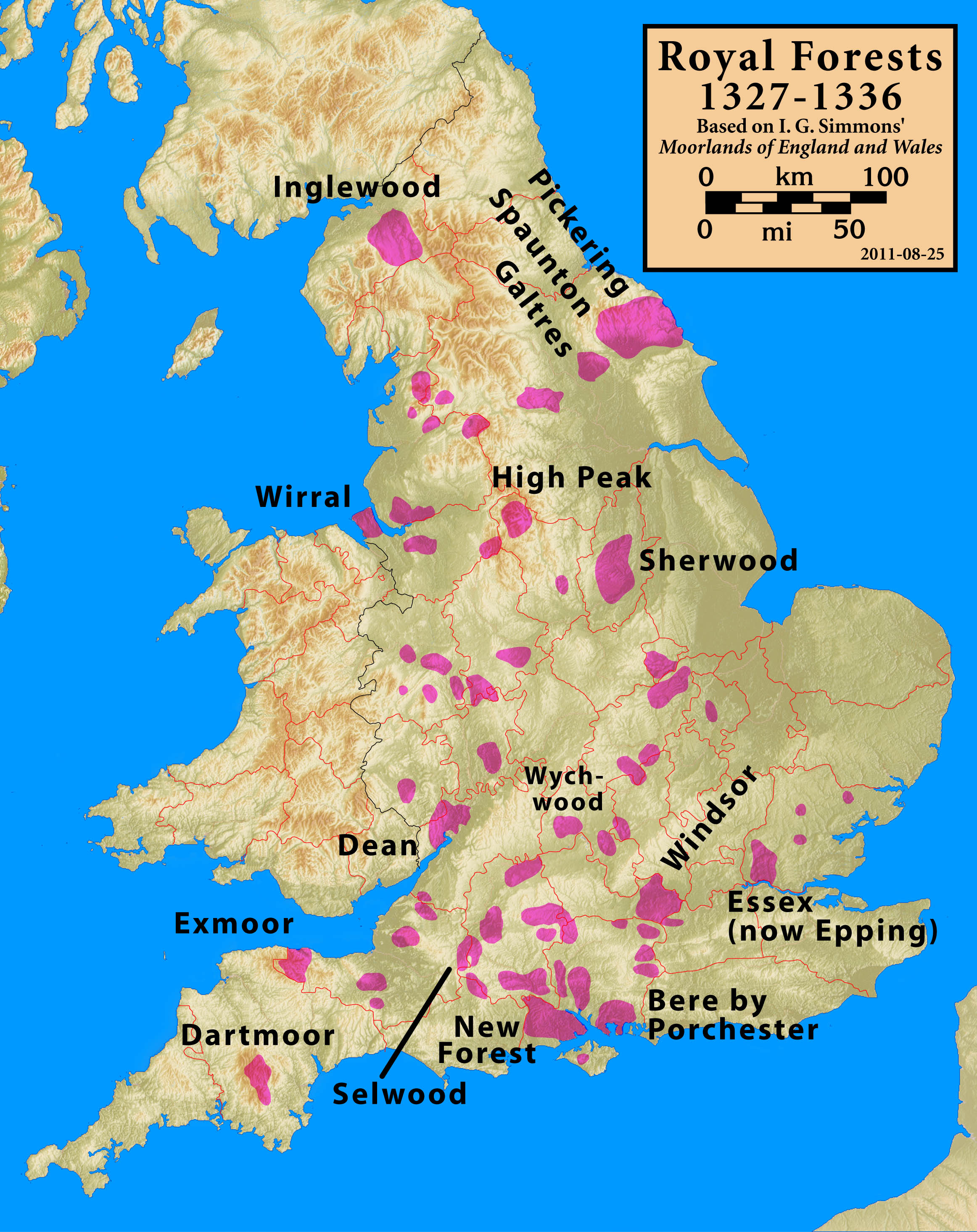
Peter, thank you for this helpful and interesting information. It gives me much better insight about regarders and the context of their work. Is it fair to say that Sherwood Forest was among the best known of the King's Forests, way back when, or am I
just thinking that because of Robin Hood?
Others here are bound to know more than I do about Sherwood - all I can
report is copy-pasted from a scan of Charles Young's book, as cited above:
p. 10: "there is no mention of Sherwood Forest [in Domesday Book], and
its condition in the eleventh century can only be a matter of speculation"
p. 84: "In Sherwood Forest some of the foresters in fee held bailiwicks
large enough to need a riding forester, two foot foresters, and some
boys for their administration."
p. 99 (table from the eyre rolls): in 1263-87 Sherwood averaged 8 cases
per year for "trespass of venison", more than any of the 12 other
forests listed - e.g. the New Forest averaged 4 cases per year from
1270-1280.
p. 125: "In 1298 Richard Oysel was commissioned to sell trees, wood, and underwood up to two thousand pounds in the forests, hayes, chaces,
parks, and woods of the king south of the Trent. In Sherwood Forest he
sold almost six thousand oaks along with other wood and underwood for
almost £718, and in various other royal woods and parks his sales
amounted to three hundred pounds. Three years later he added another
£273 from woods and parks in Northamptonshire and Lincolnshire." It
isn't clear to me that the £718 from Sherwood north of the Trent was considered as part of the amount required from forests south of the Trent.
pp. 129: "Agistment in the larger Sherwood Forest to the north was more profitable [than in Groveley and Clarendon forests], yielding an average
annual income of £3 12s. 6d ... Nevertheless, even small sums over these periods of time did add up to respectable totals of more than 23 pounds
for Groveley, 71 pounds for Clarendon, and 211 pounds for Sherwood."
pp. 162-163: "In 1323 Edward II ordered William de Vescy and his fellow justices to hold an inquest into the office of the warden of Sherwood
Forest ... He held ten knights' fees in chief, and all his lands were
outside the regard and his dogs exempt from being lawed. At the last
eyre it had been determined by William and his fellow justices that the bailiwick was held by the warden and his heirs in perpetuity. Eleven
years later an examination of rolls by the treasurer and chamberlains
proved equally effective in determining why the office of a forester in
fee within Sherwood had been taken into the king's hands by Edward II
and remained there under his son. This searching of the records showed
that the man's father had appeared before William de Vescy and fellows
in a forest eyre to account for his tenure and that of his father by
producing rolls in which he was found to have made erasures to the great
damage of the king and, thus, forfeited his office."
You may find useful information here:
https://archive.org/details/selectpleasoffor00grearich/page/n277/mode/2up
and elsewhere in the same book.
Peter Stewart
--- SoupGate-Win32 v1.05
* Origin: fsxNet Usenet Gateway (21:1/5)