David P. wrote:
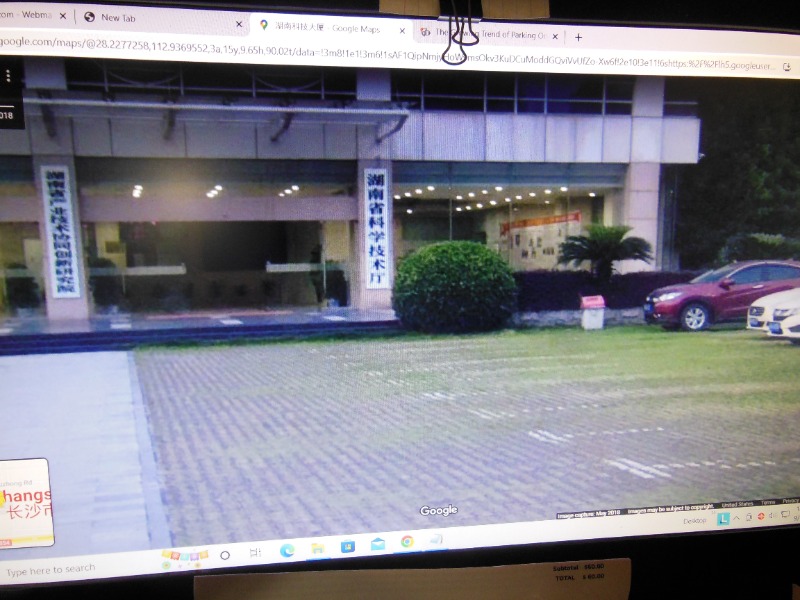
https://imagehost.vendio.com/a/30377179/view/grass-lot-changsha.JPG
---------------
Changsha has a history of more than 2,400 years of urban construction,[10] and the name "Changsha" first appeared in the Yi Zhou Shu (逸周书)written in the pre-Qin era.[11] In the Qin Dynasty, the Changsha Commandery was set up, and in the Western
Han Dynasty, the Changsha Kingdom was established. The Tongguan Kiln in Changsha during the Tang Dynasty produced the world's earliest underglaze porcelain, which was exported to Western Asia, Africa and Europe.[12] In the Period of Five Dynasties,
Changsha was the capital of Southern Chu. In the Northern Song Dynasty, the Yuelu Academy (later become Hunan University) was one of the four major private academies over the last 1000 years,[13] with the famous couplet "惟楚有才, 于斯为盛" (Only
Chu has talent, and it is flourishing in this area) coming down to modern times. In the late Qing Dynasty, Changsha was one of the four major trade cities for rice and tea in China.[14] In 1904, it was opened to foreign trade, and gradually became a
revolutionary city. In Changsha, Tan Sitong established the School of Current Affairs, Huang Xing founded the China Arise Society with the slogan "Expel the Tatar barbarians and revive Zhonghua" (驱除鞑虏,复兴中华), and Mao Zedong also carried
out his early political movements here. During the Republican Era, Changsha became one of the major home fronts in the Second Sino-Japanese War, but the subsequent Wenxi Fire in 1938 and the three Battles of Changsha from 1939 to 1942 (1939, 1941 and
1941–42) hit Changsha's economy and urban construction hard.[15]
Changsha is now one of the core cities in the Yangtze River Economic Belt and the Belt and Road Initiative,[16][17] a Beta- (global second-tier) city by the GaWC,[18] a new Chinese first-tier city[19][20] and also a pioneering area for China-Africa
economic and trade cooperation.[21] As of 2020, Changsha Huanghua International Airport was one of the 40 busiest airports in the world.[22] Known as the "Construction machinery capital of the world", Changsha has an industrial chain with construction
machinery and new materials as the main industries, complemented by automobiles, electronic information, household appliances, and biomedicine.[23][24] Since the 1990s, Changsha has begun to accelerate economic development, and then achieved the highest
growth rate among China's major cities during the 2000s.[25] The Xiangjiang New Area, the first state-level new area in Central China, was established in 2015.[26] As of 2020, more than 164 Global 500 companies have established branches in Changsha.[27]
The city has the 29th largest skyline in the world.[28] The HDI of Changsha reached 0.817 (very high) in 2019, which is roughly comparable to a moderately developed country.[29][30]
The city houses four Double First-Class Universities: Hunan, National University of Defense Technology, Central South, and Hunan Normal, making Changsha the seat of several highly ranked educational institutions,[31][32] and a major centre of research
and innovation in the Asia-Pacific with a high level of scientific research, ranking 41st globally in 2020.[33] Changsha is the birthplace of super hybrid rice, the Tianhe-1 supercomputer, China's first laser 3D printer,[34] and China's first domestic
medium-low speed maglev line.[35] Changsha has been named the first "UNESCO City of Media Arts" in China.[36] Changsha is home to Hunan Broadcasting System (HBS), the most influential provincial TV station in China.[37][38]
--- SoupGate-Win32 v1.05
* Origin: fsxNet Usenet Gateway (21:1/5)