Den 05.09.2024 23:04, skrev Richard Hachel:
Le 05/09/2024 à 22:47, "Paul.B.Andersen" a écrit :
What is "relativistic observation"?
We call "relativistic observations" observations whose relativistic effects become noticeable due to the speed.
OK.
The issue is telescope observations of moving celestial objects.
The object must obviously radiate or reflect em-radiation
(light, radio frequencies) to be observable in a telescope.
The only parameter related to motion that can be observed with
a telescope is the angular velocity, that is the angle ϕ to
the object is measured two or more times and the rate of change
with respect to time dϕ/dt is calculated.
The transverse component (transverse to the line of sight) of
the object's velocity is then the angular velocity multiplied
by the distance d to object, Vtrans = d⋅dϕ/dt
If the velocity of the object is transverse to the line of
sight and the object is moving in a straight line,
then d⋅dϕ/dt is the exact transverse velocity because the delay emission-detection is the same for all observations of ϕ.
But if the velocity of the object has an angle θ to the line
of sight, then the delay emission-detection may be different
for the different observations of ϕ, and the calculated
dϕ/dt will not be the correct angular velocity, and d⋅dϕ/dt
may not be the correct transverse component of the object's
velocity. We will call it "the apparent speed" v_app.
Let an object be moving somewhere in the universe.
We have two observations of the object, A and B.
The object has moved from A to B with the speed v
between the observations.
A
|\
| \
| \
| C \L
| \
| \
| \
|-------B
|
|
|
V
far away observer
(parallax can be ignored)
The observed time interval between reception of light emitted
from A and B (distance L) will be:
tₒ = L/v - L⋅cos(θ)/c = (L/v)⋅(1 - (v/c)⋅cos(θ))
The transverse distance between A and B is: L⋅sin(θ)
The apparent transverse speed will be the transverse distance
divided by the time interval tₒ :
v_app = L⋅cos(θ)/tₒ = v⋅sin(θ)/(1 - (v/c)⋅cos(θ)) (1)
---------
Let the moving object be a star.
(We will come back to faster objects later.)
The angular velocity of the star is called the "proper motion" of
the star, and is a parameter which is found in the star catalogues.
A concrete example:
Barnard's Star has a proper motion 10.3"/y = 4.9936E-5 rad/y.
The distance to the star is L = 5.96 ly
The observed transverse speed is
Vtrans = (5.96 ly)(4.9936E-5 rad/y) = 297.619E-6 ly/y = 89.223 km/s
Since Vtrans << c (1) can be simplified to
v_app = v⋅sin(θ) = 89.223 km/s
In this case 89.223 km/s is the real transverse speed of the star.
There is nothing "apparent" about it.
--------------
But there are much faster objects in the universe.
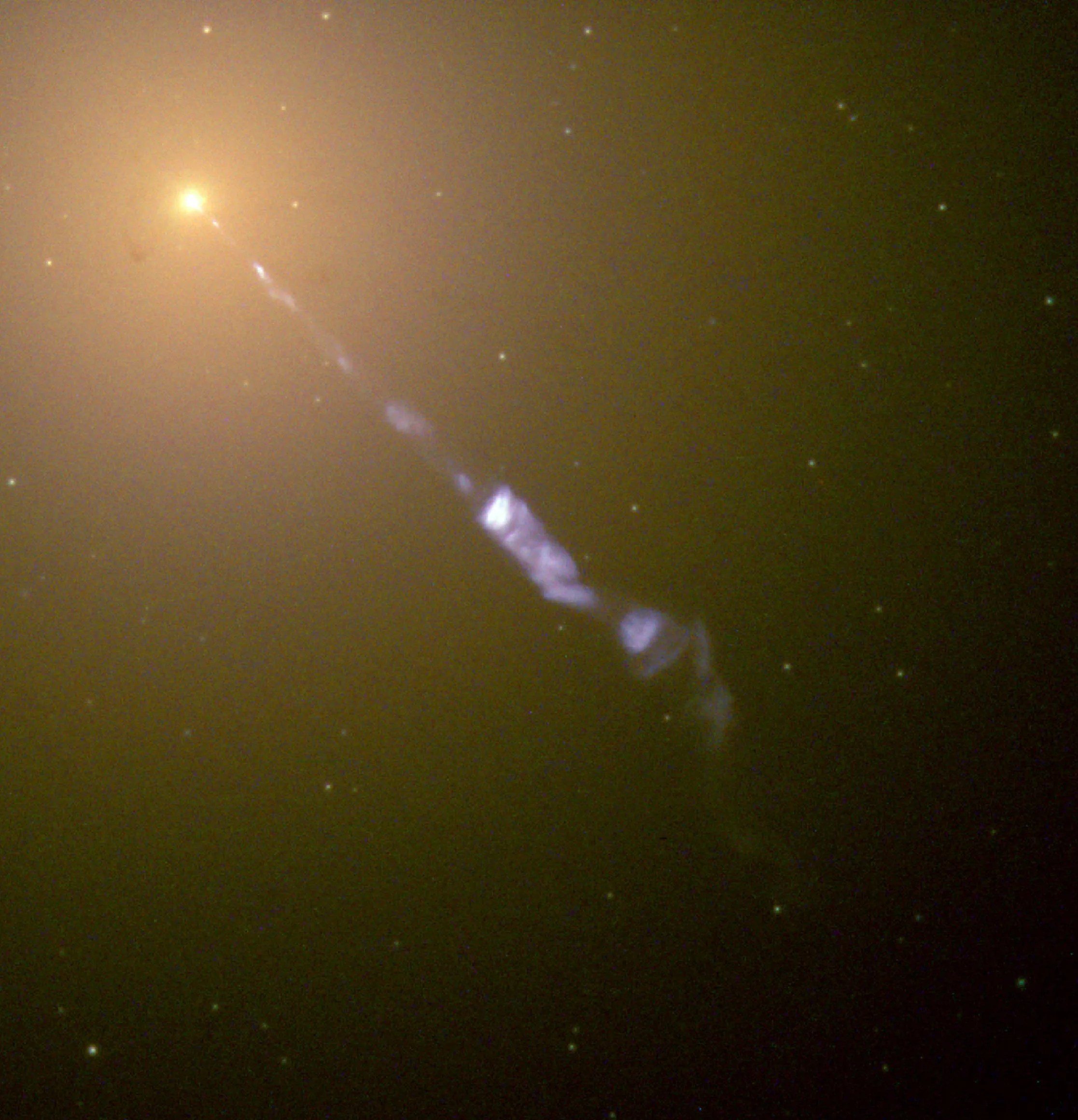
Some galaxies (quasars) have jets of matter emitted from the central
black hole. Matter in the jets is moving at high speed.
As this matter ploughs through the intergalactic medium (very thin gas), radiation - mostly at radio frequencies but also light - is emitted.
It is this radiation and not the matter itself that is observed.
The stream of matter is however not very steady. There may be "blobs"
of matter in the jets which will be visible in the observed radiation.
These "blobs" are observed to move, and it is supposed that the matter
in the jets move with the same speed as the observed "blobs".
M87 is such a galaxy:
https://science.nasa.gov/wp-content/uploads/2023/04/m87-jet-jpg.webp
The distance to M87 is d = 53e6 ly
The radial velocity of the blobs is dϕ/dt = 1.14e-7 rad/y
v_app = d⋅dϕ/dt ≈ 6 ly/y = 6c
--
Paul
https://paulba.no/
--- SoupGate-Win32 v1.05
* Origin: fsxNet Usenet Gateway (21:1/5)