• Chemical Systems Violate the Second Law of Thermodynamics

    From Pentcho Valev@21:1/5 to All on Sat Feb 5 08:32:57 2022
    Countless materials reversibly contract and swell as a chemical agent (e.g. hydrogen ions) is added to and then removed from the system:

    https://www.researchgate.net/figure/Illustration-of-a-volume-transition-in-a-cross-linked-polybase-network-triggered-by-a-pH_fig1_47426820

    These materials can, in principle, convert ambient heat into work cyclically and isothermally, in violation of the second law of thermodynamics. Here are two illustrations of how, by adding and removing hydrogen ions (H+), one can extract work from pH-
    sensitive polymers:

    Figure 4 here: https://www.ncbi.nlm.nih.gov/pmc/articles/PMC1367611/pdf/biophysj00645-0017.pdf

    Figure 16A here: https://pubs.acs.org/doi/pdf/10.1021/jp972167t.

    Adding and removing H+, per se, consumes no work if done QUASISTATICALLY. This means that the work lost e.g. in adding is compensated by the work gained in removing, and the net work involved is zero. So lifting a weight is the net work extracted from
    the cycle. The second law of thermodynamics is clearly violated.

    See more here: https://twitter.com/pentcho_valev

    Pentcho Valev

    --- SoupGate-Win32 v1.05
    * Origin: fsxNet Usenet Gateway (21:1/5)
  • From Pentcho Valev@21:1/5 to All on Sun Feb 6 01:57:37 2022
    An obviously absurd corollary of the second law of thermodynamics:

    "The use of a catalyst does not affect the position and composition of the equilibrium of a reaction, because both the forward and backward reactions are sped up by the same factor." https://en.wikipedia.org/wiki/Le_Chatelier%27s_principle

    Scientists should have noticed the obvious absurdity of this particular corollary of the second law of thermodynamics long ago, and applied reductio ad absurdum: Since the corollary is absurd, the underlying premise, the second law of thermodynamics, is
    false. Consider the dissociation-association reaction

    A ⇌ B + C

    which is in equilibrium. We add a catalyst and it starts splitting A - the rate constant of the forward (dissociation) reaction increases by a factor of, say, 745492. If the second law of thermodynamics is obeyed, the catalyst must increase the rate
    constant of the reverse (association) reaction by exactly the same factor, 745492. But this is insane! The reverse reaction is entirely different from the forward one: B and C must first get together, via diffusion, and only then can the catalyst join
    them to form A. Catalysts don't speed up diffusion!

    Far from speeding up the forward and reverse reactions "by the same factor", here a catalyst speeds up only the forward, 2H+ → H_2, and SUPPRESSES the reverse reaction, H_2 → 2H+ (violation of the second law of thermodynamics par excellence):

    Yu Hang Li et al. Unidirectional suppression of hydrogen oxidation on oxidized platinum clusters https://www.nature.com/articles/ncomms3500

    More here: https://twitter.com/pentcho_valev

    Pentcho Valev

    --- SoupGate-Win32 v1.05
    * Origin: fsxNet Usenet Gateway (21:1/5)
  • From Pentcho Valev@21:1/5 to All on Sun Feb 6 08:31:29 2022
    That catalysts can shift chemical equilibrium, thereby violating the second law of thermodynamics, was my first heretical idea, about 30 years ago. Journals used to reject my submissions, as it were, before receiving them. Still the idea is correct:

    https://youtu.be/usAPBgT3aDc?t=1101

    "In 2000, a simple, foundational thermodynamic paradox was proposed: a sealed blackbody cavity contains a diatomic gas and a radiometer whose apposing vane surfaces dissociate and recombine the gas to different degrees (A_2 ⇌ 2A). As a result of
    differing desorption rates for A and A_2 , there arise between the vane faces permanent pressure and temperature differences, either of which can be harnessed to perform work, in apparent conflict with the second law of thermodynamics. Here we report on
    the first experimental realization of this paradox, involving the dissociation of low-pressure hydrogen gas on high-temperature refractory metals (tungsten and rhenium) under blackbody cavity conditions. The results, corroborated by other laboratory
    studies and supported by theory, confirm the paradoxical temperature difference and point to physics beyond the traditional understanding of the second law." https://link.springer.com/article/10.1007/s10701-014-9781-5

    "A simple device is introduced that utilizes the phenomenon of epicatalysis to establish a stationary temperature difference by which ambient environmental thermal energy might be converted into useful work. [...] Traditional catalysis is a central pivot
    around which much of the industrial and biological worlds turn. Positive catalysts satisfy three general principles. First, they increase reaction rates by providing lower activation energies for rate-limiting steps. Second, they are not consumed by
    their net reactions although they are intimately involved in them. Third, they do not alter final thermodynamic equilibria of their reactions. Epicatalysts bend this third principle in that they shift the final gas-phase equilibria of reactions." D. P.
    Sheehan, T. M. Welsh, Epicatalytic thermal diode: Harvesting ambient thermal energy, Sustainable Energy Technologies and Assessments, Volume 31, February 2019, Pages 355-368 https://www.sciencedirect.com/science/article/pii/S2213138818301838

    There is no separate group of "epicatalysts" - actually all catalysts shift the equilibrium and so violate the second law of thermodynamics (even though in most cases the effect is difficult to detect). I believe that a major function of enzymes, apart
    from speeding up metabolic reactions, is to make some of these reactions unidirectional: the forward reaction is catalyzed, the reverse is not.

    See more: https://twitter.com/pentcho_valev

    Pentcho Valev

    --- SoupGate-Win32 v1.05
    * Origin: fsxNet Usenet Gateway (21:1/5)
  • From Pentcho Valev@21:1/5 to All on Sat Feb 18 15:41:20 2023
    Countless macroscopic materials reversibly contract and then swell (or vice versa) as the concentration of a chemical agent increases and then decreases:

    https://www.researchgate.net/profile/Paul-Topham/publication/47426820/figure/fig1/AS:307404580376582@1450302371395/Illustration-of-a-volume-transition-in-a-cross-linked-polybase-network-triggered-by-a-pH.png

    These materials can obviously do mechanical work. Here are two illustrations of how, by concentrating and deconcentrating the chemical agent (hydrogen ions), one can cyclically extract work from pH-sensitive macroscopic polymers able to lift weights:

    Figure 4 here: https://www.ncbi.nlm.nih.gov/pmc/articles/PMC1367611/pdf/biophysj00645-0017.pdf

    The upper picture here:

    https://pubs.acs.org/cms/10.1021/jp972167t/asset/images/medium/jp972167tf00016.gif

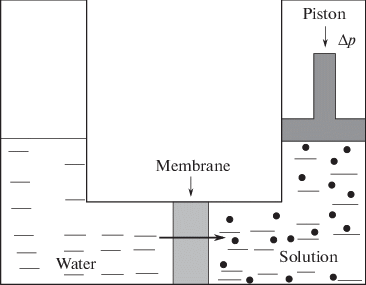
    Concentrating and then deconcentrating a chemical agent, just like compressing and then expanding a gas, if performed quasistatically and isothermally, involves zero net work (the work lost in concentrating is compensated by the work gained in
    deconcentrating). For instance, one can imagine that the polymer is placed in the solution compartment here (we assume that the membrane is permeable to water but impermeable to the solute, the hydrogen ions):

    https://media.springernature.com/lw685/springer-static/image/art%3A10.1134%2FS0012501619010019/MediaObjects/10634_2019_10004_Fig1_HTML.gif

    Clearly, lifting the weight is the net work done by the isothermal cycle, in obvious violation of the second law of thermodynamics.

    Pentcho Valev https://twitter.com/pentcho_valev

    --- SoupGate-Win32 v1.05
    * Origin: fsxNet Usenet Gateway (21:1/5)
  • From Pentcho Valev@21:1/5 to All on Sun Feb 19 02:54:26 2023
    An absurd consequence of the second law of thermodynamics is that catalysts accelerate the forward and backward reactions "equally", "by the same factor":

    "Suppose that, as indicated in the figure, the catalyst affects only the forward reaction. In its presence, the sum of the forward rates would clearly be larger than otherwise, while the backward rate would be unchanged. The position of equilibrium would
    therefore shift to the right, by the law of mass action. If we suppose further that the reaction produces heat q when it occurs, then a violation of the second law would be possible. We first allow equilibrium to be reached without the catalyst...and
    then add the catalyst, and heat δq is produced as the equilibrium is shifted. This heat is used to run a machine, and thus do work, cooling the system back to its original temperature in the process. We then remove the catalyst and the equilibrium
    shifts back. Heat δq is now extracted from the surroundings, which must warm the system back to the ambient temperature. A cycle has therefore been completed for which the net effect has been the isothermal conversion of heat energy into work, and a
    perpetual motion machine of the second kind has been found. We conclude that the supposed situation is impossible and that the catalyst must accelerate the forward and backward reactions equally." https://dtk.tankonyvtar.hu/bitstream/handle/123456789/
    8903/B9780120442621500128.pdf

    "It is important to recognize that when an enzyme (or any catalyst) lowers the activation energy for the reaction A → B, it also lowers the activation energy for the reaction B → A by exactly the same amount (see Figure 2-44). The forward and
    backward reactions will therefore be accelerated by the same factor by an enzyme..." https://www.ncbi.nlm.nih.gov/books/NBK26838/

    Scientists should have exposed the absurdity of this particular consequence of the second law long ago, and should have applied reductio ad absurdum: Since the consequence is absurd, the underlying premise, the second law of thermodynamics, is false.

    Consider the dissociation-association reaction

    A ⇌ B + C

    which is in equilibrium. We add a catalyst and it starts splitting A - the rate constant of the forward (dissociation) reaction increases by a factor of, say, 745492. If the second law of thermodynamics is obeyed, the catalyst must increase the rate
    constant of the reverse (association) reaction by exactly the same factor, 745492. But this is insane! The reverse reaction is entirely different from the forward one: B and C must first get together, via diffusion, and only then can the catalyst join
    them to form A. Catalysts don't speed up diffusion!

    There are countless examples of biased and even unidirectional catalysis in the literature but in most cases the available information does not allow one to unequivocally conclude that the second law is violated. There are exceptions of course:

    "In 2000, a simple, foundational thermodynamic paradox was proposed: a sealed blackbody cavity contains a diatomic gas and a radiometer whose apposing vane surfaces dissociate and recombine the gas to different degrees (A_2 ⇌ 2A). As a result of
    differing desorption rates for A and A_2 , there arise between the vane faces permanent pressure and temperature differences, either of which can be harnessed to perform work, in apparent conflict with the second law of thermodynamics. Here we report on
    the first experimental realization of this paradox, involving the dissociation of low-pressure hydrogen gas on high-temperature refractory metals (tungsten and rhenium) under blackbody cavity conditions. The results, corroborated by other laboratory
    studies and supported by theory, confirm the paradoxical temperature difference and point to physics beyond the traditional understanding of the second law." https://link.springer.com/article/10.1007/s10701-014-9781-5

    "A simple device is introduced that utilizes the phenomenon of epicatalysis to establish a stationary temperature difference by which ambient environmental thermal energy might be converted into useful work...Traditional catalysis is a central pivot
    around which much of the industrial and biological worlds turn. Positive catalysts satisfy three general principles. First, they increase reaction rates by providing lower activation energies for rate-limiting steps. Second, they are not consumed by
    their net reactions although they are intimately involved in them. Third, they do not alter final thermodynamic equilibria of their reactions. Epicatalysts bend this third principle in that they shift the final gas-phase equilibria of reactions." D. P.
    Sheehan, T. M. Welsh, Epicatalytic thermal diode: Harvesting ambient thermal energy, Sustainable Energy Technologies and Assessments, Volume 31, February 2019, Pages 355-368 https://www.sciencedirect.com/science/article/pii/S2213138818301838

    "A research team from three U.S. Department of Energy (DOE) national laboratories and four universities found that subtle changes to the environment surrounding some enzymes can not only change the rate of a cellular reaction by a staggering six orders
    of magnitude but also its direction. That reversal—the root of the catalytic bias dilemma—is like speeding in one direction at 10 miles-per-second, then going in the opposite direction at 1,000,000 miles-per-second." https://www.pnnl.gov/news-media/
    remarkable-rate-return-catalytic-bias

    Far from accelerating the forward and backward reactions "equally", in this experiment

    Yu Hang Li et al. Unidirectional suppression of hydrogen oxidation on oxidized platinum clusters https://www.nature.com/articles/ncomms3500

    a catalyst accelerates only the forward reaction, 2H+ → H_2, and SUPPRESSES the backward reaction, H_2 → 2H+. Violation of the second law par excellence.

    Pentcho Valev https://twitter.com/pentcho_valev

    --- SoupGate-Win32 v1.05
    * Origin: fsxNet Usenet Gateway (21:1/5)