• Variable orbital speed of the Earth

    From Gerald Kelleher@21:1/5 to All on Thu Apr 20 06:54:17 2023
    An astronomical axiom is that the closer to the Sun, the faster a planet moves.

    With the emergence of the solar system where the Sun moves in one direction in our galactic orbital motion while the planets move with the Sun for part of their orbital period and in the opposite for another part.

    Whatever the forces as the cause of the Earth and the other planets orbiting the Sun, the additional forces acting on the solar system's galactic orbital motion are bound to deliver a variable outcome for planetary orbital motions.

    It is not possible to exclude or talk a way out of omitting the solar system's galactic orbital forces.

    --- SoupGate-Win32 v1.05
    * Origin: fsxNet Usenet Gateway (21:1/5)
  • From Martin Brown@21:1/5 to Gerald Kelleher on Thu Apr 20 20:37:56 2023
    On 20/04/2023 14:54, Gerald Kelleher wrote:

    An astronomical axiom is that the closer to the Sun, the faster a planet moves.

    The astronomical "axiom" as you call it stems from the strict rule of conservation of angular momentum and conservation of energy.

    The same rule that makes ice dancers and ballerinas spin faster as they
    bring their arms in (or stars into pulsars in the astronomical context).

    [snip incoherent utter bollocks (TM)]

    Invariants like the conservation of energy, momentum and angular
    momentum are about the most powerful laws of physics that there are.

    Superstitious nincompoops not withstanding.

    --
    Martin Brown

    --- SoupGate-Win32 v1.05
    * Origin: fsxNet Usenet Gateway (21:1/5)
  • From Gerald Kelleher@21:1/5 to Martin Brown on Thu Apr 20 23:10:15 2023
    On Thursday, April 20, 2023 at 8:38:01 PM UTC+1, Martin Brown wrote:
    On 20/04/2023 14:54, Gerald Kelleher wrote:

    An astronomical axiom is that the closer to the Sun, the faster a planet moves.
    The astronomical "axiom" as you call it stems from the strict rule of conservation of angular momentum and conservation of energy.

    The same rule that makes ice dancers and ballerinas spin faster as they bring their arms in (or stars into pulsars in the astronomical context).

    [snip incoherent utter bollocks (TM)]

    Invariants like the conservation of energy, momentum and angular
    momentum are about the most powerful laws of physics that there are.

    Superstitious nincompoops not withstanding.

    --
    Martin Brown

    Thanks for the colourless jargon wrapped up in a spectacular rant; however, this is for solar system and galactic researchers rather than experimental ballerinas although no such researchers exist, at least at present. I wouldn't even bother with the
    late 17th-century notion of the Earth falling around the Sun or its contrived jargon of angular momentum, it makes more sense to return to the antecedent approach that the Earth and other planets follow a path roughly consistent with the Sun's rotation
    and, as far as I know, expressed by Kepler-

    "The Sun and the Earth rotate on their own axes...The purpose of this motion is to confer motion on the planets located around them; on the six primary planets in the case of the Sun, and on the moon in the case of the Earth. On the other hand, the moon
    does not rotate on the axis of its own body, as its spots prove " Kepler

    This is extended to the motion of the entire solar system around the galactic centre and introduces variables such as planetary speeds and a default geometry that is currently described as elliptical.

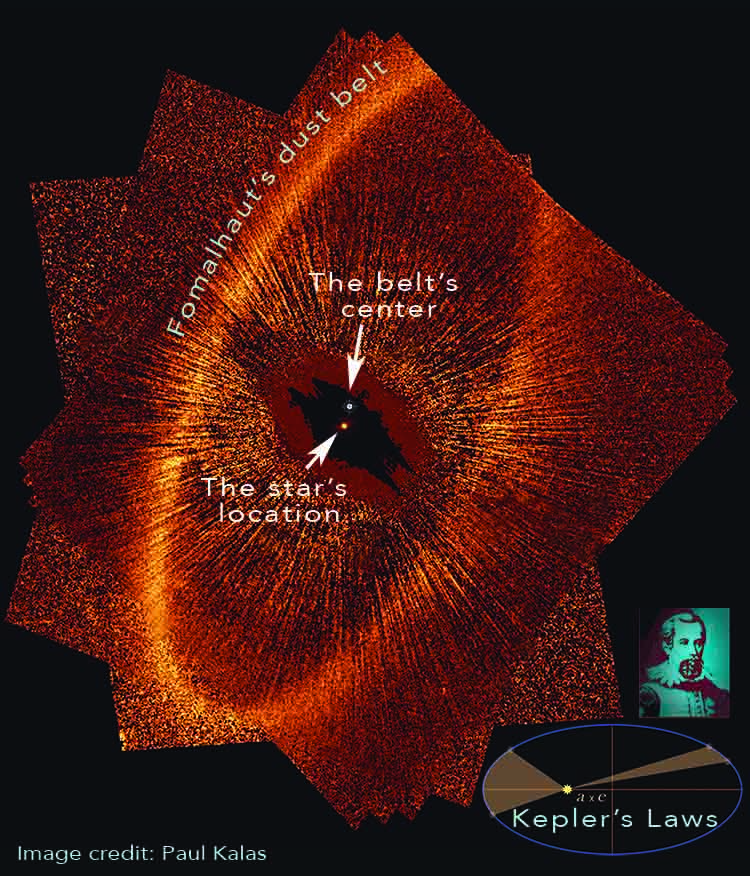
    https://w.astro.berkeley.edu/~kalas/wp-content/uploads/Paul_Kalas_Fomalhaut-1.jpg

    Kepler wrote no laws- that was done by later mathematical theorists following the equivalent of Brexiteers of astronomy, in this case, Isaac Newton who conjured up a false equivalency and attributed it to Kepler-

    "That the fixed stars being at rest, the periodic times of the five primary planets, and (whether of the sun about the Earth or) of the earth about the Sun, are in the sesquiplicate proportion of their mean distances from the Sun...This proportion, first
    observed by Kepler, is now received by all astronomers; for the periodic times are the same, and the dimensions of the orbits are the same, whether the Sun revolves about the Earth, or the Earth about the Sun." Newton

    The astronomical axiom within a Ptolemaic framework that the Earth orbits the Sun is drawn from a hypothesis from the Copernican era that the Sun passes the twelve constellations in an orbit and transferred to the Earth's motion through the same-

    "Here take notice, that the Sun or the Earth passeth the 12. Signes, or makes an entire revolution in the Ecliptick in 365 days, 5 hours 49 min. or there about, and that those days, reckon'd from noon to noon, are of different lenghts; as is known to all
    that are vers'd in Astronomy" Huygens

    https://adcs.home.xs4all.nl/Huygens/06/kort-E.html

    I do not care if mathematicians make a living by chanting voodoo to a public who are disinterested; however, I do care what was destroyed to make way for what is contrived rubbish at the expense of astronomy. Unfortunately and after 250+ years, there
    may be nobody left with the perceptive abilities to look at solar system and galactic research with fresh eyes.

    --- SoupGate-Win32 v1.05
    * Origin: fsxNet Usenet Gateway (21:1/5)
  • From Gerald Kelleher@21:1/5 to Martin Brown on Thu Apr 20 22:37:58 2023
    On Thursday, April 20, 2023 at 8:38:01 PM UTC+1, Martin Brown wrote:
    On 20/04/2023 14:54, Gerald Kelleher wrote:

    An astronomical axiom is that the closer to the Sun, the faster a planet moves.
    The astronomical "axiom" as you call it stems from the strict rule of conservation of angular momentum and conservation of energy.

    The same rule that makes ice dancers and ballerinas spin faster as they bring their arms in (or stars into pulsars in the astronomical context).

    [snip incoherent utter bollocks (TM)]

    Invariants like the conservation of energy, momentum and angular
    momentum are about the most powerful laws of physics that there are.

    Superstitious nincompoops not withstanding.

    --
    Martin Brown

    --- SoupGate-Win32 v1.05
    * Origin: fsxNet Usenet Gateway (21:1/5)
  • From Quadibloc@21:1/5 to Gerald Kelleher on Mon Apr 24 01:57:29 2023
    On Friday, April 21, 2023 at 12:10:17 AM UTC-6, Gerald Kelleher wrote:
    I wouldn't even bother with the late 17th-century notion of the Earth
    falling around the Sun or its contrived jargon of angular momentum,

    Why you consider basic mechanics to be "contrived rubbish", whether
    out of an animus to Isaac Newton, or a refusal to concede validity to mathematics which you are incapable of understanding, hardly matters.

    It will go on without you.

    John Savard

    --- SoupGate-Win32 v1.05
    * Origin: fsxNet Usenet Gateway (21:1/5)
  • From Gerald Kelleher@21:1/5 to All on Sat Apr 29 00:06:48 2023
    It is an attractive proposition to include variables that emerge as a combination of planetary motions around our parent star while the entire solar system also moves as a function of our galactic structure. It is difficult to see how anyone could be
    exempt from any influence of the galactic orbital component apart from cutting off their nose to spite their face. Obviously, some will due to the allegiance to late 17th century mathematicians who managed to boost themselves at the expense of genuine
    research and all the build-up of observational data since then.

    Only the most diehard theorist could avoid the moribund nature of their approach to cosmological structures so these people will register a common sense speculative approach as an assault, however, the idea is attractive and very hard to ignore.

    --- SoupGate-Win32 v1.05
    * Origin: fsxNet Usenet Gateway (21:1/5)