On Wednesday, April 19, 2023 at 2:57:03 AM UTC+1, palsing wrote:
On Tuesday, April 18, 2023 at 10:12:38 AM UTC-7, Gerald Kelleher wrote:
On Tuesday, April 18, 2023 at 5:17:37 PM UTC+1, palsing wrote:
On Monday, April 17, 2023 at 11:06:38 PM UTC-7, Gerald Kelleher wrote:
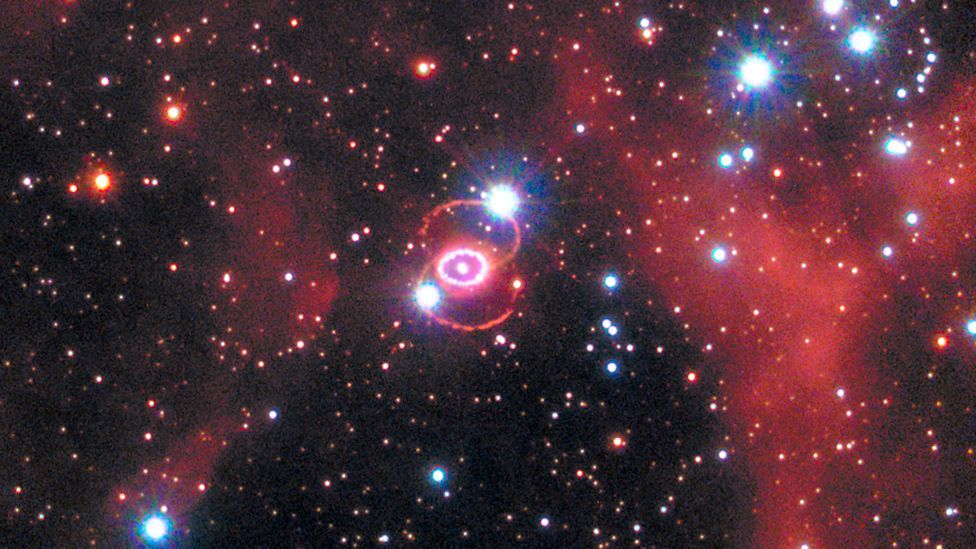
When the images of SN1987a appeared four years after I was working with the rings, it added to the consideration of certain Supernova events as transition phases rather than the end of a life cycle as I know experimental theorists can't reason
outside their belief that everything explodes and dies, from their big bang conviction to stellar evolution.
I don't know what you mean when you claim that "I was working with the rings". I suppose that you thought they looked like orbits and jumped to the conclusion that it was a solar system in the making. Again, there is zero evidence to support that
idea.
Do you have any idea about the scale of those rings, their actual size? Read this, which was written in 1990...
https://hubblesite.org/contents/media/images/1990/17/20-Image.html
... where you will see that those rings were expanding at that time at up to about 18,000 miles per second! The diameter of those rings at that time was about 1.5 light years! Here we are 33 years later, so how big do you suppose that diameter is
now? Probably several light years, at least. Do you *still* think that this is a solar system in the making? Also, if the progenitor star survived at all, it is either a pulsar, a neutron star or a black hole, with each being unsuitable for the birth of
a solar system.
When I said your claim was ignorant I only implying that it was made by a person with no formal education in the subject matter. Your guesses are not valid theories since they are not accompanied by experiments and/or observations.
Stellar evolution has a particular geometry whether it was a post-supernova star like SN1987a or a pre-supernova star like Eta Carinae-
https://upload.wikimedia.org/wikipedia/commons/f/fc/Eta_Carinae.jpg
I do what I do because my formal education is from the original astronomers and their actual perspectives rather than mathematical impostors, hence I have zero interest in appealing to those who project authority and integrity but lack a basic
appreciation of planetary and solar system facts.
As a supernova star can be isolated as an object and its evolution traced using its geometry, it is the one bright spot that mathematicians have but, because they have hollowed out geometry since the Victorian age, they are unable to follow the logic
of density/volume imbalances involved in a supernova event.
I could have included the Oort cloud much less the close asteroid belt as signatures of this scheme do exist-
https://encrypted-tbn0.gstatic.com/images?q=tbn:ANd9GcRKhToKaEF-DHX5-MiIysjpjg66UV_-Ilq2dw&usqp=CAU
https://ichef.bbci.co.uk/news/976/cpsprodpb/1017A/production/_109741956_50473482.jpg
The physical consideration of a star moving in its galactic orbital motion along with the other stars also provides a basis for the transition of a pre-supernova star to a solar system star and this includes our own Sun.
So, less ugly language about ignorance and more reasoning at a higher level where astronomical considerations dwell.
Gerald, you *completely* side-stepped my direct question... "... where you will see that those rings were expanding at that time at up to about 18,000 miles per second! The diameter of those rings at that time was about 1.5 light years! Here we are 33
years later, so how big do you suppose that diameter is now? Probably several light years, at least. Do you *still* think that this is a solar system in the making? Also, if the progenitor star survived at all, it is either a pulsar, a neutron star or a
black hole, with each being unsuitable for the birth of a solar system."
I know, it is a really tough question to dismiss... "Do you *still* think that this is a solar system in the making?" I will assume that you have no logical response... which is exactly what I would expect from anyone who makes such a claim.
The rings are a feature of stellar evolution before and after the supernova event-
https://www.youtube.com/watch?v=g12g2Nq3_2I
The rings light up as a fixed feature of the post-supernova event so I doubt very much you have a handle on what a fixed feature represents.
This is not a contest. You have made an outrageously illogical claim and have no answer for it except to deflect. I fully understand you position. Believe me when I claim that you are definitely *not* reasoning on a higher level...
Of course, it is not a contest as I take a geometric approach to stellar evolution rather than flailing around with no centre/no circumference ideologies like a black hole as the hapless do. Unlike the resolution of direct/retrogrades into two distinct
perspectives depending on whether the planets move faster or slower than the Earth, this isolates a celestial body in terms of evolution so it is not anything like the big bang/black hole mess where no such distinctions are made.
I propose that certain supernova events represent a transition phase resulting in the birth of a solar system as opposed to the demise of a star. The geometry derived from representing 432° in 360° through the four angles of non-periodic tiling and by
the stellar competition between volume and density, resulted in the geometric structure of two large external rings and one smaller intersecting ring long before they were imaged by the Hubble.
I have zero interest in the lazy who follow a seriously limiting approach and have no feel for the role geometry plays in it all. Genuine researchers would find a lot to work with here even if the geometric reasoning behind the structure of the rings
will remain beyond them for quite some time if at all.
--- SoupGate-Win32 v1.05
* Origin: fsxNet Usenet Gateway (21:1/5)