On Thursday, January 5, 2023 at 7:10:51 AM UTC-7, Quadibloc wrote:
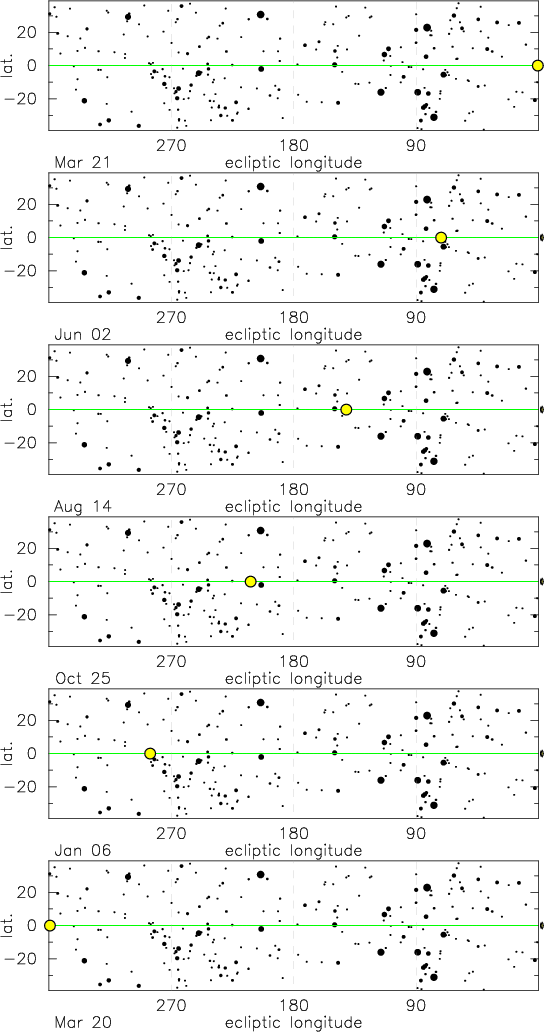
Astronomers view the Earth's rotation with respect to the fixed stars
as simple, because it is uniform - except for tiny variations caused
by momentum being transferred between the Earth and its atmosphere
due to seasonal changes in the wind. The Earth's rotation with respect
to the Sun, on the other hand, is complicated, as shown in the Equation
of Time, because the Earth's orbit is both elliptical and tilted with
respect to the Earth's equatorial plane.
As I've noted before, due to something that happened to me in Junior
High School, I am able to understand his point of view to an extent.
Our science textbooks included a little table of facts about the
Solar System. Across the top were the planets, from Mercury
to Pluto. Below them were rows giving various pieces of information
about them: their distances from the Sun, the lengths of their years,
their diameters, their masses, their surface gravities (perhaps), and
the "Length of Day" for each planet.
This was not only back when Pluto was a planet, it was also back
when it was believed that one side of Mercury always faced the
Sun, and was incredibly hot, while the other side was in perpetual
darkness and incredibly cold.
For the planet Earth, the length of the day was given as 23 hours and
56 minutes.
I happen to live on the planet Earth, and I can tell you that clocks here
take exactly 12 hours before their hands point in the same directions
again. Not 11 hours and 58 minutes. And so, if the day _was_ 23
hours and 56 minutes long, the time at which we ate lunch would
drift through the solar day in the course of a year, leading to people
having their meal at 12 noon... in the dark... six months after they
were eating it when the Sun was directly overhead (or, at least,
on the meridian, for those not living on the Equator).
But I eventually figured out what was going on. The length of the
day for Mercury was given as 88 days. Not _forever_, or infinity.
So the table was listing the *sidereal rotational periods* of the
planets, instead of the actual length of the day on those planets...
(at least, as best it was known at the time) because the people
who compiled the table were lazy.
Fine. Stuff like this happens.
And the fact that the 24 hour solar cycle is important and
fundamental to our daily lives, while the 23 hour and 56
minute (and 4 second!) "sidereal day" is a technical matter
only of concern to professional astronomers... does *not*
in any way stand in contradiction to the Earth's rotation,
in relation to the fixed stars, and hence to absolute space,
being the fundamental, simple, and uniform motion, while
the apparent path of the Sun in the sky corresponds to
a _compound_ motion, derived from *both* the Earth's
orbit and its rotation, which therefore is more complicated,
as reflected in the Equation of Time.
Because science probes more deeply into things, with
specialized tools like microscopes, and so naturally it
obtains greater knowledge than is accessible to ordinary
everyday observation, and which will sometimes contradict
surface appearances.
So there is nothing at all surprising that the length of the
day is 24 hours, and the Earth rotates once every 23 hours,
56 minutes and 4 seconds. Both of these statements are
facts, and both of them should be fully acknowledged as
true.
Ignoring the 24 hour day which regulates our daily lives
and fixating only on the sidereal rotational period would be
making exactly the opposite mistake as the one he makes,
and it would be just as wrong.
The time between the Sun being in the sky, giving us light
by which to see, and the stars being out at night, is a real
and very obvious phenomenon (except very near the poles)
and being aware of the underlying machinery behind it,
and the mathematics needed to work out how to correct
the time on sundials, and so on... doesn't make the cycle of
day and night go away.
John Savard
--- SoupGate-Win32 v1.05
* Origin: fsxNet Usenet Gateway (21:1/5)