* Game 1, Round 2 - Canadiana - Canadian Foods, Drinks, and Snacks
3. This cultivar of a root vegetable was developed in Ontario
and burst onto grocery store shelves in 1980 to great success.
It's a cross between varieties from the US and Peru. Despite
the first part of its name, it is not widely grown in northern
Canada. Its distinctive color inspired the second part of its
two-word name. What is it?
4. If you take a traditional kebab that you slice off a vertical
rotisserie, but you make it out of beef instead of pork or lamb,
then add a sauce of condensed milk, vinegar, sugar, and garlic,
and serve it in a pita, then you have this lovely treat to
serve to hungry bar-hoppers in Atlantic Canada. What is it?
5. You probably think this kitchen staple was invented by George
Washington Carver, but in fact Canada's Marcellus Edson
received the first patent in 1884. By World War I it was
in widespread use as a protein source during meat rationing.
Canadians are among the world's largest consumers per capita.
85% of you have some at home. What is it?
6. The McLaughlin family of Oshawa is best known for their motor
car company, which became part of General Motors. The eldest
son, John, however, contributed a carbonated drink to the world,
which exploded in popularity as a mixer for moonshine during
US Prohibition. Name the "patriotic" drink *brand*.
7. It's not certain, but Vancouver chef Hidekazu Tojo might be
responsible for the creation of this popular restaurant item
in the late 1970s. Two of the main ingredients are crab and
avocado. Their initial letters inspired the name of the item.
What is it?
8. The next item also bears a name from outside Canada. A Greek-
Canadian restaurateur in Chatham-Kent added canned fruit to a
popular take-out item on his menu. You either like or hate it.
What is it?
9. Tourti?re is a traditional meat pie from Quebec, which is made
with a mixture of meats like veal, beef, pork, or wild game.
However, before the 20th century, a different type of meat -- no
longer available now -- was the main meat used in tourti?re. Name it.
10. In the 1970s, University of Manitoba researchers modified an
oil-producing plant to reduce the amount of bitter and dangerous
erucic acid. They created Canola, which stands for Canadian Oil,
Low Acid. What was the source plant that they modified?
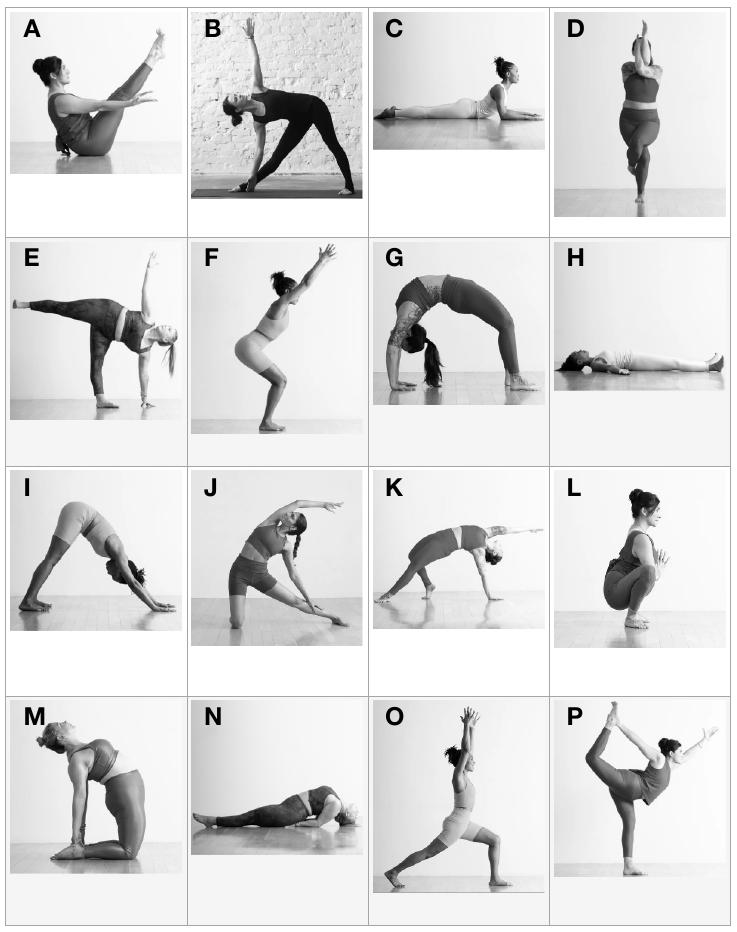
* Game 1, Round 3 - Sports - Yoga Poses
1. Paripurna Navasana ["par-ee-POOR-nah nah-VAHS-anna"] -- English,
"boat pose", literal translation "complete" or "full boat pose."
2. Parighasana ["par-ee-GAHS-ah-nah"] -- English, "gate pose",
direct translation "the bar used for shutting a gate, crossbar."
3. Natarajasana ["not-ah-raj-AHS-anna"] -- English, "dancer pose",
direct translation "King Dancer" or "Lord of the Dance."
4. Trikonasana ["trik-cone-AHS-ah-nah"] -- English, "triangle pose."
5. Ustrasana ["oosh-TRAH-sah-nah"] -- English, "camel pose."
6. Camatkarasana ["KUH-mutt-Kuh-RUSS-uh-nuh"] -- English, "wild
thing pose", direct translation "the joyful unfolding of
the heart."
7. Urdhva Dhanurasana ["OORD-vah don-your-AHS-anna"] -- English,
"wheel pose", direct translation "upward facing bow."
8. Garudasana ["gah-rue-DAHS-anna"] -- English, "eagle pose",
direct translation "the mythic king of the birds."
9. Bhujangasana ["boo-jang-GAHS-anna"] -- English, "sphinx pose"
or "cobra pose", direct translation "snake."
10. Malasana ["muh-LUH-suh-nuh"] -- English, "garland pose."
* Game 1, Round 2 - Canadiana - Canadian Foods, Drinks, and Snacks
*Note*: none of the answers is poutine!
1. Introduced in 1938 by Rowntree, now manufactured by Nestlé
in Toronto, and quite difficult to find outside Canada, this
confectionery wrapped in yellow paper "makes a nice light snack".
Name it.
2. What's the main ingredient that distinguishes the popular
Canadian cocktail, the Bloody Caesar (or just Caesar), from
the similar Bloody Mary?
3. This cultivar of a root vegetable was developed in Ontario
and burst onto grocery store shelves in 1980 to great success.
It's a cross between varieties from the US and Peru. Despite
the first part of its name, it is not widely grown in northern
Canada. Its distinctive color inspired the second part of its
two-word name. What is it?
4. If you take a traditional kebab that you slice off a vertical
rotisserie, but you make it out of beef instead of pork or lamb,
then add a sauce of condensed milk, vinegar, sugar, and garlic,
and serve it in a pita, then you have this lovely treat to
serve to hungry bar-hoppers in Atlantic Canada. What is it?
5. You probably think this kitchen staple was invented by George
Washington Carver, but in fact Canada's Marcellus Edson
received the first patent in 1884. By World War I it was
in widespread use as a protein source during meat rationing.
Canadians are among the world's largest consumers per capita.
85% of you have some at home. What is it?
6. The McLaughlin family of Oshawa is best known for their motor
car company, which became part of General Motors. The eldest
son, John, however, contributed a carbonated drink to the world,
which exploded in popularity as a mixer for moonshine during
US Prohibition. Name the "patriotic" drink *brand*.
7. It's not certain, but Vancouver chef Hidekazu Tojo might be
responsible for the creation of this popular restaurant item
in the late 1970s. Two of the main ingredients are crab and
avocado. Their initial letters inspired the name of the item.
What is it?
8. The next item also bears a name from outside Canada. A Greek-
Canadian restaurateur in Chatham-Kent added canned fruit to a
popular take-out item on his menu. You either like or hate it.
What is it?
9. Tourtière is a traditional meat pie from Quebec, which is made
with a mixture of meats like veal, beef, pork, or wild game.
However, before the 20th century, a different type of meat -- no
longer available now -- was the main meat used in tourtière. Name it.
10. In the 1970s, University of Manitoba researchers modified an
oil-producing plant to reduce the amount of bitter and dangerous
erucic acid. They created Canola, which stands for Canadian Oil,
Low Acid. What was the source plant that they modified?
* Game 1, Round 3 - Sports - Yoga Poses
Please see the handout at: http://www.vex.net/~msb/tmp/1-3/yoga.jpg
Western yoga is built on the idea of asanas ["AHSS-ah-nuhs"], or
"poses" that stretch, strengthen, and calm or energize the body.
You'll be given the name of a yoga pose in its original Sanskrit
and in English. If the commonly used English name isn't a
literal translation, we'll give you that too. For example,
Tadasana ["TAH-dass-ah-nuh"] literally means "mountain pose",
and that is its common English name, while Eka Pada Rajakapotasana
["aa-KAH pah-DAH rah-JAH-kop-poh-TAHS-anna"] literally translates
to "one-legged king pigeon", but is known as the "mermaid pose."
In each case, give the correct corresponding letter on the handout.
1. Paripurna Navasana ["par-ee-POOR-nah nah-VAHS-anna"] -- English,
"boat pose", literal translation "complete" or "full boat pose."
2. Parighasana ["par-ee-GAHS-ah-nah"] -- English, "gate pose",
direct translation "the bar used for shutting a gate, crossbar."
3. Natarajasana ["not-ah-raj-AHS-anna"] -- English, "dancer pose",
direct translation "King Dancer" or "Lord of the Dance."
4. Trikonasana ["trik-cone-AHS-ah-nah"] -- English, "triangle pose."
5. Ustrasana ["oosh-TRAH-sah-nah"] -- English, "camel pose."
6. Camatkarasana ["KUH-mutt-Kuh-RUSS-uh-nuh"] -- English, "wild
thing pose", direct translation "the joyful unfolding of
the heart."
7. Urdhva Dhanurasana ["OORD-vah don-your-AHS-anna"] -- English,
"wheel pose", direct translation "upward facing bow."
8. Garudasana ["gah-rue-DAHS-anna"] -- English, "eagle pose",
direct translation "the mythic king of the birds."
9. Bhujangasana ["boo-jang-GAHS-anna"] -- English, "sphinx pose"
or "cobra pose", direct translation "snake."
10. Malasana ["muh-LUH-suh-nuh"] -- English, "garland pose."
* Game 1, Round 2 - Canadiana - Canadian Foods, Drinks, and Snacks
7. It's not certain, but Vancouver chef Hidekazu Tojo might be
responsible for the creation of this popular restaurant item
in the late 1970s. Two of the main ingredients are crab and
avocado. Their initial letters inspired the name of the item.
What is it?
9. Tourti�re is a traditional meat pie from Quebec, which is made
with a mixture of meats like veal, beef, pork, or wild game.
However, before the 20th century, a different type of meat -- no
longer available now -- was the main meat used in tourti�re. Name it.
These questions were written to be asked in Toronto on 2024-01-29,
and should be interpreted accordingly... For further information
please see my 2023-05-24 companion posting on "Questions from the
Canadian Inquisition (QFTCI*)".
* Game 1, Round 2 - Canadiana - Canadian Foods, Drinks, and Snacks
*Note*: none of the answers is poutine!
1. Introduced in 1938 by Rowntree, now manufactured by Nestl�
in Toronto, and quite difficult to find outside Canada, this
confectionery wrapped in yellow paper "makes a nice light snack".
Name it.
2. What's the main ingredient that distinguishes the popular
Canadian cocktail, the Bloody Caesar (or just Caesar), from
the similar Bloody Mary?
3. This cultivar of a root vegetable was developed in Ontario
and burst onto grocery store shelves in 1980 to great success.
It's a cross between varieties from the US and Peru. Despite
the first part of its name, it is not widely grown in northern
Canada. Its distinctive color inspired the second part of its
two-word name. What is it?
4. If you take a traditional kebab that you slice off a vertical
rotisserie, but you make it out of beef instead of pork or lamb,
then add a sauce of condensed milk, vinegar, sugar, and garlic,
and serve it in a pita, then you have this lovely treat to
serve to hungry bar-hoppers in Atlantic Canada. What is it?
5. You probably think this kitchen staple was invented by George
Washington Carver, but in fact Canada's Marcellus Edson
received the first patent in 1884. By World War I it was
in widespread use as a protein source during meat rationing.
Canadians are among the world's largest consumers per capita.
85% of you have some at home. What is it?
6. The McLaughlin family of Oshawa is best known for their motor
car company, which became part of General Motors. The eldest
son, John, however, contributed a carbonated drink to the world,
which exploded in popularity as a mixer for moonshine during
US Prohibition. Name the "patriotic" drink *brand*.
7. It's not certain, but Vancouver chef Hidekazu Tojo might be
responsible for the creation of this popular restaurant item
in the late 1970s. Two of the main ingredients are crab and
avocado. Their initial letters inspired the name of the item.
What is it?
8. Please decode the rot13 for this question only after you
have finished with the previous one. The next item also bears
a name from outside Canada. A Greek-Canadian restaurateur in
Chatham-Kent added canned fruit to a popular take-out item on
his menu. You either like or hate it. What is it?
9. Tourti�re is a traditional meat pie from Quebec, which is made
with a mixture of meats like veal, beef, pork, or wild game.
However, before the 20th century, a different type of meat -- no
longer available now -- was the main meat used in tourti�re. Name it.
10. In the 1970s, University of Manitoba researchers modified an
oil-producing plant to reduce the amount of bitter and dangerous
erucic acid. They created Canola, which stands for Canadian Oil,
Low Acid. What was the source plant that they modified?
* Game 1, Round 3 - Sports - Yoga Poses
Please see the handout at: http://www.vex.net/~msb/tmp/1-3/yoga.jpg
Western yoga is built on the idea of asanas ["AHSS-ah-nuhs"], or
"poses" that stretch, strengthen, and calm or energize the body.
You'll be given the name of a yoga pose in its original Sanskrit
and in English. If the commonly used English name isn't a
literal translation, we'll give you that too. For example,
Tadasana ["TAH-dass-ah-nuh"] literally means "mountain pose",
and that is its common English name, while Eka Pada Rajakapotasana
["aa-KAH pah-DAH rah-JAH-kop-poh-TAHS-anna"] literally translates
to "one-legged king pigeon", but is known as the "mermaid pose."
In each case, give the correct corresponding letter on the handout.
1. Paripurna Navasana ["par-ee-POOR-nah nah-VAHS-anna"] -- English,
"boat pose", literal translation "complete" or "full boat pose."
2. Parighasana ["par-ee-GAHS-ah-nah"] -- English, "gate pose",
direct translation "the bar used for shutting a gate, crossbar."
3. Natarajasana ["not-ah-raj-AHS-anna"] -- English, "dancer pose",
direct translation "King Dancer" or "Lord of the Dance."
4. Trikonasana ["trik-cone-AHS-ah-nah"] -- English, "triangle pose."
5. Ustrasana ["oosh-TRAH-sah-nah"] -- English, "camel pose."
6. Camatkarasana ["KUH-mutt-Kuh-RUSS-uh-nuh"] -- English, "wild
thing pose", direct translation "the joyful unfolding of
the heart."
7. Urdhva Dhanurasana ["OORD-vah don-your-AHS-anna"] -- English,
"wheel pose", direct translation "upward facing bow."
8. Garudasana ["gah-rue-DAHS-anna"] -- English, "eagle pose",
direct translation "the mythic king of the birds."
9. Bhujangasana ["boo-jang-GAHS-anna"] -- English, "sphinx pose"
or "cobra pose", direct translation "snake."
10. Malasana ["muh-LUH-suh-nuh"] -- English, "garland pose."
4. If you take a traditional kebab that you slice off a vertical
rotisserie, but you make it out of beef instead of pork or lamb,
then add a sauce of condensed milk, vinegar, sugar, and garlic,
and serve it in a pita, then you have this lovely treat to
serve to hungry bar-hoppers in Atlantic Canada. What is it?
Donair.
4. If you take a traditional kebab that you slice off a vertical
rotisserie, but you make it out of beef instead of pork or lamb,
then add a sauce of condensed milk, vinegar, sugar, and garlic,
and serve it in a pita, then you have this lovely treat to
serve to hungry bar-hoppers in Atlantic Canada. What is it?
Donair.
Wikipedia thinks "doner" and "donair" are the same thing.
(So do I but Wikipedia is a bit more authoritative.)
Mark Brader:
4. If you take a traditional kebab that you slice off a vertical
rotisserie, but you make it out of beef instead of pork or lamb,
then add a sauce of condensed milk, vinegar, sugar, and garlic,
and serve it in a pita, then you have this lovely treat to
serve to hungry bar-hoppers in Atlantic Canada. What is it?
Donair.
Dan Blum:
Wikipedia thinks "doner" and "donair" are the same thing.
Not at the moment it doesn't. "A variation known as donair was introduced
in Halifax, Nova Scotia, in the early 1970s."
| Sysop: | Keyop |
|---|---|
| Location: | Huddersfield, West Yorkshire, UK |
| Users: | 765 |
| Nodes: | 16 (1 / 15) |
| Uptime: | 00:23:51 |
| Calls: | 12,760 |
| Calls today: | 4 |
| Files: | 15,360 |
| Messages: | 6,556,980 |