People are bitching about a lack of flying cars or fusion power,
but hardly notice the actual, incredible, crazy progress that is
happening.
I'm talking of course about artificial illumination. (Yes, again.)
Not sexy? Too bad.
Recently a conventional light bulb that had escaped my purge revealed
itself by dying. I replaced it with the latest generation of Philips
LED bulb that requires about 1/14 (!) as much energy for the same
light output and is specified with a lifetime of 50.000 hours, which
amounts to some 50 years of average use.
I have been replacing LED bulbs at a much higher rate than that for one >particular fixture. They aren't lasting even 10 thousand hours (why that
is happening, I have no idea - if the fixture was wired up wrong, the >incandescent bulbs I had been using wouldn't had lasted as long as they
did).
The problem is that people
don't want to pay more money for a better product unless they are forced to >do so.
In article <[email protected]>,
Christian Weisgerber <[email protected]> wrote:
People are bitching about a lack of flying cars or fusion power,
but hardly notice the actual, incredible, crazy progress that is
happening.
I'm talking of course about artificial illumination. (Yes, again.)
Not sexy? Too bad.
Recently a conventional light bulb that had escaped my purge revealed
itself by dying. I replaced it with the latest generation of Philips
LED bulb that requires about 1/14 (!) as much energy for the same
light output and is specified with a lifetime of 50.000 hours, which
amounts to some 50 years of average use.
I have been replacing LED bulbs at a much higher rate than that for one particular fixture. They aren't lasting even 10 thousand hours (why that
is happening, I have no idea - if the fixture was wired up wrong, the incandescent bulbs I had been using wouldn't had lasted as long as they
did).
If you think your LED bulbs last, and are efficient, then
you have heard of "Dubai Bulbs"
https://www.youtube.com/watch?v=klaJqofCsu4
Robert Woodward <[email protected]> wrote:
I have been replacing LED bulbs at a much higher rate than that for one
particular fixture. They aren't lasting even 10 thousand hours (why that
is happening, I have no idea - if the fixture was wired up wrong, the
incandescent bulbs I had been using wouldn't had lasted as long as they
did).
They aren't designed to last very long, that's the problem. The typical cheap American ones fail more frequently than long-life incandescents.
But there's no reason you can't make more expensive ones with much longer life, like the ones required for use in Dubai. The problem is that people don't want to pay more money for a better product unless they are forced to do so.
--scott
Robert Woodward <[email protected]> wrote:
I have been replacing LED bulbs at a much higher rate than that for one
particular fixture. They aren't lasting even 10 thousand hours (why that >>> is happening, I have no idea - if the fixture was wired up wrong, the
incandescent bulbs I had been using wouldn't had lasted as long as they
did).
They aren't designed to last very long, that's the problem. The typical
cheap American ones fail more frequently than long-life incandescents.
But there's no reason you can't make more expensive ones with much longer
life, like the ones required for use in Dubai. The problem is that people >> don't want to pay more money for a better product unless they are forced to >> do so.
--scott
I found out that a lot of the lower priced store brands don't
last as long as they should. I have given up buying them,
and buying name brands instead. For example I don't buy LED
bulbs at Walmart. I go to someplace that offers a choice.
Bill
People are bitching about a lack of flying cars or fusion power,
but hardly notice the actual, incredible, crazy progress that is
happening.
I'm talking of course about artificial illumination. (Yes, again.)
Not sexy? Too bad.
Recently a conventional light bulb that had escaped my purge revealed
itself by dying. I replaced it with the latest generation of Philips
LED bulb that requires about 1/14 (!) as much energy for the same
light output and is specified with a lifetime of 50.000 hours, which
amounts to some 50 years of average use.
Today I replaced two fluorescent tubes--one had died--in the kitchen
with LED tubes. Those require 1/3 the energy and Ledvance specifies
them with a lifetime of 75.000 hours. You do the math.
From a 20th century point of view, those figures are totally insane.
When cheap LED lamps became common a few years ago, I thought that
was the end of the line, but even LED lamps have made significant
further progress in beam angle, energy efficiency, and lifetime
within just the last few years. Anybody who is hoarding lamps for
use in a few years will be sitting on obsolete technology in no
time. Buy today, weep next year. Between the crazy pace of progress
and the ever absurder lifetimes, keeping spares around no longer
makes sense.
It is utterly stunning progress.
On 19 Jun 2024 18:22:02 -0000, [email protected] (Scott Dorsey) wrote:
The problem is that people
don't want to pay more money for a better product unless they are forced to >>do so.
Perhaps because they've learned, by long and bitter experience, that
paying more for a product doesn't guarantee that it will be of better >quality, so, unless they have definite knowledge that one product is
of superior quality, the safest way to avoid wasting money is to buy
the cheapest?
Kind of like Rapid Transit, which promises that, in 30 years, there
will be 30% fewer cars on the road /than there would be without it/,
not 30% fewer than there are today.
On Jun 19, 2024 at 11:44:52 AM CDT, "Robert Woodward" <[email protected]> >wrote:
In article <[email protected]>,
Christian Weisgerber <[email protected]> wrote:
People are bitching about a lack of flying cars or fusion power,
but hardly notice the actual, incredible, crazy progress that is
happening.
I'm talking of course about artificial illumination. (Yes, again.)
Not sexy? Too bad.
Recently a conventional light bulb that had escaped my purge revealed
itself by dying. I replaced it with the latest generation of Philips
LED bulb that requires about 1/14 (!) as much energy for the same
light output and is specified with a lifetime of 50.000 hours, which
amounts to some 50 years of average use.
I have been replacing LED bulbs at a much higher rate than that for one
particular fixture. They aren't lasting even 10 thousand hours (why that
is happening, I have no idea - if the fixture was wired up wrong, the
incandescent bulbs I had been using wouldn't had lasted as long as they
did).
The short answer, is the cheap power conversion electronics in the base of >most LED bulbs. An LED is a direct current devise, so there is a set of >electronics in the base of the bulb to convert the AC to DC.
A conventional bulb's filament is not sensitive to AC voltage fluctionations, >where the conversion electronics is. My guess is that your wiring to that >light is causing voltage dips and is stressing the electronics in the LED bulb >base.
On 6/20/2024 9:10 AM, Christian Weisgerber wrote:
On 2024-06-19, Cryptoengineer <[email protected]> wrote:
If you think your LED bulbs last, and are efficient, then
you have heard of "Dubai Bulbs"
https://www.youtube.com/watch?v=klaJqofCsu4
Interesting, but that video is three years old and Philips has since
introduced an "ultra-efficient" line that pushes the claimed life
from 15,000 to 50,000 hours and about doubles the efficiency.
I have no idea if there is a Dubai version of those.
FWIW, when I purged the incandescents and some of the compact
fluorescents at home, I just bought cheap LED bulbs from the Aldi
middle aisle. Only for types where I needed to order a replacement
have I started taking a closer look at brand-name products.
At some point I may start replacing my older LED bulbs with
full(er) spectrum versions.
On Wed, 19 Jun 2024 16:10:34 -0000 (UTC), Christian Weisgerber ><[email protected]> wrote:
People are bitching about a lack of flying cars or fusion power,
but hardly notice the actual, incredible, crazy progress that is
happening.
I'm talking of course about artificial illumination. (Yes, again.)
Not sexy? Too bad.
Recently a conventional light bulb that had escaped my purge revealed >>itself by dying. I replaced it with the latest generation of Philips
LED bulb that requires about 1/14 (!) as much energy for the same
light output and is specified with a lifetime of 50.000 hours, which >>amounts to some 50 years of average use.
Rated, yes. And based on some sort of tests, no doubt.
But one thing they /didn't/ do: actually use them "under normal
conditions" and see that they lasted 50 years.=20
By now, of course, they may have tested them for the 5.7 years or so
it would take to reach 50,000 hours. Or not. But they almost certainly
did not do that before they were first introduced. Why delay a product
6 years just to do a test?
Today I replaced two fluorescent tubes--one had died--in the kitchen
with LED tubes. Those require 1/3 the energy and Ledvance specifies
them with a lifetime of 75.000 hours. You do the math.
I have /always/ considered the main advantage of CFLs and LEDs to be
that they don't have to be changed as often. This is very helpful
with, say, porch lights which /always/ go out on dark and rainy
nights. [1]
But I never bought the "you will save money" argument. Too many
variables.
I picked up some A-sized bulbs recently at Costco that have a multiposition >slide switch on the base that selects from five different
color temperatures from 5000K to 2200K.
I replaced all the 8' fluorescents in the barn with F96T12 LED bulbs
(and removed the old ballasts). 5000K for best color rendition.
Cut the power requirements by almost 70%.
Scott Lurndal <[email protected]> wrote:
I picked up some A-sized bulbs recently at Costco that have a multiposition >>slide switch on the base that selects from five different
color temperatures from 5000K to 2200K.
I replaced all the 8' fluorescents in the barn with F96T12 LED bulbs
(and removed the old ballasts). 5000K for best color rendition.
Cut the power requirements by almost 70%.
All of those color temperatures are fake numbers that were made up by the >marketing department. Only a blackbody source has a color temperature.
What you are seeing is a number saying "This looks to the eye kind of
like blackbody source with a 5000K color temperature."
The short answer, is the cheap power conversion electronics in the base of >most LED bulbs. An LED is a direct current devise, so there is a set of >electronics in the base of the bulb to convert the AC to DC.
A conventional bulb's filament is not sensitive to AC voltage fluctionations, >where the conversion electronics is. My guess is that your wiring to that >light is causing voltage dips and is stressing the electronics in the LED bulb >base.
I once was in a situation where every time the Refrigerator (in
another room, but on the same circuit) powered up, the computer
rebooted. This gets very old very fast, but illustrates that even your
home wiring can misbehave and affect what you have plugged in.
[email protected] (Scott Dorsey) writes:
What you are seeing is a number saying "This looks to the eye kind of
like blackbody source with a 5000K color temperature."
Which is certainly sufficient for the typical lightbulb buyer who wouldn't know
color temperature from a hole in the ground.
Paul S Person <[email protected]d> writes:
I once was in a situation where every time the Refrigerator (in
another room, but on the same circuit) powered up, the computer
rebooted. This gets very old very fast, but illustrates that even your
home wiring can misbehave and affect what you have plugged in.
Your very old fridge, rated at 750 watts, draws around 1500 watts to
start, maybe more and for longer if in deteriorating condition.
Thus unknown the duration and size of the voltage drop.
My attention was called to this when, over a decade ago, our 40
y.o. fridge worked fine until I tried to run it on a 1500 watt genset
after a storm when the main gen set had failed. It bogged the
generator down severly when starting.
Paul S Person <[email protected]d> writes:
On Wed, 19 Jun 2024 16:10:34 -0000 (UTC), Christian Weisgerber >><[email protected]> wrote:
People are bitching about a lack of flying cars or fusion power,
but hardly notice the actual, incredible, crazy progress that is >>>happening.
I'm talking of course about artificial illumination. (Yes, again.)
Not sexy? Too bad.
Recently a conventional light bulb that had escaped my purge revealed >>>itself by dying. I replaced it with the latest generation of Philips
LED bulb that requires about 1/14 (!) as much energy for the same
light output and is specified with a lifetime of 50.000 hours, which >>>amounts to some 50 years of average use.
Rated, yes. And based on some sort of tests, no doubt.
Based on calculations. For example, the resistors in
the product have certain characteristics such as resistance,
tolerance, working temperature, power rating, etc. Included in that is
a lifetime rating provided by the part manufacturer when the part
is used within specifications.
One can calculate the overall expected lifetime of a
product statistically based on that per-component data
accounting for effects that degrade the data such
as operating outside specification, etc.
But one thing they /didn't/ do: actually use them "under normal
conditions" and see that they lasted 50 years.=20
By now, of course, they may have tested them for the 5.7 years or so
it would take to reach 50,000 hours. Or not. But they almost certainly
did not do that before they were first introduced. Why delay a product
6 years just to do a test?
See above.
Today I replaced two fluorescent tubes--one had died--in the kitchen
with LED tubes. Those require 1/3 the energy and Ledvance specifies
them with a lifetime of 75.000 hours. You do the math.
I have /always/ considered the main advantage of CFLs and LEDs to be
that they don't have to be changed as often. This is very helpful
with, say, porch lights which /always/ go out on dark and rainy
nights. [1]
But I never bought the "you will save money" argument. Too many
variables.
There is no doubt that they save money when compared with
incandescent bulbs.
On Thu, 20 Jun 2024 17:21:54 GMT, [email protected] (Scott Lurndal)
wrote:
Paul S Person <[email protected]d> writes:is
On Wed, 19 Jun 2024 16:10:34 -0000 (UTC), Christian Weisgerber >>><[email protected]> wrote:
People are bitching about a lack of flying cars or fusion power,
but hardly notice the actual, incredible, crazy progress that is >>>>happening.
I'm talking of course about artificial illumination. (Yes, again.)
Not sexy? Too bad.
Recently a conventional light bulb that had escaped my purge revealed >>>>itself by dying. I replaced it with the latest generation of Philips >>>>LED bulb that requires about 1/14 (!) as much energy for the same
light output and is specified with a lifetime of 50.000 hours, which >>>>amounts to some 50 years of average use.
Rated, yes. And based on some sort of tests, no doubt.
Based on calculations. For example, the resistors in
the product have certain characteristics such as resistance,
tolerance, working temperature, power rating, etc. Included in that =
a lifetime rating provided by the part manufacturer when the part
is used within specifications.
One can calculate the overall expected lifetime of a
product statistically based on that per-component data
accounting for effects that degrade the data such
as operating outside specification, etc.
The map is not the terrain.
But thanks for confirming the basic bogosity of these claims.
But one thing they /didn't/ do: actually use them "under normal >>>conditions" and see that they lasted 50 years.=3D20
By now, of course, they may have tested them for the 5.7 years or so
it would take to reach 50,000 hours. Or not. But they almost certainly >>>did not do that before they were first introduced. Why delay a product
6 years just to do a test?
See above.
Today I replaced two fluorescent tubes--one had died--in the kitchen >>>>with LED tubes. Those require 1/3 the energy and Ledvance specifies >>>>them with a lifetime of 75.000 hours. You do the math.
I have /always/ considered the main advantage of CFLs and LEDs to be
that they don't have to be changed as often. This is very helpful
with, say, porch lights which /always/ go out on dark and rainy
nights. [1]
But I never bought the "you will save money" argument. Too many >>>variables.
There is no doubt that they save money when compared with
incandescent bulbs.
If you say so.
I say it is irrelevant: people won't buy them to save money.
Yes, but it doesn't tell them what they really want to know, which is
what the color rendition is like. With some of the cheaper LED lamps
and even some of the better CFLs, I can't tell the difference between
red and orange stripes on resistors. It's very obvious under incandescent
or daylight.
I am having to replace my 100 watt equivalent 15 watt actual LED bulbs
in my office building every three years or so. I have about a hundred
light fixtures in can lights, both inside and outside (mostly inside).
I use the lights about 50% of the time.
Evidently, the LED bulbs in the can lights is causing the LED electronic >circuit board to overheat since the bulb is upside down, base up. Many
of the LED bulbs that fail have discoloration and cracks in the base.
Lynn McGuire <[email protected]> wrote:
I am having to replace my 100 watt equivalent 15 watt actual LED bulbs
in my office building every three years or so. I have about a hundred >>light fixtures in can lights, both inside and outside (mostly inside).
I use the lights about 50% of the time.
This about typical for the cheap no-name lamps when used in cans.
--Evidently, the LED bulbs in the can lights is causing the LED electronic >>circuit board to overheat since the bulb is upside down, base up. Many
of the LED bulbs that fail have discoloration and cracks in the base.
This is a combination of them being upside-down (and even the crappy ones >say on the datasheets that they can be used in any direction, even though >they usually can't) and the design of the cans which are intended for >incandescents.
Look for the Cree lamps that are marked "Good for Enclosed Use." They will >run twice the cost of the cheapies but last much more than twice as long. >(And of course the labour for relamping gets saved too.)
Paul S Person <[email protected]d> writes:
On Thu, 20 Jun 2024 17:21:54 GMT, [email protected] (Scott Lurndal) >>wrote:
Paul S Person <[email protected]d> writes:
On Wed, 19 Jun 2024 16:10:34 -0000 (UTC), Christian Weisgerber >>>><[email protected]> wrote:
People are bitching about a lack of flying cars or fusion power,
but hardly notice the actual, incredible, crazy progress that is >>>>>happening.
I'm talking of course about artificial illumination. (Yes, again.) >>>>>Not sexy? Too bad.
Recently a conventional light bulb that had escaped my purge revealed >>>>>itself by dying. I replaced it with the latest generation of Philips >>>>>LED bulb that requires about 1/14 (!) as much energy for the same >>>>>light output and is specified with a lifetime of 50.000 hours, which >>>>>amounts to some 50 years of average use.
Rated, yes. And based on some sort of tests, no doubt.
Based on calculations. For example, the resistors in
the product have certain characteristics such as resistance,
tolerance, working temperature, power rating, etc. Included in that = >>is
a lifetime rating provided by the part manufacturer when the part
is used within specifications.
One can calculate the overall expected lifetime of a
product statistically based on that per-component data
accounting for effects that degrade the data such
as operating outside specification, etc.
The map is not the terrain.
The goal is to create a statistical certainly. Obviously
any one bulb might be defective, but the majority
of bulbs will survive for the specified period.
But thanks for confirming the basic bogosity of these claims.
I did no such thing.
But one thing they /didn't/ do: actually use them "under normal >>>>conditions" and see that they lasted 50 years.=3D20
By now, of course, they may have tested them for the 5.7 years or so
it would take to reach 50,000 hours. Or not. But they almost certainly >>>>did not do that before they were first introduced. Why delay a product >>>>6 years just to do a test?
See above.
Today I replaced two fluorescent tubes--one had died--in the kitchen >>>>>with LED tubes. Those require 1/3 the energy and Ledvance specifies >>>>>them with a lifetime of 75.000 hours. You do the math.
I have /always/ considered the main advantage of CFLs and LEDs to be >>>>that they don't have to be changed as often. This is very helpful
with, say, porch lights which /always/ go out on dark and rainy
nights. [1]
But I never bought the "you will save money" argument. Too many >>>>variables.
There is no doubt that they save money when compared with
incandescent bulbs.
If you say so.
Consider that some 7 billion bulbs are sold each year in the
USA. Comparing a 60 watt incandescent to a 7 watt LED with
similar luminosity, the switch from incandescent to LED has
eliminated the need to build some number of power plants;
in that alone they've saved money (unfortunately, that
saved power has been diverted to wasteful cryptomining).
I say it is irrelevant: people won't buy them to save money.
They'll buy them because they're obviously superior to incandescents
in almost every way. And because they can no longer buy >non-special-purpose incandescents.
I am having to replace my 100 watt equivalent 15 watt actual LED bulbs
in my office building every three years or so. I have about a hundred >light fixtures in can lights, both inside and outside (mostly inside).
I use the lights about 50% of the time.
Evidently, the LED bulbs in the can lights is causing the LED electronic >circuit board to overheat since the bulb is upside down, base up. Many
of the LED bulbs that fail have discoloration and cracks in the base.
So 50% X three years X 8760 hours / year = a life of 13,140 hours per
LED bulb. My previous usage of incandescent bulbs was a life of about a >year at most. Plus more heat for the air conditioning and electric bill
for the building.
I have some 150 watt (70 bulbs) and 200 watt (90 bulbs) LED light
fixtures inside and outside my warehouse, about 20 of them. I have yet
to have any failures on these. They do have a huge heat sink on them as
the fixture weighs about 13 lbs.
https://www.amazon.com/gp/product/B077ZNJRFS/
Perhaps there are can fixtures designed to use LEDs.
BTW, I noticed last night that the ceiling light in what we call "the
hall" for want of a better term is a 60W incandescent. I don't recall
ever changing it but, if I had when I was buying CFLs, it would be a
CFL so it must be a good 20 years old and probably much older and,
if/when it goes, it will be replaced by an LED. But it isn't used very
often. Incandescents can last a long long time if they are not used
very often. They also don't use a whole lot of electricity when they
are off.
Perhaps there are can fixtures designed to use LEDs.
Paul S Person <[email protected]d> wrote:
Perhaps there are can fixtures designed to use LEDs.
There are commercial can fixtures with integral LEDs which most of the
big office building guys are using now instead of conventional can fixtures >with lamps screwed into them. I worry about them since they are not as >easily replaced as a light bulb, but I have no personal experience with them.
There are commercial can fixtures with integral LEDs which most of the
big office building guys are using now instead of conventional can fixtures >with lamps screwed into them. I worry about them since they are not as >easily replaced as a light bulb, but I have no personal experience with them.
On 6/22/2024 3:47 PM, Scott Dorsey wrote:
Paul S Person <[email protected]d> wrote:
Perhaps there are can fixtures designed to use LEDs.
There are commercial can fixtures with integral LEDs which most of the
big office building guys are using now instead of conventional can fixtures >> with lamps screwed into them. I worry about them since they are not as
easily replaced as a light bulb, but I have no personal experience with them.
--scott
I have six of them at the house. One died recently, probably 20+ years old.
In article <v57d9v$12v$[email protected]>,
Scott Dorsey <[email protected]> wrote:
There are commercial can fixtures with integral LEDs which most of the
big office building guys are using now instead of conventional can fixtures >>with lamps screwed into them. I worry about them since they are not as >>easily replaced as a light bulb, but I have no personal experience with them.
Apparently there is a regulation in California that requires these
fixtures to be provided with a standard pluggable disconnect so that
they can be replaced easily. Because California is such a big market
for energy efficiency, what sells there is also sold everywhere else
in the country.
On Thu, 20 Jun 2024 09:15:56 -0700, Paul S Person <[email protected]d> wrote:
Kind of like Rapid Transit, which promises that, in 30 years, there
will be 30% fewer cars on the road /than there would be without it/,
not 30% fewer than there are today.
Here in Edmonton, a couple of years ago we had a massive change to all
our bus routes.
The main upshot for the inner city is that the routes have been
"optimized", but their frequency of service has been reduced in many instances, meaning a bus trip needs to be planned ahead, not done on
impulse. (This makes it easier to comply with the single-use bag
bylaw!)
This was done to free up resources to increase bus service to the
suburbs. The hope was that this would result in the people whoi live
there, who pretty much all have cars, taking the bus more often.
It is a good intention, since reducing carbon emissions is important,
but expecting people with cars to start taking the bus? Anyone who
lived in the real world would have known this was ludicrous. So they
just ruined the bus service for people who need the bus for no reason.
They light the inside and outside of my 3,750 ft2 warehouse very well.
And they turn on instantly whereas the old metal halide lights took ten >minutes to turn on. Plus the old metal halide lights were 1,000 watts
each which was torture in the summer. Nice in the winter though.
On 20/06/2024 11.21, Paul S Person wrote:
On Thu, 20 Jun 2024 02:59:25 GMT, Random <[email protected]> wrote:
A conventional bulb's filament is not sensitive to AC voltage fluctionations,
where the conversion electronics is. My guess is that your wiring to that >>> light is causing voltage dips and is stressing the electronics in the LED bulb
base.
I've seen a similar claim about timers that actually count
cycles-per-second: if those vary then the timer misperforms.
This isn't really an issue in North America. According to NERC[1], frequency in
the Eastern Interconnection (EI) is above 59.972 Hz 95% of the time. This is >99.95% of nominal frequency, or an error of 28 mHz.
If frequency sat that low for a 24 hour period (which it doesn't; frequency error
regularly crosses zero), it would be a loss of 40 seconds in a day.
As a matter of fact, a few years back, the EI had an ongoing problem with frequency
being high: 3 mHz fast as a sustained average over several years. This was considered
a significant enough issue to require an investigation[2].
If uncorrected, it would have caused clocks to gain over 4 seconds per day. This
led to regularly implementing Time Error Correction. In this case, that meant a
coordinated (across the EI) reduction in generation to reduce frequency until the
time error crossed zero again.
Four seconds error per day is considered a problem. If you live in North America,
you can count[3] on your analog clock.
On 6/24/2024 1:55 PM, Lynn McGuire wrote:
...
I have some 150 watt (70 bulbs) and 200 watt (90 bulbs) LED light
fixtures inside and outside my warehouse, about 20 of them. I have yet >>>> to have any failures on these. They do have a huge heat sink on
them as
the fixture weighs about 13 lbs.
https://www.amazon.com/gp/product/B077ZNJRFS/
Currently unavailable -- but others are shown further down the page.
The size was interesting -- 17 x 15.7 x 2.4 inches
(length/width/height). That's a lot of light in a small package!
They light the inside and outside of my 3,750 ft2 warehouse very well.
And they turn on instantly whereas the old metal halide lights took
ten minutes to turn on. Plus the old metal halide lights were 1,000
watts each which was torture in the summer. Nice in the winter though.
Lynn
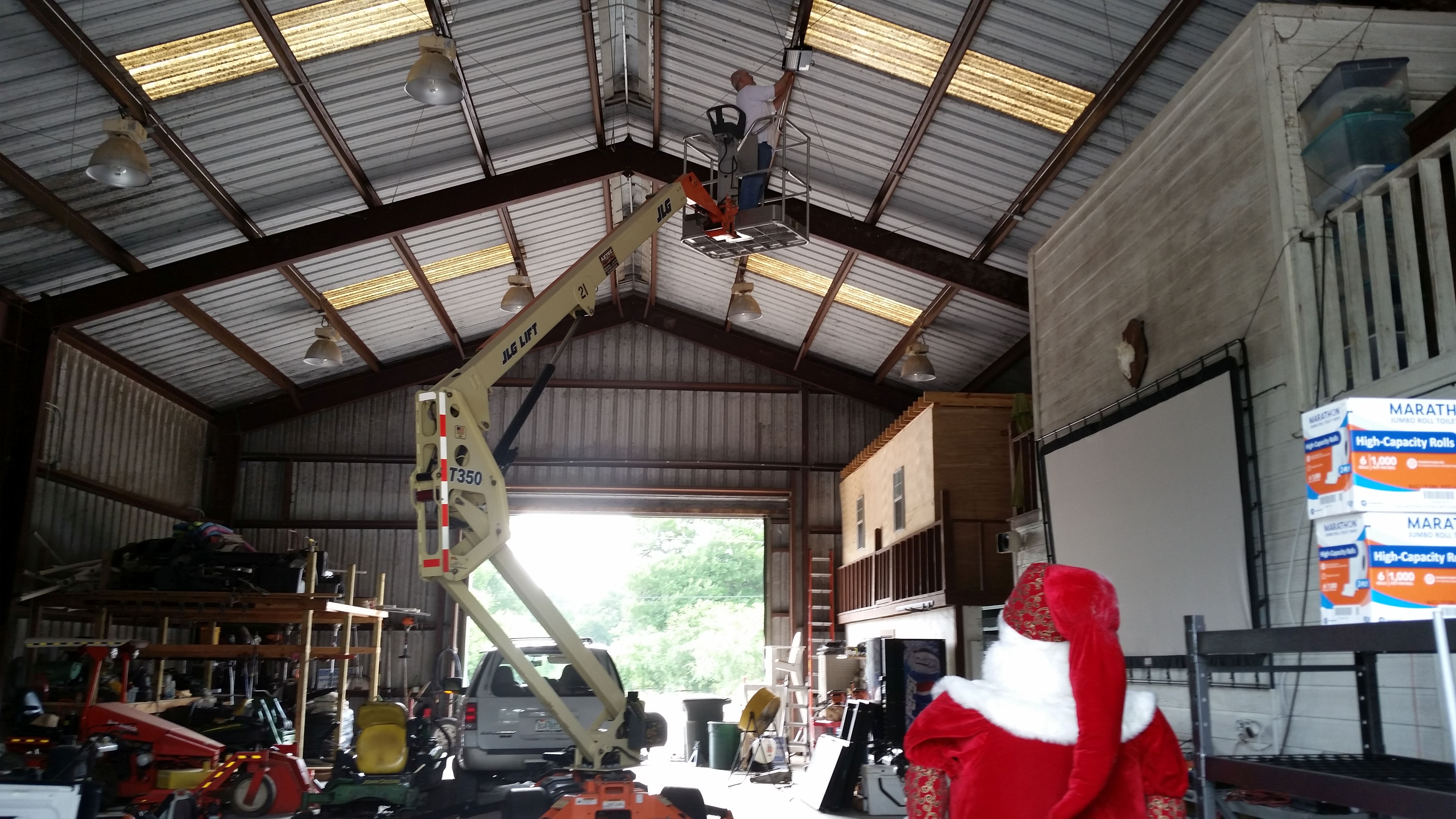
Here is me replacing one of the 1,000 watt metal halide lights with the
new 150 watt LED light fixture. So much smaller !
https://www.winsim.com/lynn_replacing_warehouse_top_light.jpg
Lynn
On 20/06/2024 11.21, Paul S Person wrote:
On Thu, 20 Jun 2024 02:59:25 GMT, Random <[email protected]> wrote:
I've seen a similar claim about timers that actually count
cycles-per-second: if those vary then the timer misperforms.
This isn't really an issue in North America. According to NERC[1], frequency in
the Eastern Interconnection (EI) is above 59.972 Hz 95% of the time. This is >99.95% of nominal frequency, or an error of 28 mHz.
On 6/25/2024 11:49 AM, Jay E. Morris wrote:
On 6/24/2024 1:58 PM, Lynn McGuire wrote:
On 6/24/2024 1:55 PM, Lynn McGuire wrote:
...
I have some 150 watt (70 bulbs) and 200 watt (90 bulbs) LED light
fixtures inside and outside my warehouse, about 20 of them. I
have yet
to have any failures on these. They do have a huge heat sink on
them as
the fixture weighs about 13 lbs.
https://www.amazon.com/gp/product/B077ZNJRFS/
Currently unavailable -- but others are shown further down the page. >>>>>
The size was interesting -- 17 x 15.7 x 2.4 inches
(length/width/height). That's a lot of light in a small package!
They light the inside and outside of my 3,750 ft2 warehouse very well. >>>>
And they turn on instantly whereas the old metal halide lights took
ten minutes to turn on. Plus the old metal halide lights were 1,000
watts each which was torture in the summer. Nice in the winter though. >>>>
Lynn
Here is me replacing one of the 1,000 watt metal halide lights with
the new 150 watt LED light fixture. So much smaller !
https://www.winsim.com/lynn_replacing_warehouse_top_light.jpg
Lynn
Also appears that you're reducing the number of lights.
Nope. Still the same number of inside and outside light fixtures.
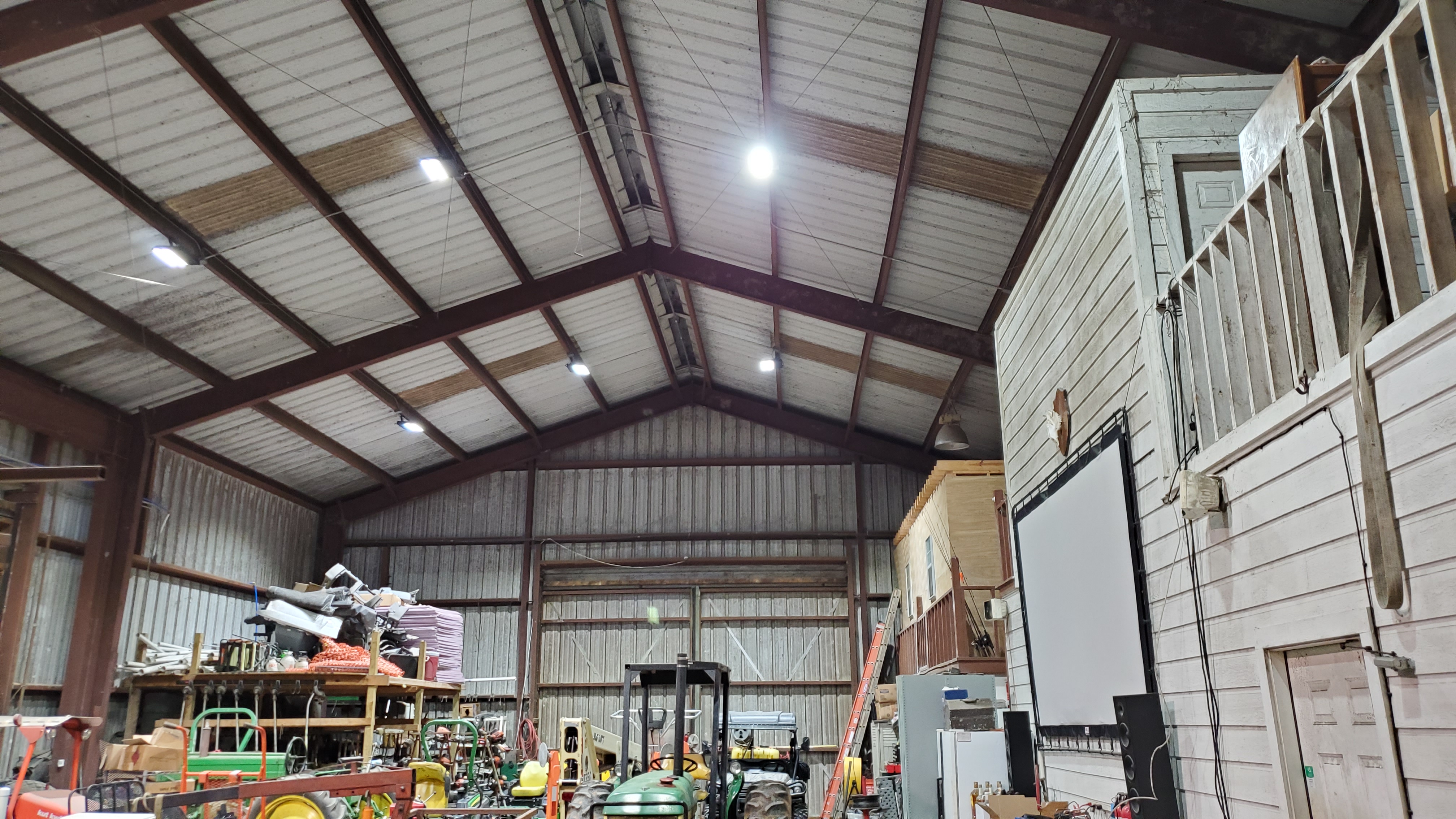
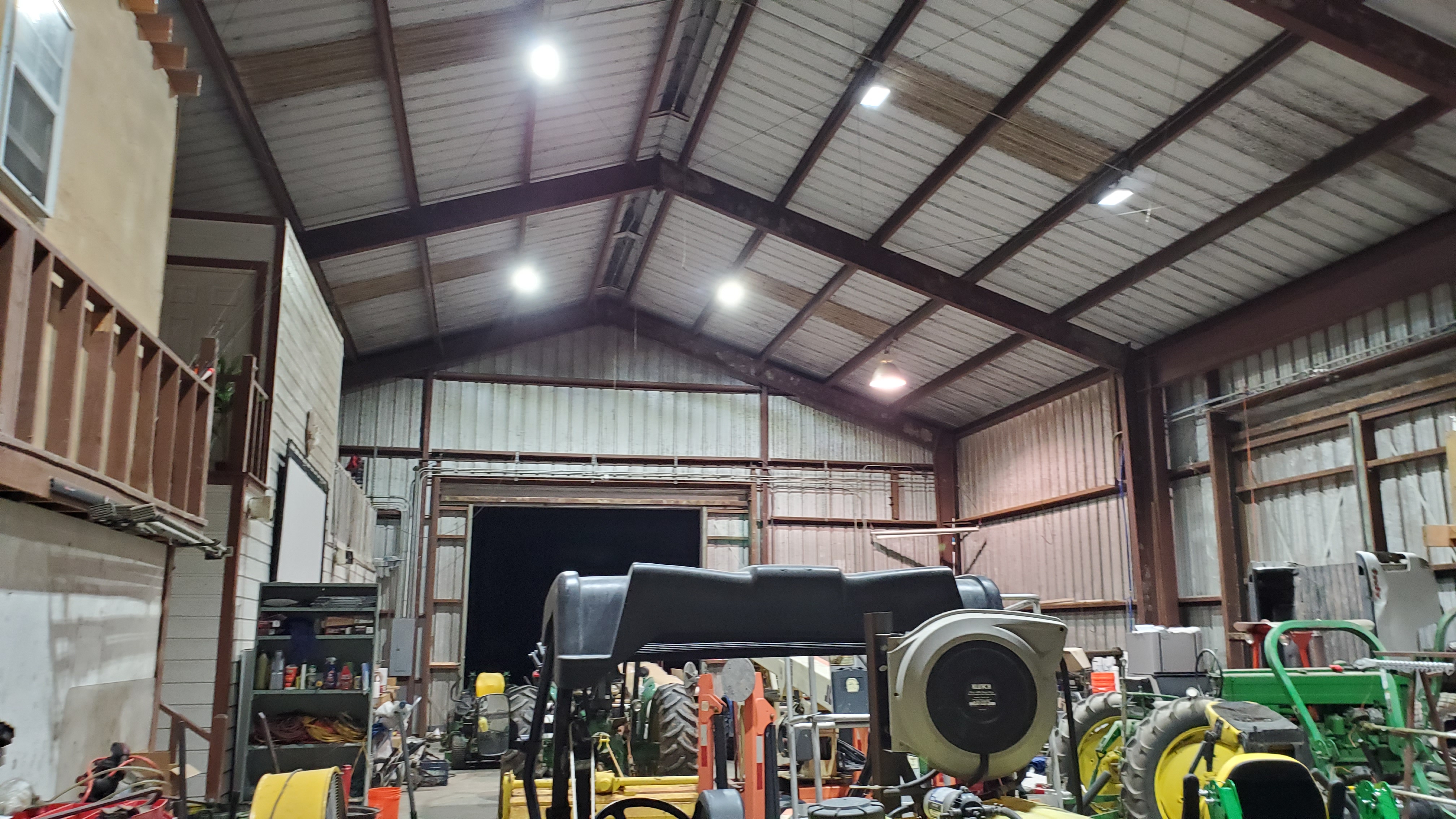
https://www.winsim.com/warehouse_west_side.jpg
https://www.winsim.com/warehouse_east_side.jpg
I still have four more light fixtures to replace that I will get to real
soon now, maybe next winter when it gets cool again. The boom lift
costs me $300 per day and I typically get three fixtures done per day.
Lynn
On 6/23/2024 9:12 PM, Joy Beeson wrote:
On Thu, 20 Jun 2024 11:07:21 -0600, John Savard
<[email protected]d> wrote:
On Thu, 20 Jun 2024 09:15:56 -0700, Paul S Person
<[email protected]d> wrote:
Kind of like Rapid Transit, which promises that, in 30 years, there
will be 30% fewer cars on the road /than there would be without it/,
not 30% fewer than there are today.
Here in Edmonton, a couple of years ago we had a massive change to all
our bus routes.
The main upshot for the inner city is that the routes have been
"optimized", but their frequency of service has been reduced in many
instances, meaning a bus trip needs to be planned ahead, not done on
impulse. (This makes it easier to comply with the single-use bag
bylaw!)
This was done to free up resources to increase bus service to the
suburbs. The hope was that this would result in the people whoi live
there, who pretty much all have cars, taking the bus more often.
It is a good intention, since reducing carbon emissions is important,
but expecting people with cars to start taking the bus? Anyone who
lived in the real world would have known this was ludicrous. So they
just ruined the bus service for people who need the bus for no reason.
I will start using the bus service when it takes me from where I am to
where I want to go, and picks me up when I have my coat on, no sooner
and not much later.
Doesn't matter, since this town has no bus service -- and can't have
any. Mass transit works only when masses want to transit.
For someone who already has a car to switch to public transit would
require the PT to be *substantially* cheaper, faster, or more
convenient.
It can happen, but, for example, a commute to my last workplace by
PT would take over 4.5 hours, vs 45 minutes to an hour by car. It
would include about 20 minutes of walking, commuter rail, Boston T,
and a bus.
It would be hard to persuade me to do that.
On 25/06/2024 10.34, Paul S Person wrote:
On Tue, 25 Jun 2024 08:56:17 -0500, "Michael F. Stemper"
<[email protected]> wrote:
On 20/06/2024 11.21, Paul S Person wrote:
On Thu, 20 Jun 2024 02:59:25 GMT, Random <[email protected]> wrote:
A conventional bulb's filament is not sensitive to AC voltage fluctionations,
where the conversion electronics is. My guess is that your wiring to that >>>>> light is causing voltage dips and is stressing the electronics in the LED bulb
base.
I've seen a similar claim about timers that actually count
cycles-per-second: if those vary then the timer misperforms.
This isn't really an issue in North America. According to NERC[1], frequency in
the Eastern Interconnection (EI) is above 59.972 Hz 95% of the time. This is
99.95% of nominal frequency, or an error of 28 mHz.
If frequency sat that low for a 24 hour period (which it doesn't; frequency error
regularly crosses zero), it would be a loss of 40 seconds in a day.
As a matter of fact, a few years back, the EI had an ongoing problem with frequency
being high: 3 mHz fast as a sustained average over several years. This was considered
a significant enough issue to require an investigation[2].
If uncorrected, it would have caused clocks to gain over 4 seconds per day. This
led to regularly implementing Time Error Correction. In this case, that meant a
coordinated (across the EI) reduction in generation to reduce frequency until the
time error crossed zero again.
Four seconds error per day is considered a problem. If you live in North America,
you can count[3] on your analog clock.
Three things:
-- I was talking about a timer, not a clock. In particular, a timer
controlling our porch light, when went wonky after about 10 years. It
could, of course, have simply aged out, or my switch to CFLs may have
been responsible, who can say? And the timer was put in in the 90s.
Still works fine as manual switch, though.
Functionally, there is no difference between a timer that works by
counting cycles and a clock that does the same. The laws of physics
are uninterested in what you call it. If it integrates frequency,
it's a clock.
-- My memory is that our City Light was reducing the CPS deliberately
-- or allowing it to fluctuate as it chose -- for some reason.
Seattle City Light can not let their frequency vary independently, unless >they were to disconnect from the WI, which would mean that they could no >longer buy or sell energy. It would also mean that they would need to
keep more generators running than would be needed for local consumption,
just to meet spinning reserve requirements.
-- Seattle is not in the Eastern Interconnection. Not that I think
whatever Interconnection it /is/ in does any different than the EI.
That'd be the Western Interconnection (WI), run by the Western Electricity >Coordinating Council (WECC). (It's often referred to as "WECC", since
that's the only Regional Entity for the WI.
Recent data[1] show that their worst performance was 2020 Q3,
when they had a whopping 20+ minutes of absolute frequency error
(actual versus scheduled) outside of 68 mHz.
[1] <https://www.wecc.org/PerformanceAnalysis/Pages/ReliabilityIndicatorDashboard.aspx?6#Indicator6%3aTrendininterconnectionfrequencyresponseandperformance>
On 6/26/2024 8:50 AM, Paul S Person wrote:
On Tue, 25 Jun 2024 15:42:48 -0400, Cryptoengineer
<[email protected]> wrote:
It can happen, but, for example, a commute to my last workplace by
PT would take over 4.5 hours, vs 45 minutes to an hour by car. It
would include about 20 minutes of walking, commuter rail, Boston T,
and a bus.
It would be hard to persuade me to do that.
And so it should be.
I haven't driven since 1983. I haven't owned a car since 1982, and
that was in West Germany. I really like public transit.
But someone with the commute you describe cannot be expected to use
it. And other situations exist, such as weekly grocery shopping for a
large family, or having to transport entire 12-year-old soccer teams
around.
And that's kind of the problem. Our whole society is built around
families having, AND USING, cars.
On Tue, 25 Jun 2024 15:42:48 -0400, Cryptoengineer
<[email protected]> wrote:
On 6/23/2024 9:12 PM, Joy Beeson wrote:
On Thu, 20 Jun 2024 11:07:21 -0600, John Savard
<[email protected]d> wrote:
On Thu, 20 Jun 2024 09:15:56 -0700, Paul S Person
<[email protected]d> wrote:
Kind of like Rapid Transit, which promises that, in 30 years, there
will be 30% fewer cars on the road /than there would be without it/, >>>>> not 30% fewer than there are today.
Here in Edmonton, a couple of years ago we had a massive change to all >>>> our bus routes.
The main upshot for the inner city is that the routes have been
"optimized", but their frequency of service has been reduced in many
instances, meaning a bus trip needs to be planned ahead, not done on
impulse. (This makes it easier to comply with the single-use bag
bylaw!)
This was done to free up resources to increase bus service to the
suburbs. The hope was that this would result in the people whoi live
there, who pretty much all have cars, taking the bus more often.
It is a good intention, since reducing carbon emissions is important,
but expecting people with cars to start taking the bus? Anyone who
lived in the real world would have known this was ludicrous. So they
just ruined the bus service for people who need the bus for no reason.
I will start using the bus service when it takes me from where I am to
where I want to go, and picks me up when I have my coat on, no sooner
and not much later.
Doesn't matter, since this town has no bus service -- and can't have
any. Mass transit works only when masses want to transit.
For someone who already has a car to switch to public transit would
require the PT to be *substantially* cheaper, faster, or more
convenient.
It can happen, but, for example, a commute to my last workplace by
PT would take over 4.5 hours, vs 45 minutes to an hour by car. It
would include about 20 minutes of walking, commuter rail, Boston T,
and a bus.
It would be hard to persuade me to do that.
And so it should be.
I haven't driven since 1983. I haven't owned a car since 1982, and
that was in West Germany. I really like public transit.
But someone with the commute you describe cannot be expected to use
it. And other situations exist, such as weekly grocery shopping for a
large family, or having to transport entire 12-year-old soccer teams
around.
On 6/26/2024 9:23 PM, Dimensional Traveler wrote:
On 6/26/2024 8:50 AM, Paul S Person wrote:
On Tue, 25 Jun 2024 15:42:48 -0400, Cryptoengineer
<[email protected]> wrote:
On 6/23/2024 9:12 PM, Joy Beeson wrote:
On Thu, 20 Jun 2024 11:07:21 -0600, John Savard
<[email protected]d> wrote:
On Thu, 20 Jun 2024 09:15:56 -0700, Paul S PersonI will start using the bus service when it takes me from where I am to >>>>> where I want to go, and picks me up when I have my coat on, no sooner >>>>> and not much later.
<[email protected]d> wrote:
Kind of like Rapid Transit, which promises that, in 30 years, there >>>>>>> will be 30% fewer cars on the road /than there would be without it/, >>>>>>> not 30% fewer than there are today.
Here in Edmonton, a couple of years ago we had a massive change to all >>>>>> our bus routes.
The main upshot for the inner city is that the routes have been
"optimized", but their frequency of service has been reduced in many >>>>>> instances, meaning a bus trip needs to be planned ahead, not done on >>>>>> impulse. (This makes it easier to comply with the single-use bag
bylaw!)
This was done to free up resources to increase bus service to the
suburbs. The hope was that this would result in the people whoi live >>>>>> there, who pretty much all have cars, taking the bus more often.
It is a good intention, since reducing carbon emissions is important, >>>>>> but expecting people with cars to start taking the bus? Anyone who >>>>>> lived in the real world would have known this was ludicrous. So they >>>>>> just ruined the bus service for people who need the bus for no reason. >>>>>
Doesn't matter, since this town has no bus service -- and can't have >>>>> any. Mass transit works only when masses want to transit.
For someone who already has a car to switch to public transit would
require the PT to be *substantially* cheaper, faster, or more
convenient.
It can happen, but, for example, a commute to my last workplace by
PT would take over 4.5 hours, vs 45 minutes to an hour by car. It
would include about 20 minutes of walking, commuter rail, Boston T,
and a bus.
It would be hard to persuade me to do that.
And so it should be.
I haven't driven since 1983. I haven't owned a car since 1982, and
that was in West Germany. I really like public transit.
But someone with the commute you describe cannot be expected to use
it. And other situations exist, such as weekly grocery shopping for a
large family, or having to transport entire 12-year-old soccer teams
around.
And that's kind of the problem. Our whole society is built around
families having, AND USING, cars.
My case is a clear no go - there's a commuter rail station about a
mile away, but the Boston commuter system as designed with the
assumption that everyone wanted to go to the city center - my last work
place was about 8 miles out, but NW of town, while I live W of town.
On 6/26/2024 9:23 PM, Dimensional Traveler wrote:
On 6/26/2024 8:50 AM, Paul S Person wrote:
On Tue, 25 Jun 2024 15:42:48 -0400, Cryptoengineer
<[email protected]> wrote:
On 6/23/2024 9:12 PM, Joy Beeson wrote:
On Thu, 20 Jun 2024 11:07:21 -0600, John Savard
<[email protected]d> wrote:
On Thu, 20 Jun 2024 09:15:56 -0700, Paul S PersonI will start using the bus service when it takes me from where I am to >>>>> where I want to go, and picks me up when I have my coat on, no sooner >>>>> and not much later.
<[email protected]d> wrote:
Kind of like Rapid Transit, which promises that, in 30 years, there >>>>>>> will be 30% fewer cars on the road /than there would be without it/, >>>>>>> not 30% fewer than there are today.
Here in Edmonton, a couple of years ago we had a massive change to all >>>>>> our bus routes.
The main upshot for the inner city is that the routes have been
"optimized", but their frequency of service has been reduced in many >>>>>> instances, meaning a bus trip needs to be planned ahead, not done on >>>>>> impulse. (This makes it easier to comply with the single-use bag
bylaw!)
This was done to free up resources to increase bus service to the
suburbs. The hope was that this would result in the people whoi live >>>>>> there, who pretty much all have cars, taking the bus more often.
It is a good intention, since reducing carbon emissions is important, >>>>>> but expecting people with cars to start taking the bus? Anyone who >>>>>> lived in the real world would have known this was ludicrous. So they >>>>>> just ruined the bus service for people who need the bus for no reason. >>>>>
Doesn't matter, since this town has no bus service -- and can't have >>>>> any.� Mass transit works only when masses want to transit.
For someone who already has a car to switch to public transit would
require the PT to be *substantially* cheaper, faster, or more
convenient.
It can happen, but, for example, a commute to my last workplace by
PT would take over 4.5 hours, vs 45 minutes to an hour by car. It
would include about 20 minutes of walking, commuter rail, Boston T,
and a bus.
It would be hard to persuade me to do that.
And so it should be.
I haven't driven since 1983. I haven't owned a car since 1982, and
that was in West Germany. I really like public transit.
But someone with the commute you describe cannot be expected to use
it. And other situations exist, such as weekly grocery shopping for a
large family, or having to transport entire 12-year-old soccer teams
around.
And that's kind of the problem.� Our whole society is built around
families having, AND USING, cars.
My case is a clear no go - there's a commuter rail station about a
mile away, but the Boston commuter system as designed with the
assumption that everyone wanted to go to the city center - my last work
place was about 8 miles out, but NW of town, while I live W of town.
Dimensional Traveler <[email protected]> writes:
On 6/26/2024 8:50 AM, Paul S Person wrote:
On Tue, 25 Jun 2024 15:42:48 -0400, Cryptoengineer
<[email protected]> wrote:
It can happen, but, for example, a commute to my last workplace by
PT would take over 4.5 hours, vs 45 minutes to an hour by car. It
would include about 20 minutes of walking, commuter rail, Boston T,
and a bus.
It would be hard to persuade me to do that.
And so it should be.
I haven't driven since 1983. I haven't owned a car since 1982, and
that was in West Germany. I really like public transit.
But someone with the commute you describe cannot be expected to use
it. And other situations exist, such as weekly grocery shopping for a
large family, or having to transport entire 12-year-old soccer teams
around.
And that's kind of the problem. Our whole society is built around >>families having, AND USING, cars.
That's relatively recent post WWII behavior, however. If it is
truly unsustainable behavior, it must change sometime.
On 6/26/2024 8:50 AM, Paul S Person wrote:
On Tue, 25 Jun 2024 15:42:48 -0400, Cryptoengineer
<[email protected]> wrote:
On 6/23/2024 9:12 PM, Joy Beeson wrote:
On Thu, 20 Jun 2024 11:07:21 -0600, John Savard
<[email protected]d> wrote:
On Thu, 20 Jun 2024 09:15:56 -0700, Paul S PersonI will start using the bus service when it takes me from where I am to >>>> where I want to go, and picks me up when I have my coat on, no sooner
<[email protected]d> wrote:
Kind of like Rapid Transit, which promises that, in 30 years, there >>>>>> will be 30% fewer cars on the road /than there would be without it/, >>>>>> not 30% fewer than there are today.
Here in Edmonton, a couple of years ago we had a massive change to all >>>>> our bus routes.
The main upshot for the inner city is that the routes have been
"optimized", but their frequency of service has been reduced in many >>>>> instances, meaning a bus trip needs to be planned ahead, not done on >>>>> impulse. (This makes it easier to comply with the single-use bag
bylaw!)
This was done to free up resources to increase bus service to the
suburbs. The hope was that this would result in the people whoi live >>>>> there, who pretty much all have cars, taking the bus more often.
It is a good intention, since reducing carbon emissions is important, >>>>> but expecting people with cars to start taking the bus? Anyone who
lived in the real world would have known this was ludicrous. So they >>>>> just ruined the bus service for people who need the bus for no reason. >>>>
and not much later.
Doesn't matter, since this town has no bus service -- and can't have
any. Mass transit works only when masses want to transit.
For someone who already has a car to switch to public transit would
require the PT to be *substantially* cheaper, faster, or more
convenient.
It can happen, but, for example, a commute to my last workplace by
PT would take over 4.5 hours, vs 45 minutes to an hour by car. It
would include about 20 minutes of walking, commuter rail, Boston T,
and a bus.
It would be hard to persuade me to do that.
And so it should be.
I haven't driven since 1983. I haven't owned a car since 1982, and
that was in West Germany. I really like public transit.
But someone with the commute you describe cannot be expected to use
it. And other situations exist, such as weekly grocery shopping for a
large family, or having to transport entire 12-year-old soccer teams
around.
And that's kind of the problem. Our whole society is built around
families having, AND USING, cars.
My case is a clear no go - there's a commuter rail station about a
mile away, but the Boston commuter system as designed with the
assumption that everyone wanted to go to the city center - my last work
place was about 8 miles out, but NW of town, while I live W of town.
Boston and DC both have systems built that way, with no rings at all, and
it is increasingly limiting their usefulness as fewer and fewer people are >working in the city center.
On Fri, 28 Jun 2024 03:59:22 -0000 (UTC),
[email protected] (Garrett Wollman) wrote:
In article <v5knpl$ss2$[email protected]>,
Scott Dorsey <[email protected]> wrote:
Boston and DC both have systems built that way, with no rings at all, and >>>it is increasingly limiting their usefulness as fewer and fewer people are >>>working in the city center.
Except that's not true for Boston: it's in the suburbs where the real >>commercial real estate crash has taken place, lots of empty space in
office parks in the 495 belt because it's just too inconvenient,
especially for RE that was historically dominated by industries that
are still largely work-from-home compatible. Kendall, Longwood, the
Back Bay, and the Seaport are all well leased and have most of the
wet-lab space beloved of our principal industry.
Now it would be great if the MBTA's construction costs weren't insane
and they were capable of doing design and engineering work in-house so
they weren't hiring outside contractors for the simplest projects.
Then maybe they could actually build the North-South Rail Link at
an internationally competitive price rather than trying to give New
York and London a run for the Guinness world record for most expensive
mile of tunnel. That might actually make some of those more suburban >>office locations worthwhile, if they're reasonably close to a
commuter-rail line. (Many of them still aren't, but could be if the
MBTA had the slightest amount of strategy.)
Perhaps a thorough audit focused on where the money is going (ie, how
many brothers-in-law of various officials are getting the contracts)
would help.
This is /exactly/ the sort of task a sane Republican would seem to be
ideal for.
In article <v5knpl$ss2$[email protected]>,
Scott Dorsey <[email protected]> wrote:
Boston and DC both have systems built that way, with no rings at all, and >>it is increasingly limiting their usefulness as fewer and fewer people are >>working in the city center.
Except that's not true for Boston: it's in the suburbs where the real >commercial real estate crash has taken place, lots of empty space in
office parks in the 495 belt because it's just too inconvenient,
especially for RE that was historically dominated by industries that
are still largely work-from-home compatible. Kendall, Longwood, the
Back Bay, and the Seaport are all well leased and have most of the
wet-lab space beloved of our principal industry.
Now it would be great if the MBTA's construction costs weren't insane
and they were capable of doing design and engineering work in-house so
they weren't hiring outside contractors for the simplest projects.
Then maybe they could actually build the North-South Rail Link at
an internationally competitive price rather than trying to give New
York and London a run for the Guinness world record for most expensive
mile of tunnel. That might actually make some of those more suburban
office locations worthwhile, if they're reasonably close to a
commuter-rail line. (Many of them still aren't, but could be if the
MBTA had the slightest amount of strategy.)
Perhaps a thorough audit focused on where the money is going (ie, how
many brothers-in-law of various officials are getting the contracts)
would help.
In article <[email protected]>,
Paul S Person <[email protected]d> wrote:
On Fri, 28 Jun 2024 03:59:22 -0000 (UTC),
[email protected] (Garrett Wollman) wrote:
In article <v5knpl$ss2$[email protected]>,
Scott Dorsey <[email protected]> wrote:
Boston and DC both have systems built that way, with no rings at all, and >>>it is increasingly limiting their usefulness as fewer and fewer people are >>>working in the city center.
Except that's not true for Boston: it's in the suburbs where the real >>commercial real estate crash has taken place, lots of empty space in >>office parks in the 495 belt because it's just too inconvenient, >>especially for RE that was historically dominated by industries that
are still largely work-from-home compatible. Kendall, Longwood, the
Back Bay, and the Seaport are all well leased and have most of the >>wet-lab space beloved of our principal industry.
Now it would be great if the MBTA's construction costs weren't insane
and they were capable of doing design and engineering work in-house so >>they weren't hiring outside contractors for the simplest projects.
Then maybe they could actually build the North-South Rail Link at
an internationally competitive price rather than trying to give New
York and London a run for the Guinness world record for most expensive >>mile of tunnel. That might actually make some of those more suburban >>office locations worthwhile, if they're reasonably close to a >>commuter-rail line. (Many of them still aren't, but could be if the
MBTA had the slightest amount of strategy.)
Perhaps a thorough audit focused on where the money is going (ie, how
many brothers-in-law of various officials are getting the contracts)
would help.
This is /exactly/ the sort of task a sane Republican would seem to be
ideal for.
There are no sane Republicans, nor uncorrupt.
[MBTA troubles]
Perhaps a thorough audit focused on where the money is going (ie, how
many brothers-in-law of various officials are getting the contracts)
would help.
This is /exactly/ the sort of task a sane Republican would seem to be
ideal for.
On Fri, 28 Jun 2024 03:59:22 -0000 (UTC),
[email protected] (Garrett Wollman) wrote:
In article <v5knpl$ss2$[email protected]>,
Scott Dorsey <[email protected]> wrote:
Boston and DC both have systems built that way, with no rings at all, and >>> it is increasingly limiting their usefulness as fewer and fewer people are >>> working in the city center.
Except that's not true for Boston: it's in the suburbs where the real
commercial real estate crash has taken place, lots of empty space in
office parks in the 495 belt because it's just too inconvenient,
especially for RE that was historically dominated by industries that
are still largely work-from-home compatible. Kendall, Longwood, the
Back Bay, and the Seaport are all well leased and have most of the
wet-lab space beloved of our principal industry.
Now it would be great if the MBTA's construction costs weren't insane
and they were capable of doing design and engineering work in-house so
they weren't hiring outside contractors for the simplest projects.
Then maybe they could actually build the North-South Rail Link at
an internationally competitive price rather than trying to give New
York and London a run for the Guinness world record for most expensive
mile of tunnel. That might actually make some of those more suburban
office locations worthwhile, if they're reasonably close to a
commuter-rail line. (Many of them still aren't, but could be if the
MBTA had the slightest amount of strategy.)
Perhaps a thorough audit focused on where the money is going (ie, how
many brothers-in-law of various officials are getting the contracts)
would help.
This is /exactly/ the sort of task a sane Republican would seem to be
ideal for.
In article <v5mldu$m1e$[email protected]>,
[email protected] (James Nicoll) wrote:
In article <[email protected]>,
Paul S Person <[email protected]d> wrote:
On Fri, 28 Jun 2024 03:59:22 -0000 (UTC),
[email protected] (Garrett Wollman) wrote:
In article <v5knpl$ss2$[email protected]>,
Scott Dorsey <[email protected]> wrote:
Boston and DC both have systems built that way, with no rings at all, and >>>>> it is increasingly limiting their usefulness as fewer and fewer people are
working in the city center.
Except that's not true for Boston: it's in the suburbs where the real
commercial real estate crash has taken place, lots of empty space in
office parks in the 495 belt because it's just too inconvenient,
especially for RE that was historically dominated by industries that
are still largely work-from-home compatible. Kendall, Longwood, the
Back Bay, and the Seaport are all well leased and have most of the
wet-lab space beloved of our principal industry.
Now it would be great if the MBTA's construction costs weren't insane
and they were capable of doing design and engineering work in-house so >>>> they weren't hiring outside contractors for the simplest projects.
Then maybe they could actually build the North-South Rail Link at
an internationally competitive price rather than trying to give New
York and London a run for the Guinness world record for most expensive >>>> mile of tunnel. That might actually make some of those more suburban
office locations worthwhile, if they're reasonably close to a
commuter-rail line. (Many of them still aren't, but could be if the
MBTA had the slightest amount of strategy.)
Perhaps a thorough audit focused on where the money is going (ie, how
many brothers-in-law of various officials are getting the contracts)
would help.
This is /exactly/ the sort of task a sane Republican would seem to be
ideal for.
There are no sane Republicans, nor uncorrupt.
James, you are overlookng the Republicans who DON'T make the national
news.
On 6/28/2024 8:31 PM, Dimensional Traveler wrote:
On 6/28/2024 8:36 AM, Paul S Person wrote:
On Fri, 28 Jun 2024 03:59:22 -0000 (UTC),
[email protected] (Garrett Wollman) wrote:
In article <v5knpl$ss2$[email protected]>,
Scott Dorsey <[email protected]> wrote:
Boston and DC both have systems built that way, with no rings at
all, and
it is increasingly limiting their usefulness as fewer and fewer
people are
working in the city center.
Except that's not true for Boston: it's in the suburbs where the real
commercial real estate crash has taken place, lots of empty space in
office parks in the 495 belt because it's just too inconvenient,
especially for RE that was historically dominated by industries that
are still largely work-from-home compatible. Kendall, Longwood, the
Back Bay, and the Seaport are all well leased and have most of the
wet-lab space beloved of our principal industry.
Now it would be great if the MBTA's construction costs weren't insane
and they were capable of doing design and engineering work in-house so >>>> they weren't hiring outside contractors for the simplest projects.
Then maybe they could actually build the North-South Rail Link at
an internationally competitive price rather than trying to give New
York and London a run for the Guinness world record for most expensive >>>> mile of tunnel. That might actually make some of those more suburban >>>> office locations worthwhile, if they're reasonably close to a
commuter-rail line. (Many of them still aren't, but could be if the
MBTA had the slightest amount of strategy.)
Perhaps a thorough audit focused on where the money is going (ie, how
many brothers-in-law of various officials are getting the contracts)
would help.
This is /exactly/ the sort of task a sane Republican would seem to be
ideal for.
A sane republican 60 years ago, maybe, when the party was actually
focused on real world cost cutting. But the modern Republican Party
is all about whittling down if not outright dismantling the government
and giving money to the 1%ers.
Funny, most of the 1%ers are Democrats now.
On 6/28/2024 7:45 PM, Lynn McGuire wrote:
On 6/28/2024 8:31 PM, Dimensional Traveler wrote:
On 6/28/2024 8:36 AM, Paul S Person wrote:
On Fri, 28 Jun 2024 03:59:22 -0000 (UTC),
Perhaps a thorough audit focused on where the money is going (ie, how
many brothers-in-law of various officials are getting the contracts)
would help.
This is /exactly/ the sort of task a sane Republican would seem to be
ideal for.
A sane republican 60 years ago, maybe, when the party was actually
focused on real world cost cutting. But the modern Republican Party
is all about whittling down if not outright dismantling the government
and giving money to the 1%ers.
Funny, most of the 1%ers are Democrats now.
You are wrong. Most of the 1%ers stay OUT of the public eye.
In article <[email protected]>,
Paul S Person <[email protected]d> wrote:
On Fri, 28 Jun 2024 03:59:22 -0000 (UTC),
[email protected] (Garrett Wollman) wrote:
In article <v5knpl$ss2$[email protected]>,
Scott Dorsey <[email protected]> wrote:
Boston and DC both have systems built that way, with no rings at all, and >>>>it is increasingly limiting their usefulness as fewer and fewer people are >>>>working in the city center.
Except that's not true for Boston: it's in the suburbs where the real >>>commercial real estate crash has taken place, lots of empty space in >>>office parks in the 495 belt because it's just too inconvenient, >>>especially for RE that was historically dominated by industries that
are still largely work-from-home compatible. Kendall, Longwood, the
Back Bay, and the Seaport are all well leased and have most of the >>>wet-lab space beloved of our principal industry.
Now it would be great if the MBTA's construction costs weren't insane
and they were capable of doing design and engineering work in-house so >>>they weren't hiring outside contractors for the simplest projects.
Then maybe they could actually build the North-South Rail Link at
an internationally competitive price rather than trying to give New
York and London a run for the Guinness world record for most expensive >>>mile of tunnel. That might actually make some of those more suburban >>>office locations worthwhile, if they're reasonably close to a >>>commuter-rail line. (Many of them still aren't, but could be if the
MBTA had the slightest amount of strategy.)
Perhaps a thorough audit focused on where the money is going (ie, how
many brothers-in-law of various officials are getting the contracts)
would help.
This is /exactly/ the sort of task a sane Republican would seem to be
ideal for.
There are no sane Republicans, nor uncorrupt.
On 6/28/2024 7:45 PM, Lynn McGuire wrote:
On 6/28/2024 8:31 PM, Dimensional Traveler wrote:
On 6/28/2024 8:36 AM, Paul S Person wrote:
On Fri, 28 Jun 2024 03:59:22 -0000 (UTC),
[email protected] (Garrett Wollman) wrote:
In article <v5knpl$ss2$[email protected]>,
Scott Dorsey <[email protected]> wrote:
Boston and DC both have systems built that way, with no rings at
all, and
it is increasingly limiting their usefulness as fewer and fewer
people are
working in the city center.
Except that's not true for Boston: it's in the suburbs where the real >>>>> commercial real estate crash has taken place, lots of empty space in >>>>> office parks in the 495 belt because it's just too inconvenient,
especially for RE that was historically dominated by industries that >>>>> are still largely work-from-home compatible.� Kendall, Longwood, the >>>>> Back Bay, and the Seaport are all well leased and have most of the
wet-lab space beloved of our principal industry.
Now it would be great if the MBTA's construction costs weren't insane >>>>> and they were capable of doing design and engineering work in-house so >>>>> they weren't hiring outside contractors for the simplest projects.
Then maybe they could actually build the North-South Rail Link at
an internationally competitive price rather than trying to give New
York and London a run for the Guinness world record for most expensive >>>>> mile of tunnel.� That might actually make some of those more suburban >>>>> office locations worthwhile, if they're reasonably close to a
commuter-rail line.� (Many of them still aren't, but could be if the >>>>> MBTA had the slightest amount of strategy.)
Perhaps a thorough audit focused on where the money is going (ie, how
many brothers-in-law of various officials are getting the contracts)
would help.
This is /exactly/ the sort of task a sane Republican would seem to be
ideal for.
A sane republican 60 years ago, maybe, when the party was actually
focused on real world cost cutting.� But the modern Republican Party
is all about whittling down if not outright dismantling the government
and giving money to the 1%ers.
Funny, most of the 1%ers are Democrats now.
You are wrong. Most of the 1%ers stay OUT of the public eye.
In article <v5mldu$m1e$[email protected]>,
There are no sane Republicans, nor uncorrupt.
James, you are overlookng the Republicans who DON'T make the national
news.
On Fri, 28 Jun 2024 15:38:38 -0000 (UTC), [email protected] (James
Nicoll) wrote:
There are no sane Republicans, nor uncorrupt.=20
That's unduly pessimistic.
They are just local and so unknown to outsiders.
I will, however, concede that they are getting harder to find.
Robert Woodward <[email protected]> wrote:
In article <v5mldu$m1e$[email protected]>,
There are no sane Republicans, nor uncorrupt.
James, you are overlookng the Republicans who DON'T make the national
news.
There are fewer and fewer of those, sadly. Some of them have ceased to be Republicans, while others seem to have gone insane in the past decade.
Our local representative, Rob Whittman, was a reasonable conservative who advocated just policies that benefitted his constituents for a couple decades.
Unfortunately, in the last decade or so, he has taken to advocating whatever Donald Trump is advocating, and since that changes on a regular basis and
is often contradictory, he has taken to some unusual contortions to explain them.
Scott Dorsey wrote:
Paul S Person <[email protected]d> wrote:A friend of mine was the treasurer of the Republican party for a county
On Fri, 28 Jun 2024 15:38:38 -0000 (UTC), [email protected] (James
Nicoll) wrote:
There are no sane Republicans, nor uncorrupt.=20
That's unduly pessimistic.
They are just local and so unknown to outsiders.
I will, however, concede that they are getting harder to find.
Again true a decade ago, but at least in our local party the sane people
are being driven out. We have folks running for city council who are
obsessed with stopping abortion and promoting what they claim to be
Christian values. One of the big deals is promotion of school vouchers,
which are likely of real benefit in some urban areas but which here are
primarily used to fund de-facto school segregation. So many of the
small-government pro-business Republicans are no longer active in the
local party.
--scott
in Virginia. He left that post when the local party voted to nominate Oliver North for the Senate, and became much less active as a republican
in the following years.
He may yet be a registered republican, though. Not being familiar with
this part of the American system I don't know whether such things lapse with time.
Scott Dorsey wrote:
Paul S Person <[email protected]d> wrote:A friend of mine was the treasurer of the Republican party for a county
On Fri, 28 Jun 2024 15:38:38 -0000 (UTC), [email protected] (James
Nicoll) wrote:
There are no sane Republicans, nor uncorrupt.=20
That's unduly pessimistic.
They are just local and so unknown to outsiders.
I will, however, concede that they are getting harder to find.
Again true a decade ago, but at least in our local party the sane people
are being driven out. We have folks running for city council who are
obsessed with stopping abortion and promoting what they claim to be
Christian values. One of the big deals is promotion of school vouchers,
which are likely of real benefit in some urban areas but which here are
primarily used to fund de-facto school segregation. So many of the
small-government pro-business Republicans are no longer active in the
local party.
--scott
in Virginia. He left that post when the local party voted to nominate >Oliver North for the Senate, and became much less active as a republican
in the following years.
He may yet be a registered republican, though. Not being familiar with
this part of the American system I don't know whether such things lapse >with time.
Paul S Person <[email protected]d> wrote:
On Fri, 28 Jun 2024 15:38:38 -0000 (UTC), [email protected] (James
Nicoll) wrote:
There are no sane Republicans, nor uncorrupt.=20
That's unduly pessimistic.
They are just local and so unknown to outsiders.
I will, however, concede that they are getting harder to find.
Again true a decade ago, but at least in our local party the sane people
are being driven out. We have folks running for city council who are >obsessed with stopping abortion and promoting what they claim to be >Christian values. One of the big deals is promotion of school vouchers, >which are likely of real benefit in some urban areas but which here are >primarily used to fund de-facto school segregation. So many of the >small-government pro-business Republicans are no longer active in the
local party.
On 29 Jun 2024 18:07:58 -0000, [email protected] (Scott Dorsey) wrote:
Paul S Person <[email protected]d> wrote:
On Fri, 28 Jun 2024 15:38:38 -0000 (UTC), [email protected] (James
Nicoll) wrote:
There are no sane Republicans, nor uncorrupt.=20
That's unduly pessimistic.
They are just local and so unknown to outsiders.
I will, however, concede that they are getting harder to find.
Again true a decade ago, but at least in our local party the sane people
are being driven out. We have folks running for city council who are
obsessed with stopping abortion and promoting what they claim to be
Christian values. One of the big deals is promotion of school vouchers,
which are likely of real benefit in some urban areas but which here are
primarily used to fund de-facto school segregation. So many of the
small-government pro-business Republicans are no longer active in the
local party.
Our wide-open primary (anybody can claim any party they want to), at
least some time back, included not just "Republican", but "Old
Republican" (ie, pre-Trump), "G.O.P" (also non-Trump) and so on. The
actual political parties have nothing to say about this (in the
primary).
They also regularly include people who believe that "Mayor of Seattle"
means that they set National policy on various issues. I don't vote
for such persons, as they clearly have no idea what the job they are
running for is, and so are unlikely to be good at it.
As to de-facto school segregation: "white flight" (from the Public
Schools) has been for decades and continues to be a well-known
phenomenon. A lot of the attacks on Public Schools are because they
let "them" in and, worse, mix "them" with "us".
I wonder if the groups running the "white flight" schools realize
that, if a certain Supreme Court justice gets his way, Brown v BoE
will fall and their entire reason for existing will vanish in puff of legaleeze.
On 6/30/2024 8:42 AM, Paul S Person wrote:
On 29 Jun 2024 18:07:58 -0000, [email protected] (Scott Dorsey) wrote:
Paul S Person <[email protected]d> wrote:
On Fri, 28 Jun 2024 15:38:38 -0000 (UTC), [email protected] (James
Nicoll) wrote:
There are no sane Republicans, nor uncorrupt.=20
That's unduly pessimistic.
They are just local and so unknown to outsiders.
I will, however, concede that they are getting harder to find.
Again true a decade ago, but at least in our local party the sane people >>> are being driven out. We have folks running for city council who are
obsessed with stopping abortion and promoting what they claim to be
Christian values. One of the big deals is promotion of school vouchers, >>> which are likely of real benefit in some urban areas but which here are
primarily used to fund de-facto school segregation. So many of the
small-government pro-business Republicans are no longer active in the
local party.
Our wide-open primary (anybody can claim any party they want to), at
least some time back, included not just "Republican", but "Old
Republican" (ie, pre-Trump), "G.O.P" (also non-Trump) and so on. The
actual political parties have nothing to say about this (in the
primary).
They also regularly include people who believe that "Mayor of Seattle"
means that they set National policy on various issues. I don't vote
for such persons, as they clearly have no idea what the job they are
running for is, and so are unlikely to be good at it.
As to de-facto school segregation: "white flight" (from the Public
Schools) has been for decades and continues to be a well-known
phenomenon. A lot of the attacks on Public Schools are because they
let "them" in and, worse, mix "them" with "us".
I wonder if the groups running the "white flight" schools realize
that, if a certain Supreme Court justice gets his way, Brown v BoE
will fall and their entire reason for existing will vanish in puff of
legaleeze.
Why would they need to continue once they've won?
On 25/06/2024 16:34, Paul S Person wrote:
On Tue, 25 Jun 2024 08:56:17 -0500, "Michael F. Stemper"
<[email protected]> wrote:
On 20/06/2024 11.21, Paul S Person wrote:
On Thu, 20 Jun 2024 02:59:25 GMT, Random <[email protected]> wrote:
A conventional bulb's filament is not sensitive to AC voltage fluctionations,
where the conversion electronics is. My guess is that your wiring to that >>>>> light is causing voltage dips and is stressing the electronics in the LED bulb
base.
I've seen a similar claim about timers that actually count
cycles-per-second: if those vary then the timer misperforms.
This isn't really an issue in North America. According to NERC[1], frequency in
the Eastern Interconnection (EI) is above 59.972 Hz 95% of the time. This is
99.95% of nominal frequency, or an error of 28 mHz.
If frequency sat that low for a 24 hour period (which it doesn't; frequency error
regularly crosses zero), it would be a loss of 40 seconds in a day.
As a matter of fact, a few years back, the EI had an ongoing problem with frequency
being high: 3 mHz fast as a sustained average over several years. This was considered
a significant enough issue to require an investigation[2].
If uncorrected, it would have caused clocks to gain over 4 seconds per day. This
led to regularly implementing Time Error Correction. In this case, that meant a
coordinated (across the EI) reduction in generation to reduce frequency until the
time error crossed zero again.
Four seconds error per day is considered a problem. If you live in North America,
you can count[3] on your analog clock.
Three things:
-- I was talking about a timer, not a clock. In particular, a timer
controlling our porch light, when went wonky after about 10 years. It
could, of course, have simply aged out, or my switch to CFLs may have
been responsible, who can say? And the timer was put in in the 90s.
Still works fine as manual switch, though.
-- My memory is that our City Light was reducing the CPS deliberately
-- or allowing it to fluctuate as it chose -- for some reason.
-- Seattle is not in the Eastern Interconnection. Not that I think
whatever Interconnection it /is/ in does any different than the EI.
Summary:
-- wrong device
-- possible misapplication of modern conditions to the past
-- wrong part of country
In the 1990s, I'd expect your device to have
its own microprocessor clock,,but I suppose
you'd know.
I think I heard that fluorescent and CFL lamps
do create a sort of anti-signal that confuses
an electricity meter - this may be not true at
all, but I can see it upsetting a clock, as well.
You could try LED.
I think I've got one CFL, bathroom, that won't
die. It's slightly annoying, as it's the type
that takes a while to be bright enough to read by.
On Mon, 1 Jul 2024 16:04:09 +0100, Robert Carnegie
I think I've got one CFL, bathroom, that won't
die. It's slightly annoying, as it's the type
that takes a while to be bright enough to read by.
I've had tubes do that, when they get old and slow. The CFL on the
front porch can take a while to get started when it is cold out but
it's not actually intended to be used outside.
On 22/06/2024 17:26, Paul S Person wrote:
On Fri, 21 Jun 2024 16:51:19 GMT, [email protected] (Scott Lurndal)
wrote:
Paul S Person <[email protected]d> writes:
On Thu, 20 Jun 2024 17:21:54 GMT, [email protected] (Scott Lurndal)
wrote:
Paul S Person <[email protected]d> writes:
On Wed, 19 Jun 2024 16:10:34 -0000 (UTC), Christian Weisgerber
<[email protected]> wrote:
People are bitching about a lack of flying cars or fusion power, >>>>>>> but hardly notice the actual, incredible, crazy progress that is >>>>>>> happening.
I'm talking of course about artificial illumination. (Yes, again.) >>>>>>> Not sexy? Too bad.
Recently a conventional light bulb that had escaped my purge revealed >>>>>>> itself by dying. I replaced it with the latest generation of Philips >>>>>>> LED bulb that requires about 1/14 (!) as much energy for the same >>>>>>> light output and is specified with a lifetime of 50.000 hours, which >>>>>>> amounts to some 50 years of average use.
Rated, yes. And based on some sort of tests, no doubt.
Based on calculations. For example, the resistors in
the product have certain characteristics such as resistance,
tolerance, working temperature, power rating, etc. Included in that = >>>> is
a lifetime rating provided by the part manufacturer when the part
is used within specifications.
One can calculate the overall expected lifetime of a
product statistically based on that per-component data
accounting for effects that degrade the data such
as operating outside specification, etc.
The map is not the terrain.
The goal is to create a statistical certainly. Obviously
any one bulb might be defective, but the majority
of bulbs will survive for the specified period.
But thanks for confirming the basic bogosity of these claims.
I did no such thing.
Actually, you did.
You confirmed that the length-of-life claims have no basis in how long
they actually last but merely in projections based on assumptions and
(have now added above ) are only true in the statistical sense -- as
opposed to the real-world sense.
The truth is that, unless everyone keeps strict records, we do not
have and never will have a true picture of how long they last under
various conditions.
It's science. Science is pretty good stuff.
It's probably also conservative - in the sense
of under-claiming what is delivered. In the
political sense, not wasting energy is the
opposite of conservative.
On Mon, 1 Jul 2024 16:11:11 +0100, Robert Carnegie
BTW, the two main bulbs (one now an LED, the other a CFL that has been
going for about 3.5 years per my records) are on during the day and
during the night (respectively). So between them, one or the other is
always on. So that is an average of 12 hours/day. Since 12 =3D 3 x 4, >7yrs/(12 hrs/3hrs/day) =3D 7/4 hrs =3D 1.75 years in realistic use. The
CFL, at least, is doing much better. And the LED is meeting
expectations.
If they want their claims to be valid, this is what they need to do:
On Sun, 30 Jun 2024 10:02:21 -0700, Dimensional Traveler
<[email protected]> wrote:
On 6/30/2024 8:42 AM, Paul S Person wrote:
On 29 Jun 2024 18:07:58 -0000, [email protected] (Scott Dorsey) wrote:
Paul S Person <[email protected]d> wrote:
On Fri, 28 Jun 2024 15:38:38 -0000 (UTC), [email protected] (James
Nicoll) wrote:
There are no sane Republicans, nor uncorrupt.=20
That's unduly pessimistic.
They are just local and so unknown to outsiders.
I will, however, concede that they are getting harder to find.
Again true a decade ago, but at least in our local party the sane people >>>> are being driven out. We have folks running for city council who are
obsessed with stopping abortion and promoting what they claim to be
Christian values. One of the big deals is promotion of school vouchers, >>>> which are likely of real benefit in some urban areas but which here are >>>> primarily used to fund de-facto school segregation. So many of the
small-government pro-business Republicans are no longer active in the
local party.
Our wide-open primary (anybody can claim any party they want to), at
least some time back, included not just "Republican", but "Old
Republican" (ie, pre-Trump), "G.O.P" (also non-Trump) and so on. The
actual political parties have nothing to say about this (in the
primary).
They also regularly include people who believe that "Mayor of Seattle"
means that they set National policy on various issues. I don't vote
for such persons, as they clearly have no idea what the job they are
running for is, and so are unlikely to be good at it.
As to de-facto school segregation: "white flight" (from the Public
Schools) has been for decades and continues to be a well-known
phenomenon. A lot of the attacks on Public Schools are because they
let "them" in and, worse, mix "them" with "us".
I wonder if the groups running the "white flight" schools realize
that, if a certain Supreme Court justice gets his way, Brown v BoE
will fall and their entire reason for existing will vanish in puff of
legaleeze.
Why would they need to continue once they've won?
But do they /want/ to win? Wouldn't they rather keep raking in the
bucks from racist parents?
If the latter is the case, they need to see if they can shovel enough
money into his pockets to change his tune. This won't be easy; they'll
be competing with a very rich man who already appears to own him.
And some people think slavery is dead ...
Paul S Person <[email protected]d> writes:
On Mon, 1 Jul 2024 16:04:09 +0100, Robert Carnegie
I think I've got one CFL, bathroom, that won't
die. It's slightly annoying, as it's the type
that takes a while to be bright enough to read by.
I've had tubes do that, when they get old and slow. The CFL on the
front porch can take a while to get started when it is cold out but
it's not actually intended to be used outside.
I've found that slow start behavior to be beneficial in a bathroom
in the middle of the night.
Paul S Person <[email protected]d> writes:
On Mon, 1 Jul 2024 16:11:11 +0100, Robert Carnegie
BTW, the two main bulbs (one now an LED, the other a CFL that has been >>going for about 3.5 years per my records) are on during the day and
during the night (respectively). So between them, one or the other is >>always on. So that is an average of 12 hours/day. Since 12 =3D 3 x 4, >>7yrs/(12 hrs/3hrs/day) =3D 7/4 hrs =3D 1.75 years in realistic use. The >>CFL, at least, is doing much better. And the LED is meeting
expectations.
If they want their claims to be valid, this is what they need to do:
https://energy.gov/sites/prod/files/2017/04/f34/lsrc_colorshift_apr2017.pdf
LED packages rarely fail abruptly (i.e., instantaneously stop emittin
light), but rather experience parametric failures such as degradation
or shifts in luminous flux, color point (chromaticity coordinates),
color rendering index (CRI), or efficacy. Of these parametric shifts,
lumen depreciation has received the most attention because it was
previously thought that the degradation of lumen output of the LED
source itself would be the prime determinant of lifetime for the
completed product. While it is now understood that this is not
the case, lumen maintenance is still used as a proxy for LED lamp or
luminaire lifetime ratings, largely due to the availability of
standardized methods for measuring and projecting LED package lumen depreciation.
Many researchers have put a great deal of effort into devising a
way to project the time at which L70 will be reached for an LED
package in a luminaire, and IES has documented a forecasting procedure,
IES TM-21,3 which uses the LM-80 test data for the lumen maintenance
projections (a minimum of 6,000 hours of test data is required). The
LM-80 data (luminous flux vs. test hours) for the LEDs tested is averaged
and an exponential curve fit is applied to the data; the results of th
curve fit are used to calculate a lumen maintenance lifetime projection.
This technical memorandum stipulates that any projection may
not exceed a set multiple (depending on sample size statistics) of
the actual hours of LM-80 testing data taken, which helps avoid exaggerated claims.
It should be noted that LM-80 measurements are taken with the LED packages
operating continuously in a temperature-controlled environment, where the
solder point and ambient air temperature are at equilibrium. This does not
necessarily reflect real-world operating conditions, so there may not be a
perfect match between predictions based on laboratory test results and
practical experiences with lamps and luminaires in the field. Nevertheless,
lumen maintenance projections can help sophisticated users compare products,
as long as their limitations are properly understood.
When LEDs are installed in a luminaire or system, there are many
additional factors that can affect the rate of lumen depreciation
or the likelihood of catastrophic failure. These include temperature
extremes, humidity, chemical incursion, voltage or current fluctuations,
failure of the driver or other electrical components, damage or degradation
of the encapsulant material covering the LEDs, damage to the interconnections
between the LEDs and the fixture, degradation of the phosphors, and yellowing
of the optics. In addition, abrupt semi-random short-term failures may be
observed due to assembly, material, or design defects. More information on
system level lifetime can be found in LSRC's LED
Luminaire Lifetime: Recommendations for Testing and Reporting.
Much more useful information in the aforecited URL.
Again true a decade ago, but at least in our local party the sane people
are being driven out. We have folks running for city council who are >obsessed with stopping abortion and promoting what they claim to be
Christian values. One of the big deals is promotion of school vouchers, >which are likely of real benefit in some urban areas but which here are >primarily used to fund de-facto school segregation. So many of the >small-government pro-business Republicans are no longer active in the
local party.
My case is a clear no go - there's a commuter rail station about a
mile away, but the Boston commuter system as designed with the
assumption that everyone wanted to go to the city center - my last work >>place was about 8 miles out, but NW of town, while I live W of town.
Boston and DC both have systems built that way, with no rings at all, and
it is increasingly limiting their usefulness as fewer and fewer people are >working in the city center. In the case of Boston the commuter rail is >actually a lot better than the subway, but the subway is a major problem.
In the case of DC there is talk about adding some rings in the future
and there is a good chance of the purple line happening but it's really
too little and too late.
--scott
So why are said persons running for municipal office? Surely they know >abortion and related issues aren't dealt with by city coucil?
On 29 Jun 2024 18:07:58 -0000, [email protected] (Scott Dorsey) wrote:
Again true a decade ago, but at least in our local party the sane people >>are being driven out. We have folks running for city council who are >>obsessed with stopping abortion and promoting what they claim to be >>Christian values. One of the big deals is promotion of school vouchers, >>which are likely of real benefit in some urban areas but which here are >>primarily used to fund de-facto school segregation. So many of the >>small-government pro-business Republicans are no longer active in the
local party.
So why are said persons running for municipal office? Surely they know >abortion and related issues aren't dealt with by city coucil?
(And if they don't I have severe doubt in their mental acuity which to
my mind is #1 qualification for office even if I fundamentally
disagree with their beliefs or politicies)
On 29 Jun 2024 18:07:58 -0000, [email protected] (Scott Dorsey) wrote:
Again true a decade ago, but at least in our local party the sane people
are being driven out. We have folks running for city council who are
obsessed with stopping abortion and promoting what they claim to be
Christian values. One of the big deals is promotion of school vouchers,
which are likely of real benefit in some urban areas but which here are
primarily used to fund de-facto school segregation. So many of the
small-government pro-business Republicans are no longer active in the
local party.
So why are said persons running for municipal office? Surely they know abortion and related issues aren't dealt with by city coucil?
(And if they don't I have severe doubt in their mental acuity which to
my mind is #1 qualification for office even if I fundamentally
disagree with their beliefs or politicies)
The Horny Goat wrote:
On 27 Jun 2024 22:06:45 -0000, [email protected] (Scott Dorsey) wrote:
My case is a clear no go - there's a commuter rail station about a
mile away, but the Boston commuter system as designed with the
assumption that everyone wanted to go to the city center - my last work >>>> place was about 8 miles out, but NW of town, while I live W of town.
Boston and DC both have systems built that way, with no rings at all, and >>> it is increasingly limiting their usefulness as fewer and fewer people are >>> working in the city center. In the case of Boston the commuter rail is >>> actually a lot better than the subway, but the subway is a major problem. >>> In the case of DC there is talk about adding some rings in the future
and there is a good chance of the purple line happening but it's really
too little and too late.
--scott
So does Vancouver - I had to go to the pharmacy yesterday (I'm
temporarily unable to drive due to recent eye surgery) and had to bus
it and had to take 2 buses - both of which eventually went or had come
from downtown simply to go what is generally a 10-15 minute drive for
me. Given the outside temperature (high 80s / low 90s) I was not
amused at having a 15-20 minute wait at my transfer point (which was
far away from the straight line path from home to pharmacy)
It was unnecessarily getting up from the bus stop and walking around
constantly simply to get some air flow....
I was preemptively getting ready to vent some ire at the Toronto
Transit commission today, but the scheming rascals preempted my
preemption by giving me a smooth and timely trip. Some people!
But yes, bus-to-bus transfers are always a heart attack waiting to happen.
Still, by law I have to complain about something, so I will. All bus
stops need benches. If we stopped renaming things to appease the >ill-informed we could use the money for that.
Paul S Person wrote:
On Wed, 10 Jul 2024 20:29:30 -0400, William Hyde
<[email protected]> wrote:
The Horny Goat wrote:
On 27 Jun 2024 22:06:45 -0000, [email protected] (Scott Dorsey) wrote:
My case is a clear no go - there's a commuter rail station about a >>>>>> mile away, but the Boston commuter system as designed with theBoston and DC both have systems built that way, with no rings at all, and >>>>> it is increasingly limiting their usefulness as fewer and fewer people are
assumption that everyone wanted to go to the city center - my last work >>>>>> place was about 8 miles out, but NW of town, while I live W of town. >>>>>
working in the city center. In the case of Boston the commuter rail is >>>>> actually a lot better than the subway, but the subway is a major problem. >>>>> In the case of DC there is talk about adding some rings in the future >>>>> and there is a good chance of the purple line happening but it's really >>>>> too little and too late.
--scott
So does Vancouver - I had to go to the pharmacy yesterday (I'm
temporarily unable to drive due to recent eye surgery) and had to bus
it and had to take 2 buses - both of which eventually went or had come >>>> from downtown simply to go what is generally a 10-15 minute drive for
me. Given the outside temperature (high 80s / low 90s) I was not
amused at having a 15-20 minute wait at my transfer point (which was
far away from the straight line path from home to pharmacy)
It was unnecessarily getting up from the bus stop and walking around
constantly simply to get some air flow....
I was preemptively getting ready to vent some ire at the Toronto
Transit commission today, but the scheming rascals preempted my
preemption by giving me a smooth and timely trip. Some people!
But yes, bus-to-bus transfers are always a heart attack waiting to happen. >>>
Still, by law I have to complain about something, so I will. All bus
stops need benches. If we stopped renaming things to appease the
ill-informed we could use the money for that.
Provided the transit system owns the rights to the space required.
"Owns" here may be literal (leased from a private owner) or, more
likely, may mean that the land was designated for their use by the
gummint (who owns it). Other complications are possible.
Anyhoo, a when King County took over Seattle Transit, Seattle paid
them for a "free ride zone" downtown. This allowed shoppers and those
we now call "the homeless" could ride about as needed for free. This
was implemented by collecting the fare (on inbound trips) when the bus
was entered and (on outbound trips) when the bus was exited.
Which meant that, except for downtown, everybody exited and entered
(in that order) the bus at the front.
Which meant that the bus stops outside the ride-free area were not
bus-length because they didn't have to be, no doubt saving money and
making more spaces available.
Well, that changed. Everybody paid when the got on. And, except for
those who needed the "kneeling bus" feature (available only at the
front), everybody got off at the rear. Which could be:
1. a shrubbery (with associated tripping hazard)
2. a driveway (adding 3" to the drop from bus to ground)
3. a few inches away (for articulated buses that were swung slightly
away from the curb in back, adding inches to the space to be traversed
in a single step unless you wanted to step down into the street, a
good 3" below the curb)
The first two, of course, illustrate why some of the new bus stops
/had/ to be so short: a stop capable of accomodating a long
(articulated) bus -- or in some cases even a short bus -- would not
have been practical, particularly if it collided with a driveway.
That's a lot of problems we just don't have. Possibly due to greater >municipal powers.
Buses are now accessible by a debit card or, if you wish, a special
transit card. For two hours after you pay all rides are free. So
yesterday I could go downtown to BMV bookstore, take he subway to a
grocery store for items not available here in the hinterland, get a good >coffee ditto, then take subway and bus back here, all for one fare.
Back in the dim and terrible past of transit zones, that would have been >four fares. Another example of progress!
| Sysop: | Keyop |
|---|---|
| Location: | Huddersfield, West Yorkshire, UK |
| Users: | 766 |
| Nodes: | 16 (2 / 14) |
| Uptime: | 18:44:43 |
| Calls: | 12,763 |
| Calls today: | 1 |
| Files: | 15,362 |
| Messages: | 6,557,168 |