On 3/30/2023 2:47 AM, Marco Moock wrote:
Am 29.03.2023 schrieb Mansa Musa <[email protected]>:
The above link says "We make 23.04 the BEST release we EVER had". So
what is so special about 23.04?
Ubuntu Cinnamon is an official flavour - nothing more.
I thought the next version on Ubuntu (LTS) doesn't come out until
24.04.
True, but LTS isn't better because it has longer support.
Are they saying that Cinnamon is part of Ubuntu but they will keep
their own release cadence?
The cinnamon desktop is part of Ubuntu for years.
They now only provide an ISO image with cinnamon preinstalled.
What about Support? Can people use Ubuntu forums for support or do we
still continue using Mint forums?
The OS is still Ubuntu - just another desktop is preinstalled.
They should use the Ubuntu forums.
I don't use Mint forum because some years ago I posted a very simple
question but which appeared briefly but then deleted and they banned
me.
Then ask in Usenet, they cannot ban you.
So now I only use Ubuntu and I like it very much because all
cloud providers support Ubuntu.
The virtualization technology usually supports any Linux distribution.
Even Windows 10 and 11 have Ubuntu as WSL.
WSL is very limited and different, don't expect it works the same as Ubuntu.
Have you tried it ?
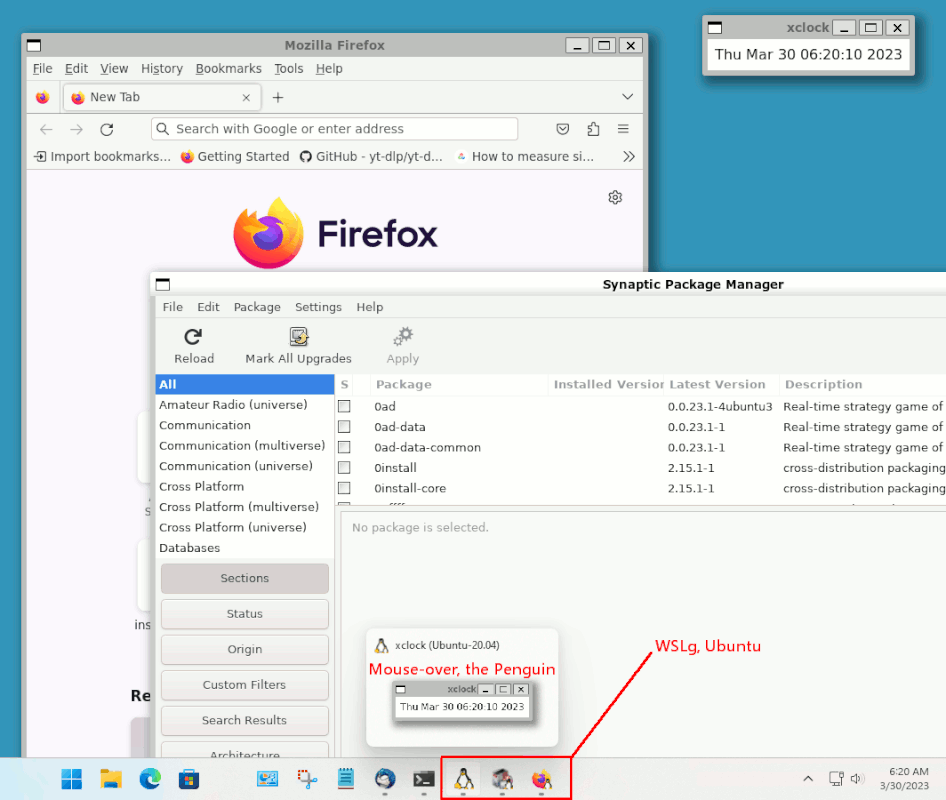
[Picture]
https://i.postimg.cc/g2NhbvhH/WSLg-Ubuntu-on-W11-Home.gif
In Task Manager, you see vmmemWSL running and using about 1GB of memory.
I had LO Draw running in it yesterday, to open a Microsoft Publisher sample file.
$ dd if=/dev/zero of=/dev/null bs=1M count=1024
1024+0 records in
1024+0 records out
1073741824 bytes (1.1 GB, 1.0 GiB) copied, 0.0365727 s, 29.4 GB/s
I got the Linux version of Prime95, had it run in Torture Test Mode
under bash shell, and it managed to use fifty percent of CPU when
asked to test on six cores (6C 12T). It tested half of the system RAM,
so in terms of malloc limit, it seems to be able to use about
half of the system RAM. The reason I did that test, is to make sure
the virtualization is not limited to just one core. And it
seemed to pass that test.
From a graphics perspective, I don't think it knows what VSYNC is.
And /dev, while present, still is not an "authentic emulation".
(/dev/sda is there, but not /dev/sda1).
So some things, like gnome-disks, still don't work. But I would
say, of the things tested, it's a damn impressive piece of work.
The graphics path it's using is ridiculous, but... it works.
It's using Terminal Services for the rootless windows for
things like Firefox, yet I don't think Firefox can tell it is
running over Terminal Services. That is like, remote desktop protocol.
And firefox is fooled into thinking regular Linux graphics are present.
That means all the normal graphics layers are present, plus the output
is piped over Terminal Services to the Windows desktop. The glxgears
run, the graphics look perfectly normal.
$ inxi -G
Graphics: Device-1: Microsoft driver: dxgkrnl v: N/A
Display: wayland-0 server: Microsoft Corporation X.org 1.20.13 driver: dxgkrnl resolution: 1440x900~60Hz
OpenGL: renderer: llvmpipe (LLVM 12.0.0 256 bits) v: 4.5 Mesa 21.2.6
$ glxgears
10551 frames in 5.0 seconds = 2110.035 FPS
11310 frames in 5.0 seconds = 2261.971 FPS
11309 frames in 5.0 seconds = 2261.759 FPS
X connection to :0 broken (explicit kill or server shutdown).
The graphics performance isn't exactly "flaming hot", but it does work.
Since the graphics subsystem doesn't emulate VSYNC, that's why glxgears
runs faster than 60FPS, without any additional directive to suppress VSYNC.
The graphics is only a GTX1050, so it's not a high end card.
While glxgears was running, the Windows Task Manager reports the GPU
activity level is "zero", while the CPU activity level (6C 12T) is 32 percent. So the graphics path does not appear to be accelerated. That means the CPU
was drawing the 3D image for glxgears, onto the screen (via Terminal Services).
Paul
--- SoupGate-Win32 v1.05
* Origin: fsxNet Usenet Gateway (21:1/5)