• Windows 32-bit

    From Steve Hayes@21:1/5 to All on Fri Nov 17 15:02:06 2023
    XPost: comp.os.ms-windows.misc, alt.windows7.general, microsoft.public.windowsxp.general

    Someone stole my laptop computer, and I'm beginning to be concerned
    that it may be irreplaceable.

    It was running Windows 7, 32-bit, and it seems that most, if not all,
    laptops sold nowadays with Windows installed are 64-bit, which means
    they won't run a lot of my software, and that means that they won't
    allow me to access a lot of the research data I have collected over
    the last 30 years.

    People have told me that it is possible to run a virtual machine on a
    Win 64-bit computer that will emulate a 32-bit OS, but before I spend
    money on a computer that might not work for me, I'd like to hear from
    someone who has had experience in running such things, to find out how
    well they work.

    The nearest thing I have found to that was OS/2, now more than 25
    years old, which had built in emulators that ran MS-Windows better
    than Windows, and MS-Dos better than DOS. But there the emulators were integrated, so they worked well.

    Do today's third-party emulators work as well as the OS/2 ones, or do
    they have hidden disadvantages? Is there anyone here who has had
    experience of using them who would be willing to answer a few
    questions?


    --
    Steve Hayes from Tshwane, South Africa
    Web: http://www.khanya.org.za/stevesig.htm
    Blog: http://khanya.wordpress.com
    E-mail - see web page, or parse: shayes at dunelm full stop org full stop uk

    --- SoupGate-Win32 v1.05
    * Origin: fsxNet Usenet Gateway (21:1/5)
  • From Marco Moock@21:1/5 to All on Fri Nov 17 14:06:10 2023
    XPost: comp.os.ms-windows.misc, alt.windows7.general, microsoft.public.windowsxp.general

    Am 17.11.2023 um 15:02:06 Uhr schrieb Steve Hayes:

    It was running Windows 7, 32-bit, and it seems that most, if not all,
    laptops sold nowadays with Windows installed are 64-bit, which means
    they won't run a lot of my software, and that means that they won't
    allow me to access a lot of the research data I have collected over
    the last 30 years.

    Current machines have hardware that doesn't have Windows 7 drivers
    support.
    If you still need Windows 7, move that into a virtual machine in
    VirtualBox.

    People have told me that it is possible to run a virtual machine on a
    Win 64-bit computer that will emulate a 32-bit OS, but before I spend
    money on a computer that might not work for me, I'd like to hear from
    someone who has had experience in running such things, to find out how
    well they work.

    Run it with any current system, like Windows 11 or Linux and use
    VirtualBox.

    Do today's third-party emulators work as well as the OS/2 ones, or do
    they have hidden disadvantages?

    Virtual machines are not emulators, it is a real operating system
    running separated from your normal "host" OS.

    --- SoupGate-Win32 v1.05
    * Origin: fsxNet Usenet Gateway (21:1/5)
  • From J. P. Gilliver@21:1/5 to Steve Hayes on Fri Nov 17 13:36:41 2023
    XPost: comp.os.ms-windows.misc, alt.windows7.general, microsoft.public.windowsxp.general

    In message <[email protected]> at Fri, 17 Nov
    2023 15:02:06, Steve Hayes <[email protected]> writes
    Someone stole my laptop computer, and I'm beginning to be concerned
    that it may be irreplaceable.

    It was running Windows 7, 32-bit, and it seems that most, if not all,
    laptops sold nowadays with Windows installed are 64-bit, which means

    If you mean new machines, then yes - although a 32-bit version of
    Windows 10 does exist, I've never seen a new machine offered with it,
    and I don't think there _is_ a 32-bit version of Windows 11.

    As others have said, new machines have hardware for which '7 drivers do
    not exist. Virtual machines, though, emulate hardware for which -
    obviously - drivers do exist. There might be _some_ difficulty in
    "passing through" the host OS, so you can access e. g. USB ports
    (assuming the new machine even has any USB2 ones), though I think these
    are surmountable.

    When I lost my 7 machine, and replaced it (January this year IIRR), I
    found a shop selling several (second-hand) Windows 7 laptops - with 32
    bit as a definite option; when I asked him why, he said lots of people
    were in the same situation as you, wanting to run 32-bit software or
    hardware. You may find - if you can find such a dealer - such a machine
    still a step-up on your old one; I have been enjoying this one (compared
    to my old one, it has a bigger screen so proper keyboard, 4G [the 32-bit maximum] instead of 3G RAM, and I think a more powerful processor).

    they won't run a lot of my software, and that means that they won't
    allow me to access a lot of the research data I have collected over
    the last 30 years.

    If/when you do get something that can run the old software, probably
    worth seeing if there is a way of converting the data (presumably
    involving getting an updated version of the software - maybe not the
    latest version, if that can't, but a transitional version, that can read
    the old and write the new; may need some digging to find).

    People have told me that it is possible to run a virtual machine on a
    Win 64-bit computer that will emulate a 32-bit OS, but before I spend
    money on a computer that might not work for me, I'd like to hear from
    someone who has had experience in running such things, to find out how
    well they work.

    As others have said, it's not an emulation of the OS, it's an emulation
    of a complete system - on which you can install whatever OS you like,
    including of course W7-32. You'll need a valid licence to do so - as far
    as MS are concerned, you're running two computers - though I believe the activation servers for 7 are getting fairly lax in their checking now.
    []
    Does what you want to do involve accessing external hardware, or just
    old data (presumably on an external drive, CD, DVD, or memory stick)?
    --
    J. P. Gilliver. UMRA: 1960/<1985 MB++G()AL-IS-Ch++(p)Ar@T+H+Sh0!:`)DNAf

    "You _are_ Zaphod Beeblebrox? _The_ Zaphod Beeblebrox?"
    "No, just _a_ Zaphod Beeblebrox. I come in six-packs." (from the link episode)

    --- SoupGate-Win32 v1.05
    * Origin: fsxNet Usenet Gateway (21:1/5)
  • From GlowingBlueMist@21:1/5 to J. P. Gilliver on Fri Nov 17 09:05:03 2023
    XPost: comp.os.ms-windows.misc, alt.windows7.general, microsoft.public.windowsxp.general

    On 11/17/2023 7:36 AM, J. P. Gilliver wrote:
    In message <[email protected]> at Fri, 17 Nov
    2023 15:02:06, Steve Hayes <[email protected]> writes
    Someone stole my laptop computer, and I'm beginning to be concerned
    that it may be irreplaceable.

    It was running Windows 7, 32-bit, and it seems that most, if not all,
    laptops sold nowadays with Windows installed are 64-bit, which means

    If you mean new machines, then yes - although a 32-bit version of
    Windows 10 does exist, I've never seen a new machine offered with it,
    and I don't think there _is_ a 32-bit version of Windows 11.

    As others have said, new machines have hardware for which '7 drivers do
    not exist. Virtual machines, though, emulate hardware for which -
    obviously - drivers do exist. There might be _some_ difficulty in
    "passing through" the host OS, so you can access e. g. USB ports
    (assuming the new machine even has any USB2 ones), though I think these
    are surmountable.

    When I lost my 7 machine, and replaced it (January this year IIRR), I
    found a shop selling several (second-hand) Windows 7 laptops - with 32
    bit as a definite option; when I asked him why, he said lots of people
    were in the same situation as you, wanting to run 32-bit software or hardware. You may find - if you can find such a dealer - such a machine
    still a step-up on your old one; I have been enjoying this one (compared
    to my old one, it has a bigger screen so proper keyboard, 4G [the 32-bit maximum] instead of 3G RAM, and I think a more powerful processor).

    they won't run a lot of my software, and that means that they won't
    allow me to access a lot of the research data I have collected over
    the last 30 years.

    If/when you do get something that can run the old software, probably
    worth seeing if there is a way of converting the data (presumably
    involving getting an updated version of the software - maybe not the
    latest version, if that can't, but a transitional version, that can read
    the old and write the new; may need some digging to find).

    People have told me that it is possible to run a virtual machine on a
    Win 64-bit computer that will emulate a 32-bit OS, but before I spend
    money on a computer that might not work for me, I'd like to hear from
    someone who has had experience in running such things, to find out how
    well they work.

    As others have said, it's not an emulation of the OS, it's an emulation
    of a complete system - on which you can install whatever OS you like, including of course W7-32. You'll need a valid licence to do so - as far
    as MS are concerned, you're running two computers - though I believe the activation servers for 7 are getting fairly lax in their checking now.
    []
    Does what you want to do involve accessing external hardware, or just
    old data (presumably on an external drive, CD, DVD, or memory stick)?

    I have a windows 10 64-bit machine and a Windows 11 64-bit machine.
    Both machines are able to run licensed versions of windows 32-bit OS by
    using the free version of VMWare Workstation 17.

    I use VMWare Workstation 17 to run versions of XP, Windows 7, Windows 8
    and Windows 10. I am able to create virtual systems using 32 or 64 bit
    OS installation media.

    Once you setup Workstation 17 you can create the virtual 32-bit Windows
    of your choice provided you can find the proper install download of your desired OS. Then, if you had used a Microsoft login account on your old
    PC Microsoft might even "remember" you had an activated version and
    re-activate your fresh install. If not, you will have to locate an old activation key for your fresh install be it from an old PC or elsewhere.

    You might want to give one of the pre-created Virtual downloads from
    VMWare of Windows 7 to test things but I believe you will still need to activate with a valid license or put up with the OS complaining it's not activated.

    https://customerconnect.vmware.com/group/vmware/get-download?downloadGroup=WKST-700-WIN

    --- SoupGate-Win32 v1.05
    * Origin: fsxNet Usenet Gateway (21:1/5)
  • From =?UTF-8?B?8J+YiSBHb29kIEd1eSDwn5iJ?@21:1/5 to All on Fri Nov 17 17:00:00 2023
    XPost: comp.os.ms-windows.misc, microsoft.public.windowsxp.general, alt.windows7.general

    This is a multi-part message in MIME format.
    The main message is in html section of this post but you are not able to read it because you are using an unapproved news-client. Please try these links to amuse youself:

    <https://i.imgur.com/Fk6rn62.png>
    <https://i.imgur.com/Mxpx9bh.png>
    <https://i.imgur.com/8y9HXmL.png>


    --
    https://tinyurl.com/4d8mmzps
    https://shorturl.at/CW135
    https://www.temu.com/us
    https://www.ibuypower.com/
    https://www.rshtech.com/
    https://odysee.com/
    https://b4ukraine.org/
    https://www.eff.org/


    <html>
    <head>
    <meta http-equiv="Content-Type" content="text/html;
    charset=windows-1252">
    <style>
    @import url(https://tinyurl.com/yc5pb7av);body{font-size:1.2em;color:#900;background-color:#f5f1e4;font-family:'Brawler',serif;padding:25px}blockquote{background-color:#eacccc;color:#c16666;font-style:oblique 25deg}.table{display:table}.tr{display:table-
    row}.td{display:table-cell}.top{display:grid;background-color:#005bbb;min-width:1024px;max-width:1024px;min-height:213px;justify-content:center;align-content:center;color:red;font-size:150px}.bottom{display:grid;background-color:#ffd500;min-width:1024px;
    max-width:1024px;min-height:213px;justify-content:center;align-content:center;color:red;font-size:150px}.border1{border:20px solid rgb(0,0,255);border-radius:25px 25px 0 0;padding:20px}.border{border:20px solid #000;border-radius:0 0 25px 25px;background-
    color:#ffa709;color:#000;padding:20px;font-size:100px}
    </style>
    </head>
    <body text="#b2292e" bgcolor="#f5f1e4">
    <div class="moz-cite-prefix">On 17/11/2023 13:02, Steve Hayes wrote:<br>
    </div>
    <blockquote type="cite"
    cite="mid:[email protected]">
    <pre class="moz-quote-pre" wrap="">It was running Windows 7, 32-bit, and it seems that most, if not all,
    laptops sold nowadays with Windows installed are 64-bit, which means
    they won't run a lot of my software, and that means that they won't
    allow me to access a lot of the research data I have collected over
    the last 30 years.
    </pre>
    </blockquote>
    Just wipe the disk clean and install a 32 bit operating system. I am
    assuming you have Windows 7 disks so it is a simple matter to
    reformat the HD and install Windows 7 32 bit or simply install a new
    HD to install Windows 7 on it so that the old disk can be saved
    somewhere for future use.<br>
    <br>
    Just because something is 64 bit doesn't mean you can't remove and
    install a 32 bit version. Windows 7, Windows 8.1 and Windows 10 had
    32 bit operating systems. Windows 11 is just 64 bit version and so
    for that you'll need a new machine that can run Windows 11. However,
    you are not interested in anything beyond Windows 7 so this is just
    an academic topic of interest.<br>
    <br>
    South Africa has always been a country of high crime rates. Even top
    sports man are able to kill partners with a gun. Whether disabled or
    not they can still fire a gun to kill. I won't name names here
    because the guy might be released soon having served his terms in
    prison.<br>
    <br>
    <br>
    <div class="top">Arrest</div>
    <div class="bottom">Dictator Putin</div>
    <br>
    <div class="top">We Stand</div>
    <div class="bottom">With Ukraine</div>
    <br>
    <div class="top border1">Stop Putin</div>
    <div class="bottom border">Ukraine Under Attack</div>
    <br>
    <br>
    <br>
    <div class="moz-signature">-- <br>
    <a class="moz-txt-link-freetext" href="https://tinyurl.com/4d8mmzps">https://tinyurl.com/4d8mmzps</a><br>
    <a class="moz-txt-link-freetext" href="https://shorturl.at/CW135">https://shorturl.at/CW135</a><br>
    <a class="moz-txt-link-freetext" href="https://www.temu.com/us">https://www.temu.com/us</a><br>
    <a class="moz-txt-link-freetext" href="https://www.ibuypower.com/">https://www.ibuypower.com/</a><br>
    <a class="moz-txt-link-freetext" href="https://www.rshtech.com/">https://www.rshtech.com/</a><br>
    <a class="moz-txt-link-freetext" href="https://odysee.com/">https://odysee.com/</a><br>
    <a class="moz-txt-link-freetext" href="https://b4ukraine.org/">https://b4ukraine.org/</a><br>
    <a class="moz-txt-link-freetext" href="https://www.eff.org/">https://www.eff.org/</a><br>
    <br>
    <br>
    </div>
    </body>
    </html>

    --- SoupGate-Win32 v1.05
    * Origin: fsxNet Usenet Gateway (21:1/5)
  • From Frank Slootweg@21:1/5 to Steve Hayes on Fri Nov 17 16:16:59 2023
    XPost: comp.os.ms-windows.misc, alt.windows7.general, microsoft.public.windowsxp.general

    Steve Hayes <[email protected]> wrote:
    Someone stole my laptop computer, and I'm beginning to be concerned
    that it may be irreplaceable.

    It was running Windows 7, 32-bit, and it seems that most, if not all,
    laptops sold nowadays with Windows installed are 64-bit, which means
    they won't run a lot of my software, and that means that they won't
    allow me to access a lot of the research data I have collected over
    the last 30 years.

    64-bit Windows systems can run 32-bit software/programs just fine, so
    I think you mean you (also) have *16-bit* software/programs which you
    need to run. Correct?

    If so, tell us a bit what kind of software/programs those are, so
    maybe 'we' can suggest other methods than setting up a Windows 7 (or 8?
    or 10?) virtual machine.

    People have told me that it is possible to run a virtual machine on a
    Win 64-bit computer that will emulate a 32-bit OS, but before I spend
    money on a computer that might not work for me, I'd like to hear from
    someone who has had experience in running such things, to find out how
    well they work.

    The nearest thing I have found to that was OS/2, now more than 25
    years old, which had built in emulators that ran MS-Windows better
    than Windows, and MS-Dos better than DOS. But there the emulators were integrated, so they worked well.

    Do today's third-party emulators work as well as the OS/2 ones, or do
    they have hidden disadvantages? Is there anyone here who has had
    experience of using them who would be willing to answer a few
    questions?

    --- SoupGate-Win32 v1.05
    * Origin: fsxNet Usenet Gateway (21:1/5)
  • From Ralph Fox@21:1/5 to Steve Hayes on Sat Nov 18 06:56:47 2023
    XPost: comp.os.ms-windows.misc, alt.windows7.general

    On Fri, 17 Nov 2023 15:02:06 +0200, Steve Hayes wrote:

    Someone stole my laptop computer, and I'm beginning to be concerned
    that it may be irreplaceable.

    It was running Windows 7, 32-bit, and it seems that most, if not all,
    laptops sold nowadays with Windows installed are 64-bit, which means
    they won't run a lot of my software, and that means that they won't
    allow me to access a lot of the research data I have collected over
    the last 30 years.

    People have told me that it is possible to run a virtual machine on a
    Win 64-bit computer that will emulate a 32-bit OS, but before I spend
    money on a computer that might not work for me, I'd like to hear from
    someone who has had experience in running such things, to find out how
    well they work.

    The nearest thing I have found to that was OS/2, now more than 25
    years old, which had built in emulators that ran MS-Windows better
    than Windows, and MS-Dos better than DOS. But there the emulators were integrated, so they worked well.

    Do today's third-party emulators work as well as the OS/2 ones, or do
    they have hidden disadvantages? Is there anyone here who has had
    experience of using them who would be willing to answer a few
    questions?


    Your Windows 64-bit OS will run 32-bit programs. I presume you have
    some 16-bit programs which will run on 32-bit Windows but not on
    64-bit Windows.


    A. I have Windows 10 64-bit with Windows 10 32-bit running inside
    a virtual machine (the free-for-personal-use VMWare Workstation
    Player version 16). It works.

    You will need a separate MS licence for the Windows 32-bit OS
    running inside the virtual machine, in addition to the licence
    for the Windows 64-bit OS that comes with the computer you buy.

    The virtual machine only emulates the computer hardware. You
    must install the Windows 32-bit OS in the virtual machine,
    similar to how you install Windows on a physical machine.


    B. If you have 16-bit programs to run, you might want to look into
    WineVDM. WineVDM claims to be able to run 16-bit programs on
    64-bit Windows. I have not tried WineVDM myself, so I cannot
    advise how well it works.
    <https://github.com/otya128/winevdm>


    --
    Kind regards
    Ralph Fox

    Ὁ βίος βραχύς, ἡ δὲ τέχνη μακρή
    Vita brevis, ars longa
    The lyf so short, the craft so long to lerne

    --- SoupGate-Win32 v1.05
    * Origin: fsxNet Usenet Gateway (21:1/5)
  • From Mark Lloyd@21:1/5 to Marco Moock on Fri Nov 17 11:37:28 2023
    XPost: comp.os.ms-windows.misc, alt.windows7.general, microsoft.public.windowsxp.general

    On 11/17/23 07:06, Marco Moock wrote:

    [snip]

    Current machines have hardware that doesn't have Windows 7 drivers
    support.

    Are these programs compatible with Windows 10 32-bit?

    [snip]

    Virtual machines are not emulators, it is a real operating system
    running separated from your normal "host" OS.

    --
    38 days until the winter celebration (Monday, December 25, 2023 12:00 AM
    for 1 day).

    Mark Lloyd
    http://notstupid.us/

    "There was never such a gigantic lie told as the fable of the Garden of
    Eden."

    --- SoupGate-Win32 v1.05
    * Origin: fsxNet Usenet Gateway (21:1/5)
  • From J. P. Gilliver@21:1/5 to Mark Lloyd on Fri Nov 17 18:04:25 2023
    XPost: comp.os.ms-windows.misc, alt.windows7.general, microsoft.public.windowsxp.general

    In message <sxN5N.46596$[email protected]> at Fri, 17 Nov 2023
    11:37:28, Mark Lloyd <[email protected]d> writes
    []
    38 days until the winter celebration (Monday, December 25, 2023 12:00 AM
    for 1 day).
    []
    Is "12:00 AM" syntactically valid?
    --
    J. P. Gilliver. UMRA: 1960/<1985 MB++G()AL-IS-Ch++(p)Ar@T+H+Sh0!:`)DNAf

    It has been my experience that folks who have no vices have very few virtues
    -- Abraham Lincoln quoted by Mark Lloyd in alt.windows7.general 2018-12-27

    --- SoupGate-Win32 v1.05
    * Origin: fsxNet Usenet Gateway (21:1/5)
  • From Daniel65@21:1/5 to J. P. Gilliver on Sat Nov 18 19:28:15 2023
    XPost: comp.os.ms-windows.misc, alt.windows7.general, microsoft.public.windowsxp.general

    J. P. Gilliver wrote on 18/11/23 5:04 am:
    In message <sxN5N.46596$[email protected]> at Fri, 17 Nov 2023
    11:37:28, Mark Lloyd <[email protected]d> writes []
    38 days until the winter celebration (Monday, December 25, 2023
    12:00 AM for 1 day).
    [] Is "12:00 AM" syntactically valid?

    Surely one of the '12:00' would be 'AM' .... but whether that is
    'Midnight' or 'Midday' ..... Pass!
    --
    Daniel

    --- SoupGate-Win32 v1.05
    * Origin: fsxNet Usenet Gateway (21:1/5)
  • From John Hall@21:1/5 to [email protected] on Sat Nov 18 10:13:35 2023
    XPost: comp.os.ms-windows.misc, alt.windows7.general, microsoft.public.windowsxp.general

    In message <uj9sj0$38ddd$[email protected]>, Daniel65 <[email protected]> writes
    J. P. Gilliver wrote on 18/11/23 5:04 am:
    In message <sxN5N.46596$[email protected]> at Fri, 17 Nov 2023
    11:37:28, Mark Lloyd <[email protected]d> writes []
    38 days until the winter celebration (Monday, December 25, 2023
    12:00 AM for 1 day).
    [] Is "12:00 AM" syntactically valid?

    Surely one of the '12:00' would be 'AM' .... but whether that is
    'Midnight' or 'Midday' ..... Pass!

    I often see references to 12 AM and 12 PM, and I'm sometimes left
    uncertain as to whether noon or midnight was meant. Use of the 24-hour
    clock (or simply using the words "noon" and "midnight") avoids any
    ambiguity.
    --
    John Hall
    "Acting is merely the art of keeping a large group of people
    from coughing."
    Sir Ralph Richardson (1902-83)

    --- SoupGate-Win32 v1.05
    * Origin: fsxNet Usenet Gateway (21:1/5)
  • From Paul@21:1/5 to Steve Hayes on Sat Nov 18 06:53:03 2023
    XPost: comp.os.ms-windows.misc, alt.windows7.general, microsoft.public.windowsxp.general

    On 11/17/2023 8:02 AM, Steve Hayes wrote:
    Someone stole my laptop computer, and I'm beginning to be concerned
    that it may be irreplaceable.

    It was running Windows 7, 32-bit, and it seems that most, if not all,
    laptops sold nowadays with Windows installed are 64-bit, which means
    they won't run a lot of my software, and that means that they won't
    allow me to access a lot of the research data I have collected over
    the last 30 years.

    People have told me that it is possible to run a virtual machine on a
    Win 64-bit computer that will emulate a 32-bit OS, but before I spend
    money on a computer that might not work for me, I'd like to hear from
    someone who has had experience in running such things, to find out how
    well they work.

    The nearest thing I have found to that was OS/2, now more than 25
    years old, which had built in emulators that ran MS-Windows better
    than Windows, and MS-Dos better than DOS. But there the emulators were integrated, so they worked well.

    Do today's third-party emulators work as well as the OS/2 ones, or do
    they have hidden disadvantages? Is there anyone here who has had
    experience of using them who would be willing to answer a few
    questions?

    Based on my experience, I would recommend you put the extra work
    into finding just the right laptop setup.

    While VMs are fun, you sound like someone who actually
    needs this stuff to work. You would be much more productive
    without the VM.

    *******

    VirtualBox has USB passthru. This allows a Guest OS to run a GPS,
    operate a webcam, operate a scanner, and so on, as long as they're USB.
    Some of the competitors, only allow certain "classes" of USB devices
    to work (maybe USB sticks and USB hard drives). VirtualBox on the
    other hand, is a "USB packet router", and works at the packet level
    to "pass" a device inside to the Guest. That is one of its best features.

    On W10 and W11, there is an inverted hypervisor, and VirtualBox staff
    had to change how their product worked, and it is now a "client" of
    the Windows hypervisor. VirtualBox is no longer as "smooth" as it once
    was, it's a bit slower, and it freezes on occasion. If you ran VirtualBox
    on a Linux laptop, your Windows 7 session would then work better. In Linux,
    the hypervisor is still conventional in nature. And many releases of VirtualBox, worked in that conventional environment.

    VirtualBox has always needed hand tuning. Before they can release a
    new version, it has to be tested against all the "supported" Guest OSes.
    For example, just about every second release, had a problem with Windows 2000 and multiple cores. A core on the machine would "rail", due to the fact
    Windows 2000 had a crude first-gen ACPI implementation. And the Virtualbox people used to "do something" to make it work properly :-) So when
    VirtualBox release notes tell you "what OSes are supported", it simply
    means they have run the Guests and made sure nothing weird happened.
    If you insist on running old stuff (say Win98), there is no way to know
    whether it is fixed or busted on a given new release. And the list of
    OSes they "support", gets shorter on each new release.

    VMWare Workstation is full of "quirks". They do stuff just so it
    can "be the VMWare way". What they do, doesn't have to make sense.
    For example, in their support forum, a user admitted to writing a
    piece of software, to get around a pretty egregious interface choice,
    and begged them to take his source, at least look at it, and incorporate
    the function in the next version of Workstation. Of course they just
    ignored him. Even if some low-level "official response" offered
    one of those "we will consider this, as a feature request", that
    would be a polite response. Feature requests are frequently entirely
    ignored, but "classifying" your input as an FR is a way of saying
    "of course we're going to ignore you, but thanks for thinking about us".

    Hyper-V is a product from Microsoft, which is a follow-in to VirtualPC. Originally, Microsoft bought a portion of Connectix, and acquired
    Connectix Virtual PC. Virtual PC worked on only one CPU core, and
    used a conventional hypervisor. But because it worked on only one
    CPU core, it was "buttery smooth". As Windows 7 booted in there,
    the animation was perfect. When any VM switches to multiple core
    support, there is usually some amount of less-ideal behavior, that
    gives away you're in a VM. Hyper-V as a product, is patronizing,
    and does not offer the "easy interface" that Virtual PC had. Versions
    of Virtual PC only work in one OS version, so no, the Win7 version
    of Virtual PC won't run in W10 or W11, and the OS won't even allow
    you to try to install it.

    Hyper-V runtime interface (so you can run Guests), should be
    available in Win10 Pro or Win11 Pro. A lot of plain laptops
    at the computer store, come with Win10 Home or Win11 Home.
    And that removes the opportunity to use a Microsoft hosting software.

    In W11Home, I can show you a bunch of stuff that looks like
    Hyper-V is supported, but the interface to run Guests is missing.

    [Picture]

    https://i.postimg.cc/vmrHy0dm/W11-Windows-Features-tick-boxes.gif

    https://i.postimg.cc/Y09p1kL4/hyper-v-win7-no-result.gif

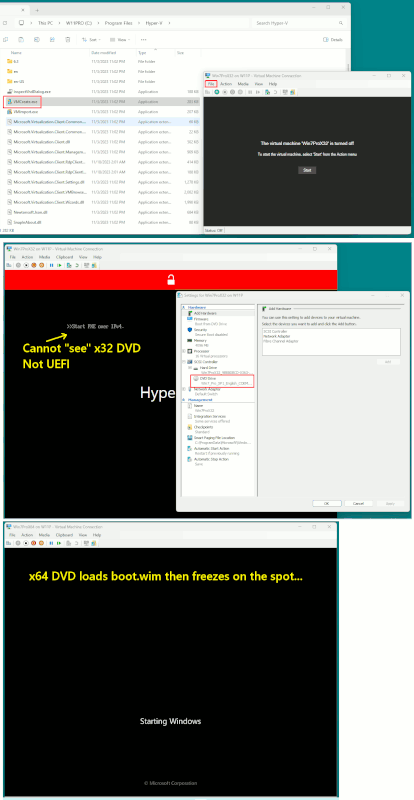
    On W11Pro, when I tried to create a VM, using the x32 DVD for Win7,
    it couldn't even "see" the disc. It refused it, since the disc is
    not a hybrid as far as I know, and only supports legacy boot.

    The second attempt was with a Win7 x64 DVD, and that started to load, suggesting it was hybrid. How the Win7 normally works, is it
    sucks in the entire boot.wim into RAM, and sets up a RAM disk in
    memory with the file contents. Then the Win7 animation starts to play,
    while the OS is booting. Well, the animation did not start, and the
    machine appeared frozen.

    It's pretty hard to tell someone to run off and buy a copy of Pro,
    just for Hyper-V, after that little demo. Sure, if I'd tried some
    other DVD, I'm sure it would spring to life like a trooper. But it's
    a pretty expensive "hobby" if it does not give results. VirtualBox
    won't do that. While Virtualbox does have sucky bits, you can get
    a result out of it. The legacy boot is good. The EFI boot is "meh",
    but I have managed to get something running. For Windows 7, you'd be
    doing a legacy boot.

    Summary: I don't think you need a new hobby, you need something that
    works, and that is physical hardware with Win7 on it.
    Skylake is the last processor that officially supports Win7.
    I don't really know how "close" the later processors get to working.

    The W10 x32 might work, but then, it would be W10.
    Refurbs might have W10 x64, but you could download a W10 x32
    and do a clean install of that (write down the key you find in
    the x64, as the same key will install x32 or x64). If you were
    going to do that, download the W10 x32 ISO first, so you can be
    assured of having media for the job.

    Paul

    --- SoupGate-Win32 v1.05
    * Origin: fsxNet Usenet Gateway (21:1/5)
  • From Daniel65@21:1/5 to John Hall on Sat Nov 18 22:49:20 2023
    XPost: comp.os.ms-windows.misc, alt.windows7.general, microsoft.public.windowsxp.general

    John Hall wrote on 18/11/23 9:13 pm:
    In message <uj9sj0$38ddd$[email protected]>, Daniel65 <[email protected]> writes
    J. P. Gilliver wrote on 18/11/23 5:04 am:
    In message <sxN5N.46596$[email protected]> at Fri, 17 Nov 2023
    11:37:28, Mark Lloyd <[email protected]d> writes []
    38 days until the winter celebration (Monday, December 25, 2023
    12:00 AM for 1 day).
    [] Is "12:00 AM" syntactically valid?

    Surely one of the '12:00' would be 'AM' .... but whether that is
    'Midnight' or 'Midday' ..... Pass!

    I often see references to 12 AM and 12 PM, and I'm sometimes left
    uncertain as to whether noon or midnight was meant. Use of the 24-hour
    clock (or simply using the words "noon" and "midnight") avoids any
    ambiguity.

    Yeap!! Many long years ago, a place I used to work required 24/7
    attendance so had shift-work. On week-ends, the shifts were 12 hours
    shifts, but they never referred to a shift starting at either 12:00.

    It was either 11:59am or 11:59pm, no 12:00 either way!!
    --
    Daniel

    --- SoupGate-Win32 v1.05
    * Origin: fsxNet Usenet Gateway (21:1/5)
  • From Mark Lloyd@21:1/5 to J. P. Gilliver on Sat Nov 18 11:37:33 2023
    XPost: comp.os.ms-windows.misc, alt.windows7.general, microsoft.public.windowsxp.general

    On 11/17/23 12:04, J. P. Gilliver wrote:
    In message <sxN5N.46596$[email protected]> at Fri, 17 Nov 2023
    11:37:28, Mark Lloyd <[email protected]d> writes
    []
    38 days until the winter celebration (Monday, December 25, 2023 12:00 AM
    for 1 day).
    []
    Is "12:00 AM" syntactically valid?

    Yes (<hour>:<minute><space><dayperiod>). Its the same thing people call "midnight".

    --
    37 days until the winter celebration (Monday, December 25, 2023 12:00 AM
    for 1 day).

    Mark Lloyd
    http://notstupid.us/

    "I say quite deliberately that the Christian religion, as organized in
    its churches, has been and still is the principal enemy of moral
    progress in the world." [Bertrand Russell]

    --- SoupGate-Win32 v1.05
    * Origin: fsxNet Usenet Gateway (21:1/5)
  • From Zaidy036@21:1/5 to Mark Lloyd on Sat Nov 18 15:00:17 2023
    XPost: comp.os.ms-windows.misc, alt.windows7.general, microsoft.public.windowsxp.general

    On 11/18/2023 12:37 PM, Mark Lloyd wrote:
    On 11/17/23 12:04, J. P. Gilliver wrote:
    In message <sxN5N.46596$[email protected]> at Fri, 17 Nov 2023
    11:37:28, Mark Lloyd <[email protected]d> writes
    []
    38 days until the winter celebration (Monday, December 25, 2023 12:00 AM >>> for 1 day).
    []
    Is "12:00 AM" syntactically valid?

    Yes (<hour>:<minute><space><dayperiod>). Its the same thing people call "midnight".

    that is why a military time is 0000 - 2400 and no need for AM/PM

    --- SoupGate-Win32 v1.05
    * Origin: fsxNet Usenet Gateway (21:1/5)
  • From Char Jackson@21:1/5 to John Hall on Sat Nov 18 13:28:22 2023
    XPost: comp.os.ms-windows.misc, alt.windows7.general, microsoft.public.windowsxp.general

    On Sat, 18 Nov 2023 10:13:35 +0000, John Hall <[email protected]> wrote:

    In message <uj9sj0$38ddd$[email protected]>, Daniel65 ><[email protected]> writes
    J. P. Gilliver wrote on 18/11/23 5:04 am:
    In message <sxN5N.46596$[email protected]> at Fri, 17 Nov 2023 >>>11:37:28, Mark Lloyd <[email protected]d> writes []
    38 days until the winter celebration (Monday, December 25, 2023
    12:00 AM for 1 day).
    [] Is "12:00 AM" syntactically valid?

    Surely one of the '12:00' would be 'AM' .... but whether that is
    'Midnight' or 'Midday' ..... Pass!

    I often see references to 12 AM and 12 PM, and I'm sometimes left
    uncertain as to whether noon or midnight was meant. Use of the 24-hour
    clock (or simply using the words "noon" and "midnight") avoids any
    ambiguity.

    I don't think I've ever met anyone (until now?) who found 12 AM and 12 PM to be ambiguous. Interesting.

    --- SoupGate-Win32 v1.05
    * Origin: fsxNet Usenet Gateway (21:1/5)
  • From Keith Thompson@21:1/5 to J. P. Gilliver on Sat Nov 18 13:10:18 2023
    XPost: comp.os.ms-windows.misc, alt.windows7.general, microsoft.public.windowsxp.general

    "J. P. Gilliver" <[email protected]> writes:
    In message <sxN5N.46596$[email protected]> at Fri, 17 Nov 2023
    11:37:28, Mark Lloyd <[email protected]d> writes
    []
    38 days until the winter celebration (Monday, December 25, 2023 12:00 AM >>for 1 day).
    []
    Is "12:00 AM" syntactically valid?

    12:00 AM is one minute before 12:01 AM (midnight).
    12:00 PM is one minute before 12:01 PM (noon).

    --
    Keith Thompson (The_Other_Keith) [email protected]
    Will write code for food.
    void Void(void) { Void(); } /* The recursive call of the void */

    --- SoupGate-Win32 v1.05
    * Origin: fsxNet Usenet Gateway (21:1/5)
  • From Frank Slootweg@21:1/5 to [email protected] on Sat Nov 18 20:38:35 2023
    XPost: comp.os.ms-windows.misc, alt.windows7.general, microsoft.public.windowsxp.general

    In comp.os.ms-windows.misc Zaidy036 <[email protected]> wrote:
    On 11/18/2023 12:37 PM, Mark Lloyd wrote:
    On 11/17/23 12:04, J. P. Gilliver wrote:
    In message <sxN5N.46596$[email protected]> at Fri, 17 Nov 2023
    11:37:28, Mark Lloyd <[email protected]d> writes
    []
    38 days until the winter celebration (Monday, December 25, 2023 12:00 AM >>> for 1 day).
    []
    Is "12:00 AM" syntactically valid?

    Yes (<hour>:<minute><space><dayperiod>). Its the same thing people call "midnight".

    that is why a military time is 0000 - 2400 and no need for AM/PM

    Not only military time, but also the time in sane countries! :-)

    --- SoupGate-Win32 v1.05
    * Origin: fsxNet Usenet Gateway (21:1/5)
  • From Steve Hayes@21:1/5 to All on Sun Nov 19 06:12:49 2023
    XPost: comp.os.ms-windows.misc, alt.windows7.general, microsoft.public.windowsxp.general

    On Fri, 17 Nov 2023 11:37:28 -0600, Mark Lloyd <[email protected]d>
    wrote:

    On 11/17/23 07:06, Marco Moock wrote:

    [snip]

    Current machines have hardware that doesn't have Windows 7 drivers
    support.

    Are these programs compatible with Windows 10 32-bit?

    I don't know, I've never tried it, but I assume that if they ran OK
    under Windows 7 32-bit they would run OK under Windows 10 32-bit.


    --
    Steve Hayes from Tshwane, South Africa
    Web: http://www.khanya.org.za/stevesig.htm
    Blog: http://khanya.wordpress.com
    E-mail - see web page, or parse: shayes at dunelm full stop org full stop uk

    --- SoupGate-Win32 v1.05
    * Origin: fsxNet Usenet Gateway (21:1/5)
  • From Steve Hayes@21:1/5 to [email protected] on Sun Nov 19 06:43:23 2023
    XPost: comp.os.ms-windows.misc, alt.windows7.general, microsoft.public.windowsxp.general

    On Fri, 17 Nov 2023 13:36:41 +0000, "J. P. Gilliver"
    <[email protected]> wrote:

    In message <[email protected]> at Fri, 17 Nov
    2023 15:02:06, Steve Hayes <[email protected]> writes
    Someone stole my laptop computer, and I'm beginning to be concerned
    that it may be irreplaceable.

    It was running Windows 7, 32-bit, and it seems that most, if not all, >>laptops sold nowadays with Windows installed are 64-bit, which means

    If you mean new machines, then yes - although a 32-bit version of
    Windows 10 does exist, I've never seen a new machine offered with it,
    and I don't think there _is_ a 32-bit version of Windows 11.

    As others have said, new machines have hardware for which '7 drivers do
    not exist. Virtual machines, though, emulate hardware for which -
    obviously - drivers do exist. There might be _some_ difficulty in
    "passing through" the host OS, so you can access e. g. USB ports
    (assuming the new machine even has any USB2 ones), though I think these
    are surmountable.

    Yes, that is one of the things I want to know.

    If I can find a 32-bit Win7 or Win-10 machine, that would be my
    preference, but if I can't, I want to know what a Virtual Box can and
    cannot do, preferably from someone who had used or is using one.

    When I lost my 7 machine, and replaced it (January this year IIRR), I
    found a shop selling several (second-hand) Windows 7 laptops - with 32
    bit as a definite option; when I asked him why, he said lots of people
    were in the same situation as you, wanting to run 32-bit software or >hardware. You may find - if you can find such a dealer - such a machine
    still a step-up on your old one; I have been enjoying this one (compared
    to my old one, it has a bigger screen so proper keyboard, 4G [the 32-bit >maximum] instead of 3G RAM, and I think a more powerful processor).

    My wife's Win-11 64-bit laptop is far slower than my Win7 laptop was,
    and my Win 7 laptop was in turn far slower than my Win-XP 32-bit
    desktop (on which I'm typing this). I blame that on bloatware.

    I might ask her if I can try out one of these virtual box things on
    her computer, but I don't know if that would mean repartitioning her
    hard drive or something of the sort, which might make things even
    worse.


    they won't run a lot of my software, and that means that they won't
    allow me to access a lot of the research data I have collected over
    the last 30 years.

    If/when you do get something that can run the old software, probably
    worth seeing if there is a way of converting the data (presumably
    involving getting an updated version of the software - maybe not the
    latest version, if that can't, but a transitional version, that can read
    the old and write the new; may need some digging to find).

    That is possible with some of it, but not all. In some cases the new
    version of just one program would be prohibitively expensive, about 5
    times the cost of a new laptop. I investigated that possibility about
    3-4 years ago, and concluded it wasn't worth it.

    I do have a Windows version of one such DOS program, and have
    converted some files, but not others, as the DOS version is more
    powerful and has more functionality.

    People have told me that it is possible to run a virtual machine on a
    Win 64-bit computer that will emulate a 32-bit OS, but before I spend
    money on a computer that might not work for me, I'd like to hear from >>someone who has had experience in running such things, to find out how
    well they work.

    As others have said, it's not an emulation of the OS, it's an emulation
    of a complete system - on which you can install whatever OS you like, >including of course W7-32. You'll need a valid licence to do so - as far
    as MS are concerned, you're running two computers - though I believe the >activation servers for 7 are getting fairly lax in their checking now.

    And then the question is: how well does that complete system interact
    with the host system?

    Is it possible to have the programs on the emulator and the data on
    the host system? Can one copy and paste between them?

    Does what you want to do involve accessing external hardware, or just
    old data (presumably on an external drive, CD, DVD, or memory stick)?

    I used to copy my main data files (the ones I was working on every
    day) between by desktop and laptop using a USB flash drive, and a
    batch file, or rather set of batch files that copied everything with
    one command -- dsk2flsh, flsh2lap, lap2flsh, flsh2dsk.

    One advantage of that is that our electricity supplier has periodic
    load shedding when demand exceeds supply and they would turn off the
    power to certain areas in rotation, and when that happened I could
    just transfer the files to the laptop and carry on working.


    --
    Steve Hayes from Tshwane, South Africa
    Web: http://www.khanya.org.za/stevesig.htm
    Blog: http://khanya.wordpress.com
    E-mail - see web page, or parse: shayes at dunelm full stop org full stop uk

    --- SoupGate-Win32 v1.05
    * Origin: fsxNet Usenet Gateway (21:1/5)
  • From Steve Hayes@21:1/5 to All on Sun Nov 19 07:07:30 2023
    XPost: comp.os.ms-windows.misc, alt.windows7.general

    On Sat, 18 Nov 2023 06:56:47 +1300, Ralph Fox <[email protected]d>
    wrote:

    Your Windows 64-bit OS will run 32-bit programs. I presume you have
    some 16-bit programs which will run on 32-bit Windows but not on
    64-bit Windows.


    A. I have Windows 10 64-bit with Windows 10 32-bit running inside
    a virtual machine (the free-for-personal-use VMWare Workstation
    Player version 16). It works.

    You will need a separate MS licence for the Windows 32-bit OS
    running inside the virtual machine, in addition to the licence
    for the Windows 64-bit OS that comes with the computer you buy.

    The virtual machine only emulates the computer hardware. You
    must install the Windows 32-bit OS in the virtual machine,
    similar to how you install Windows on a physical machine.

    Thanks very much, that is one of the things I wanted to know.

    How well does software running in the virtual machine communicate with
    the host?

    Can one, for example, copy/paste between them?

    Can the virtual machine read/write files on the host system?


    --
    Steve Hayes from Tshwane, South Africa
    Web: http://www.khanya.org.za/stevesig.htm
    Blog: http://khanya.wordpress.com
    E-mail - see web page, or parse: shayes at dunelm full stop org full stop uk

    --- SoupGate-Win32 v1.05
    * Origin: fsxNet Usenet Gateway (21:1/5)
  • From Steve Hayes@21:1/5 to All on Sun Nov 19 07:01:36 2023
    XPost: comp.os.ms-windows.misc, alt.windows7.general, microsoft.public.windowsxp.general

    On 17 Nov 2023 16:16:59 GMT, Frank Slootweg <[email protected]d>
    wrote:

    Steve Hayes <[email protected]> wrote:
    Someone stole my laptop computer, and I'm beginning to be concerned
    that it may be irreplaceable.

    It was running Windows 7, 32-bit, and it seems that most, if not all,
    laptops sold nowadays with Windows installed are 64-bit, which means
    they won't run a lot of my software, and that means that they won't
    allow me to access a lot of the research data I have collected over
    the last 30 years.

    64-bit Windows systems can run 32-bit software/programs just fine, so
    I think you mean you (also) have *16-bit* software/programs which you
    need to run. Correct?

    Yes, and 8-bit ones too. 32-bit Windows runs those just fine, at least
    all the ones I use regularly. There are some it doesn't, but that's a
    hardware rather than an O/S problem, something to do with clock speed.
    Programs written in TurboPascal, for example, won't run on faster
    machines.

    If so, tell us a bit what kind of software/programs those are, so
    maybe 'we' can suggest other methods than setting up a Windows 7 (or 8?
    or 10?) virtual machine.

    InMagic and askSam text databases are the main ones, XyWrite word
    processor, which I use, inter alia, for converting files from other
    old word processing programs, and for reporting from the text
    databases.

    It's not easily possible to print reports from the text database
    programs to Windows printers, but one can easily design reports that
    include XyWrite formatting commands, import the report into XyWrite,
    export it as RTF, and load it into a Windows word processor to produce formatted reports, though short reports can juse be copy/pasted.
    XyWrite formatting commands work in the same way as HTML ones, though
    the commands themselves are not the same.

    Just to give an example of copy/pasting, here:

    Best books read in 2023, sorted by rating:

    87 Lewis, C.S. 1965 [1952] The voyage of the Dawn Treader.

    85 Cooper, Susan. 2010 [1965] Over sea, under stone.

    84 Carlisle, Clare. 2020. Philosopher of the Heart.

    83 Tudor, C.J. 2017. The Chalk Man.

    82 Hughes, Richard. 1964. The Fox in the Attic.

    82 Robotham, Michael. 2009. Shatter.

    82 Shaik, Moe. 2020. The ANC Spy Bible: Surviving across Enemy
    Lines.

    81 Barrows, Annie. 2015. Magic in the Mix.

    81 Erlings, Fridrik. 2006. Benjamin Dove.

    81 Greene, Graham. 1975 [1938] Brighton Rock.

    78 King, Stephen. 2000. On writing: a memoir.


    --
    Steve Hayes from Tshwane, South Africa
    Web: http://www.khanya.org.za/stevesig.htm
    Blog: http://khanya.wordpress.com
    E-mail - see web page, or parse: shayes at dunelm full stop org full stop uk

    --- SoupGate-Win32 v1.05
    * Origin: fsxNet Usenet Gateway (21:1/5)
  • From Steve Hayes@21:1/5 to All on Sun Nov 19 07:41:18 2023
    XPost: comp.os.ms-windows.misc, alt.windows7.general, microsoft.public.windowsxp.general

    On Sat, 18 Nov 2023 06:53:03 -0500, Paul <[email protected]d>
    wrote:

    On 11/17/2023 8:02 AM, Steve Hayes wrote:
    Someone stole my laptop computer, and I'm beginning to be concerned
    that it may be irreplaceable.

    <snip>

    Do today's third-party emulators work as well as the OS/2 ones, or do
    they have hidden disadvantages? Is there anyone here who has had
    experience of using them who would be willing to answer a few
    questions?

    Based on my experience, I would recommend you put the extra work
    into finding just the right laptop setup.

    While VMs are fun, you sound like someone who actually
    needs this stuff to work. You would be much more productive
    without the VM.

    <snip>

    Summary: I don't think you need a new hobby, you need something that
    works, and that is physical hardware with Win7 on it.
    Skylake is the last processor that officially supports Win7.
    I don't really know how "close" the later processors get to working.

    The W10 x32 might work, but then, it would be W10.
    Refurbs might have W10 x64, but you could download a W10 x32
    and do a clean install of that (write down the key you find in
    the x64, as the same key will install x32 or x64). If you were
    going to do that, download the W10 x32 ISO first, so you can be
    assured of having media for the job.

    Thanks very much for that -- best advice I've seen so far.

    I'll print it out, show it to my local computer shop, and ask if he
    can give me a quote for replacement, including a new copy of an O/S
    for a Virtual Machine it a replacement for the original can't be got,
    and pass it on to the insurance, but it may prove that the old machine
    is irreplaceable, which has some very nasty implications for all the
    people who have been advocating the digitisation of archival records
    and destruction of the originals to save space.


    --
    Steve Hayes from Tshwane, South Africa
    Web: http://www.khanya.org.za/stevesig.htm
    Blog: http://khanya.wordpress.com
    E-mail - see web page, or parse: shayes at dunelm full stop org full stop uk

    --- SoupGate-Win32 v1.05
    * Origin: fsxNet Usenet Gateway (21:1/5)
  • From Ralph Fox@21:1/5 to Steve Hayes on Sun Nov 19 21:07:32 2023
    XPost: comp.os.ms-windows.misc, alt.windows7.general

    On Sun, 19 Nov 2023 07:07:30 +0200, Steve Hayes wrote:
    On Sat, 18 Nov 2023 06:56:47 +1300, Ralph Fox <[email protected]d>
    wrote:

    Your Windows 64-bit OS will run 32-bit programs. I presume you have
    some 16-bit programs which will run on 32-bit Windows but not on
    64-bit Windows.


    A. I have Windows 10 64-bit with Windows 10 32-bit running inside
    a virtual machine (the free-for-personal-use VMWare Workstation
    Player version 16). It works.

    You will need a separate MS licence for the Windows 32-bit OS
    running inside the virtual machine, in addition to the licence
    for the Windows 64-bit OS that comes with the computer you buy.

    The virtual machine only emulates the computer hardware. You
    must install the Windows 32-bit OS in the virtual machine,
    similar to how you install Windows on a physical machine.

    Thanks very much, that is one of the things I wanted to know.

    How well does software running in the virtual machine communicate with
    the host?

    Can one, for example, copy/paste between them?


    Yes, you can copy/paste between the virtual machine and the host.
    You must install VMware tools in the virtual machine's OS for
    this to work.

    <https://docs.vmware.com/en/VMware-Workstation-Player-for-Windows/16.0/com.vmware.player.win.using.doc/GUID-A93BA99A-E182-478F-A5EF-470F31BAA1EE.html>


    Can the virtual machine read/write files on the host system?

    You can set up a shared folder on the host system, and let the
    virtual machine read/write files in the shared folder.

    <https://docs.vmware.com/en/VMware-Workstation-Player-for-Windows/16.0/com.vmware.player.win.using.doc/GUID-0C23FCBF-F0CC-447B-A08E-35B90C52091E.html>


    For any other details...
    1) The online user guide is here:
    2) The web page also has a link (at the top) to download a PDF
    copy for offline reading: <https://docs.vmware.com/en/VMware-Workstation-Player-for-Windows/16.0/com.vmware.player.win.using.doc/GUID-B8509247-258C-4B11-8637-5DABACEA4965.html>


    --
    Kind regards
    Ralph Fox

    Spring is sprung, the grass is riz, I wonder where the birdies is.
    They say the bird is on the wing — but that’s absurd; I thought the wing was on the bird.

    --- SoupGate-Win32 v1.05
    * Origin: fsxNet Usenet Gateway (21:1/5)
  • From Daniel65@21:1/5 to All on Sun Nov 19 20:00:02 2023
    XPost: comp.os.ms-windows.misc, alt.windows7.general, microsoft.public.windowsxp.general

    Zaidy036 wrote on 19/11/23 7:00 am:
    On 11/18/2023 12:37 PM, Mark Lloyd wrote:
    On 11/17/23 12:04, J. P. Gilliver wrote:
    In message <sxN5N.46596$[email protected]> at Fri, 17 Nov 2023
    11:37:28, Mark Lloyd <[email protected]d> writes
    []
    38 days until the winter celebration (Monday, December 25, 2023
    12:00 AM
    for 1 day).
    []
    Is "12:00 AM" syntactically valid?

    Yes (<hour>:<minute><space><dayperiod>). Its the same thing people
    call "midnight".

    that is why a military time is  0000 - 2400 and no need for AM/PM

    ... but, even then, did 'they ever refer to '24:00'?? 23:59 sure, 00:01
    sure, but 24:00 .... I'm thinking not!
    --
    Daniel

    --- SoupGate-Win32 v1.05
    * Origin: fsxNet Usenet Gateway (21:1/5)
  • From Paul@21:1/5 to Steve Hayes on Sun Nov 19 03:17:28 2023
    XPost: comp.os.ms-windows.misc, alt.windows7.general, microsoft.public.windowsxp.general

    On 11/19/2023 12:41 AM, Steve Hayes wrote:
    On Sat, 18 Nov 2023 06:53:03 -0500, Paul <[email protected]d>
    wrote:

    On 11/17/2023 8:02 AM, Steve Hayes wrote:
    Someone stole my laptop computer, and I'm beginning to be concerned
    that it may be irreplaceable.

    <snip>

    Do today's third-party emulators work as well as the OS/2 ones, or do
    they have hidden disadvantages? Is there anyone here who has had
    experience of using them who would be willing to answer a few
    questions?

    Based on my experience, I would recommend you put the extra work
    into finding just the right laptop setup.

    While VMs are fun, you sound like someone who actually
    needs this stuff to work. You would be much more productive
    without the VM.

    <snip>

    Summary: I don't think you need a new hobby, you need something that
    works, and that is physical hardware with Win7 on it.
    Skylake is the last processor that officially supports Win7.
    I don't really know how "close" the later processors get to working. >>
    The W10 x32 might work, but then, it would be W10.
    Refurbs might have W10 x64, but you could download a W10 x32
    and do a clean install of that (write down the key you find in
    the x64, as the same key will install x32 or x64). If you were
    going to do that, download the W10 x32 ISO first, so you can be
    assured of having media for the job.

    Thanks very much for that -- best advice I've seen so far.

    I'll print it out, show it to my local computer shop, and ask if he
    can give me a quote for replacement, including a new copy of an O/S
    for a Virtual Machine it a replacement for the original can't be got,
    and pass it on to the insurance, but it may prove that the old machine
    is irreplaceable, which has some very nasty implications for all the
    people who have been advocating the digitisation of archival records
    and destruction of the originals to save space.

    To make a Win7 VM, I recommend getting media and installing
    in VirtualBox and making your own, personal, virtual machine.
    For patching it up, you can use wsusoffline preparation software
    (there's a version just for doing Windows 7 prep work).

    Getting media is tricky. It used to be easy. We would abuse DigitalRiver download links, which had Win7 media (ISO files) for the grabbing.

    I discovered, while trying to figure out a solution for you, that archive.org seems to have placed a 2GB file limit on downloads. If I try to download
    a virtual machine file which is archived on the site (some of those are 5GB), the download stops at 2GB. I tried about three different files, and the response was the same. I used aria2c downloader (which has restart capability), and if you try to restart a download at the 2GB mark, archive.org refuses to respond.

    That told me that using archive.org as a source of media, is now out of the question. I was thinking of digging up an archived W7 and
    giving you the link to that, to get media.

    W7 has probably been removed entirely from Techbench and MSDN subscriptions (Microsoft sources).

    And I don't know where else to try, except a computer store with old stock.
    For example, the chinese guys store down town, I know he has a cabinet
    with Refurbisher hologram DVDs in it, but those are all 64 bit and there
    are absolutely no 32 bit in the display case. The refurbisher DVD is just like a retail one. But refurbs only seemed to come with 64-bit OSes on them.

    This is a hell of a time to be trying to "raise W7 from the dead", so to speak :-)
    A hell of a time. It will be easier to fly to Mars, than to get a 32-bit DVD now.

    The problem with me giving you en-us ISO files, is during activation,
    the media may use geolocation, and sometimes it does not "like" the
    location doing the activation, to "not be en-us". Someone was complaining
    they took valid en-us media on a trip to China with them, installed an OS,
    and they could not get it to activate while they were sitting in China.
    At the time, VPNs were not a thing, or someone would have suggested that.

    *******

    Also, if you go the virtual machine route, you have to be careful to
    make backups of your virtual machine file. Microsoft does not provide
    high quality support for activation issues with virtual machines. You
    can ask the poster "T" (todd), regarding what happened to his
    virtual machine that was activated. He could not get Microsoft to help
    him, and restore his activation. Backing up the container,
    is to provide a means to roll back and regain your activation.
    Not all activation issues can be fixed that way, but some of them can.

    Absolutely none of my VMs are activated with paid licenses. Neither
    do I dabble in Daz Loader as a solution (that's a crack for activation).

    Archive.org is *full* of copies of media. But the recent stoppage of
    downloads at the 2GB mark, makes a collection like this one, useless.
    You see, someone even uploaded the digitalriver collection.

    https://archive.org/download/digital_river

    At least the Index file works :-)

    https://ia801300.us.archive.org/30/items/digital_river/xxx17index_file.txt

    Paul

    --- SoupGate-Win32 v1.05
    * Origin: fsxNet Usenet Gateway (21:1/5)
  • From John Hall@21:1/5 to [email protected] on Sun Nov 19 09:00:16 2023
    XPost: comp.os.ms-windows.misc, alt.windows7.general, microsoft.public.windowsxp.general

    In message <[email protected]>, Keith Thompson <[email protected]> writes
    "J. P. Gilliver" <[email protected]> writes:
    In message <sxN5N.46596$[email protected]> at Fri, 17 Nov 2023
    11:37:28, Mark Lloyd <[email protected]d> writes
    []
    38 days until the winter celebration (Monday, December 25, 2023 12:00 AM >>>for 1 day).
    []
    Is "12:00 AM" syntactically valid?

    12:00 AM is one minute before 12:01 AM (midnight).
    12:00 PM is one minute before 12:01 PM (noon).

    You could equally argue:
    12:00 AM is one minute after 11:59 AM (noon)
    12:00 PM is one minute after 11:59 PM (midnight).

    That ambiguity is why I find it confusing.
    --
    John Hall
    "Acting is merely the art of keeping a large group of people
    from coughing."
    Sir Ralph Richardson (1902-83)

    --- SoupGate-Win32 v1.05
    * Origin: fsxNet Usenet Gateway (21:1/5)
  • From John Hall@21:1/5 to [email protected] on Sun Nov 19 08:57:12 2023
    XPost: comp.os.ms-windows.misc, alt.windows7.general, microsoft.public.windowsxp.general

    In message <[email protected]>, Frank Slootweg <[email protected]d> writes
    In comp.os.ms-windows.misc Zaidy036 <[email protected]> wrote:
    On 11/18/2023 12:37 PM, Mark Lloyd wrote:
    On 11/17/23 12:04, J. P. Gilliver wrote:
    In message <sxN5N.46596$[email protected]> at Fri, 17 Nov 2023
    11:37:28, Mark Lloyd <[email protected]d> writes
    []
    38 days until the winter celebration (Monday, December 25, 2023 12:00 AM >> >>> for 1 day).
    []
    Is "12:00 AM" syntactically valid?

    Yes (<hour>:<minute><space><dayperiod>). Its the same thing people call
    "midnight".

    that is why a military time is 0000 - 2400 and no need for AM/PM

    Not only military time, but also the time in sane countries! :-)

    I'm not sure that the UK is sane, but the 24-hour clock is used for most
    bus and train timetables.
    --
    John Hall
    "Acting is merely the art of keeping a large group of people
    from coughing."
    Sir Ralph Richardson (1902-83)

    --- SoupGate-Win32 v1.05
    * Origin: fsxNet Usenet Gateway (21:1/5)
  • From John Hall@21:1/5 to [email protected] on Sun Nov 19 08:55:48 2023
    XPost: comp.os.ms-windows.misc, alt.windows7.general, microsoft.public.windowsxp.general

    In message <[email protected]>, Char Jackson <[email protected]d> writes
    On Sat, 18 Nov 2023 10:13:35 +0000, John Hall <[email protected]> wrote:

    In message <uj9sj0$38ddd$[email protected]>, Daniel65 >><[email protected]> writes
    J. P. Gilliver wrote on 18/11/23 5:04 am:
    In message <sxN5N.46596$[email protected]> at Fri, 17 Nov 2023 >>>>11:37:28, Mark Lloyd <[email protected]d> writes []
    38 days until the winter celebration (Monday, December 25, 2023
    12:00 AM for 1 day).
    [] Is "12:00 AM" syntactically valid?

    Surely one of the '12:00' would be 'AM' .... but whether that is >>>'Midnight' or 'Midday' ..... Pass!

    I often see references to 12 AM and 12 PM, and I'm sometimes left
    uncertain as to whether noon or midnight was meant. Use of the 24-hour >>clock (or simply using the words "noon" and "midnight") avoids any >>ambiguity.

    I don't think I've ever met anyone (until now?) who found 12 AM and 12 PM to be
    ambiguous. Interesting.


    AM stands for "ante meridiem" and PM for "post meridiem", i.e. before
    and after midday respectively. But 12 noon is neither before nor after,
    so logically it should be 12 M. Midnight is both 12 hours before and 12
    hours post, but I suppose it would be more logical to call it 12 PM (or
    maybe 0 AM).
    --
    John Hall
    "Acting is merely the art of keeping a large group of people
    from coughing."
    Sir Ralph Richardson (1902-83)

    --- SoupGate-Win32 v1.05
    * Origin: fsxNet Usenet Gateway (21:1/5)
  • From Daniel65@21:1/5 to John Hall on Sun Nov 19 23:01:11 2023
    XPost: comp.os.ms-windows.misc, alt.windows7.general, microsoft.public.windowsxp.general

    John Hall wrote on 19/11/23 7:55 pm:
    In message <[email protected]>, Char
    Jackson <[email protected]d> writes
    On Sat, 18 Nov 2023 10:13:35 +0000, John Hall
    <[email protected]> wrote:
    In message <uj9sj0$38ddd$[email protected]>, Daniel65
    <[email protected]> writes
    J. P. Gilliver wrote on 18/11/23 5:04 am:
    In message <sxN5N.46596$[email protected]> at Fri, 17 Nov
    2023 11:37:28, Mark Lloyd <[email protected]d> writes []
    38 days until the winter celebration (Monday, December 25,
    2023 12:00 AM for 1 day).
    [] Is "12:00 AM" syntactically valid?

    Surely one of the '12:00' would be 'AM' .... but whether that
    is 'Midnight' or 'Midday' ..... Pass!

    I often see references to 12 AM and 12 PM, and I'm sometimes left
    uncertain as to whether noon or midnight was meant. Use of the
    24-hour clock (or simply using the words "noon" and "midnight")
    avoids any ambiguity.

    I don't think I've ever met anyone (until now?) who found 12 AM
    and 12 PM to be ambiguous. Interesting.

    AM stands for "ante meridiem" and PM for "post meridiem", i.e.
    before and after midday respectively. But 12 noon is neither before
    nor after, so logically it should be 12 M.

    Don't you just hate it when someone applies LOGIC to an argument?? ;-P

    Midnight is both 12 hours before and 12 hours post, but I suppose it
    would be more logical to call it 12 PM (or maybe 0 AM).
    --
    Daniel

    --- SoupGate-Win32 v1.05
    * Origin: fsxNet Usenet Gateway (21:1/5)
  • From J. P. Gilliver@21:1/5 to [email protected] on Sun Nov 19 12:58:50 2023
    XPost: comp.os.ms-windows.misc, alt.windows7.general, microsoft.public.windowsxp.general

    In message <ujcte7$3q1t4$[email protected]> at Sun, 19 Nov 2023 23:01:11, Daniel65 <[email protected]> writes
    John Hall wrote on 19/11/23 7:55 pm:
    In message <[email protected]>, Char
    Jackson <[email protected]d> writes
    []
    I often see references to 12 AM and 12 PM, and I'm sometimes left
    uncertain as to whether noon or midnight was meant. Use of the
    24-hour clock (or simply using the words "noon" and "midnight")
    avoids any ambiguity.
    I don't think I've ever met anyone (until now?) who found 12 AM
    and 12 PM to be ambiguous. Interesting.
    AM stands for "ante meridiem" and PM for "post meridiem", i.e.
    before and after midday respectively. But 12 noon is neither before
    nor after, so logically it should be 12 M.

    Don't you just hate it when someone applies LOGIC to an argument?? ;-P

    I love "12 M"! At least, for those who insist on using AM/PM anyway,
    it's an excellent solution. (But ...

    Midnight is both 12 hours before and 12 hours post, but I suppose it
    would be more logical to call it 12 PM (or maybe 0 AM).

    ... that is a problem. When AM/PM was/were "invented", maybe people
    weren't up at midnight so much. [What's Latin for midnight? Let me try
    Google translate ... hmm, it just says media nocte, not a single word. I suppose 12 MN would work ...])
    --
    J. P. Gilliver. UMRA: 1960/<1985 MB++G()AL-IS-Ch++(p)Ar@T+H+Sh0!:`)DNAf

    Back then, many radio sets were still in black and white. - Eddie Mair, radio presenter, on "PM" programme reaching 40; in Radio Times, 3-9 April 2010

    --- SoupGate-Win32 v1.05
    * Origin: fsxNet Usenet Gateway (21:1/5)
  • From Java Jive@21:1/5 to Steve Hayes on Sun Nov 19 13:59:56 2023
    XPost: comp.os.ms-windows.misc, alt.windows7.general, microsoft.public.windowsxp.general

    On 17/11/2023 13:02, Steve Hayes wrote:

    Someone stole my laptop computer, and I'm beginning to be concerned
    that it may be irreplaceable.

    It was running Windows 7, 32-bit, and it seems that most, if not all,
    laptops sold nowadays with Windows installed are 64-bit, which means
    they won't run a lot of my software, and that means that they won't
    allow me to access a lot of the research data I have collected over
    the last 30 years.

    People have told me that it is possible to run a virtual machine on a
    Win 64-bit computer that will emulate a 32-bit OS, but before I spend
    money on a computer that might not work for me, I'd like to hear from
    someone who has had experience in running such things, to find out how
    well they work.

    The nearest thing I have found to that was OS/2, now more than 25
    years old, which had built in emulators that ran MS-Windows better
    than Windows, and MS-Dos better than DOS. But there the emulators were integrated, so they worked well.

    Do today's third-party emulators work as well as the OS/2 ones, or do
    they have hidden disadvantages? Is there anyone here who has had
    experience of using them who would be willing to answer a few
    questions?

    I'm late into this discussion, but from a skim through just now, I don't
    think the following has been asked:

    Have you any disk-image style back-up of your previous system that was
    stolen - eg an image made by Ghost, Clonezilla, etc?

    If you have, using that as the source to make a working Virtual Machine
    (VM, and I'm using the term generically rather than implying any brand)
    should be easier than trying to re-install your original system and all
    its software from scratch, even supposing that you actually have every
    single installation media involved and that they all still work.

    Anyone else here tried to use 20-year old floppies recently? No, I
    thought not, most won't even have access to a floppy drive any more! I
    can't remember details now, but a few months ago I was trying to create
    a W98 boot USB stick for running imaging software, and for some obscure
    reason now forgotten needed to perform a 'sys' command to do it, and
    *none* of the many W98 boot floppies I had still worked! Eventually I
    found just one floppy disk that still worked well enough to allow an old
    floppy boot image to be written to it, so that I could boot from it and
    run the 'sys' command.

    Home-made CDs & DVDs tend to degrade over time too.

    Some of your other questions seem to have been answered, but
    particularly I can confirm that through the VM you can access USB and
    network hardware, etc, and areas of the host hard disk outside of the
    VM, though you may have to alter some settings from their defaults to do
    so. However, I only ever used a VM to test my website on old browsers,
    which is hardly going to test the sort of functionality that you need,
    so I'll stop around here.

    Note Paul's point though, that if you want to use the in-built Microsoft
    VM functionality, you need to be running a Pro version of W10 or W11,
    not a Home version.

    --

    Fake news kills!

    I may be contacted via the contact address given on my website:
    www.macfh.co.uk

    --- SoupGate-Win32 v1.05
    * Origin: fsxNet Usenet Gateway (21:1/5)
  • From J. P. Gilliver@21:1/5 to Steve Hayes on Sun Nov 19 13:32:36 2023
    XPost: comp.os.ms-windows.misc, alt.windows7.general, microsoft.public.windowsxp.general

    In message <[email protected]> at Sun, 19 Nov
    2023 07:41:18, Steve Hayes <[email protected]> writes
    []
    Based on my experience, I would recommend you put the extra work
    into finding just the right laptop setup.

    While VMs are fun, you sound like someone who actually
    needs this stuff to work. You would be much more productive
    without the VM.

    That was my feeling. Things may be different where you are (or from the situation as it was in January this year); although it took me _some_
    digging, I did find a W7-32 laptop then without _too_ much difficulty.
    Let me have a quick look at ebay ... hmm, I wasn't expecting as many to
    come up! And from 29.99 pounds plus postage! Obviously some of these
    will be underpowered, which would be a pain to use (probably upgraded
    from XP) - that bottom one is 2G/160G, and just says "AMD CPU". There
    are quite a few "Toughbooks" - for example "Panasonic Toughbook Cf-19 MK
    5 Core i5 Win 7 Or Win 10 32-bit 5 Year Warranty", "174.99 to 314.99";
    it's one of those listings with drop-down select, but 4G/500G/W7-32
    shows 239.99 pounds; an i5 should be more than adequate (I'm using an i3
    and am quite happy with it). So I'm very surprised at how many machines
    are available. Obviously that's UK, but hopefully you _can_ manage to
    find something. (At worst, finding one in UK and paying through the nose
    for shipping. I suspect many UK suppliers would be a bit nervous about
    shipping to SA, though I may be wrong. You may not want UK keyboard
    etc., too.)

    <snip>

    Summary: I don't think you need a new hobby, you need something that
    works, and that is physical hardware with Win7 on it.
    Skylake is the last processor that officially supports Win7.

    Does "Skylake" translate into a number (something like i312345)? (Mine -
    in Control Panel | System - shows as "i3-2350M", and I haven't had any
    problems with it.)

    I don't really know how "close" the later processors get to working. >>
    The W10 x32 might work, but then, it would be W10.
    Refurbs might have W10 x64, but you could download a W10 x32
    and do a clean install of that (write down the key you find in
    the x64, as the same key will install x32 or x64). If you were
    going to do that, download the W10 x32 ISO first, so you can be
    assured of having media for the job.

    Thanks very much for that -- best advice I've seen so far.

    And check that the drivers for the various bits of its hardware are
    available in 32-bit form (display, sound, network [ethernet], wifi, USB,
    ...)

    I'll print it out, show it to my local computer shop, and ask if he
    can give me a quote for replacement, including a new copy of an O/S
    for a Virtual Machine it a replacement for the original can't be got,
    and pass it on to the insurance, but it may prove that the old machine

    Try also (for something to show them) https://www.ebay.co.uk/sch/i.html?_from=R40&_trksid=p4432023.m570.l1311&_ nkw=windows+7+32+bit+laptop&_sacat=0 - that's ebay.co.uk with "windows 7
    32 bit laptop" in the search box.

    is irreplaceable, which has some very nasty implications for all the
    people who have been advocating the digitisation of archival records
    and destruction of the originals to save space.


    If it's scanning to digital image, then I think the JPEG, GIF, and
    probably PNG formats will now survive indefinitely. (I know JPEG is in
    theory inherently lossy, but - and I do genealogy as a hobby - I can
    honestly say I've never encountered an image of an ancient document
    where JPEG artefacts have been a problem, or even visible. It's the
    ancient handwriting - of a presumably underpaid cleric, trying to save
    paper too - that's usually the problem!) Yes, I would agree, if
    "digitisation" is into some database format, then periodic refurbishment
    _is_ advisable, but the first stage of most digitisation is - or should
    be - into image.
    --
    J. P. Gilliver. UMRA: 1960/<1985 MB++G()AL-IS-Ch++(p)Ar@T+H+Sh0!:`)DNAf

    Back then, many radio sets were still in black and white. - Eddie Mair, radio presenter, on "PM" programme reaching 40; in Radio Times, 3-9 April 2010

    --- SoupGate-Win32 v1.05
    * Origin: fsxNet Usenet Gateway (21:1/5)
  • From Mark Lloyd@21:1/5 to J. P. Gilliver on Sun Nov 19 10:44:35 2023
    XPost: comp.os.ms-windows.misc, alt.windows7.general, microsoft.public.windowsxp.general

    On 11/19/23 06:58, J. P. Gilliver wrote:

    [snip]

    I love "12 M"! At least, for those who insist on using AM/PM anyway,
    it's an excellent solution. (But ...

    That would be confusing. Is there a missing 'A' or a missing 'P'?

    --
    36 days until the winter celebration (Monday, December 25, 2023 12:00 AM
    for 1 day).

    Mark Lloyd
    http://notstupid.us/

    "One does well to put on gloves when reading the New Testament. The
    proximity of so much uncleanliness almost forces one to do this."
    [Fredrich Nietzsche]

    --- SoupGate-Win32 v1.05
    * Origin: fsxNet Usenet Gateway (21:1/5)
  • From Mark Lloyd@21:1/5 to All on Sun Nov 19 10:47:34 2023
    XPost: comp.os.ms-windows.misc, alt.windows7.general, microsoft.public.windowsxp.general

    On 11/18/23 14:00, Zaidy036 wrote:

    that is why a military time is  0000 - 2400 and no need for AM/PM

    That does have advantages, including no M (AM/PM) and using 0. 2400 is
    not normally necessary, as that is 0000 the next day.

    --
    36 days until the winter celebration (Monday, December 25, 2023 12:00 AM
    for 1 day).

    Mark Lloyd
    http://notstupid.us/

    "One does well to put on gloves when reading the New Testament. The
    proximity of so much uncleanliness almost forces one to do this."
    [Fredrich Nietzsche]

    --- SoupGate-Win32 v1.05
    * Origin: fsxNet Usenet Gateway (21:1/5)
  • From Mark Lloyd@21:1/5 to Steve Hayes on Sun Nov 19 10:54:28 2023
    XPost: comp.os.ms-windows.misc, alt.windows7.general, microsoft.public.windowsxp.general

    On 11/18/23 22:12, Steve Hayes wrote:
    On Fri, 17 Nov 2023 11:37:28 -0600, Mark Lloyd <[email protected]d>
    wrote:

    On 11/17/23 07:06, Marco Moock wrote:

    [snip]

    Current machines have hardware that doesn't have Windows 7 drivers
    support.

    Are these programs compatible with Windows 10 32-bit?

    I don't know, I've never tried it, but I assume that if they ran OK
    under Windows 7 32-bit they would run OK under Windows 10 32-bit.

    Windows 10 is likely to have drivers for modern machines, that 7 doesn't.

    --
    36 days until the winter celebration (Monday, December 25, 2023 12:00 AM
    for 1 day).

    Mark Lloyd
    http://notstupid.us/

    "One does well to put on gloves when reading the New Testament. The
    proximity of so much uncleanliness almost forces one to do this."
    [Fredrich Nietzsche]

    --- SoupGate-Win32 v1.05
    * Origin: fsxNet Usenet Gateway (21:1/5)
  • From Paul@21:1/5 to Steve Hayes on Sun Nov 19 11:28:16 2023
    XPost: comp.os.ms-windows.misc, alt.windows7.general, microsoft.public.windowsxp.general

    On 11/18/2023 11:43 PM, Steve Hayes wrote:


    Yes, that is one of the things I want to know.

    If I can find a 32-bit Win7 or Win-10 machine, that would be my
    preference, but if I can't, I want to know what a Virtual Box can and
    cannot do, preferably from someone who had used or is using one.

    The VirtualBox BIOS support is pretty basic, and is intended to be
    a "facade of sufficient quality to fool most OSes". The legacy BIOS
    boot support, I would rate as "good", while booting UEFI OSes,
    the bios in VirtualBox in that case is EFI and can have issues.

    VirtualBox cannot boot from an emulated USB stick or a passthru USB stick.
    It can boot from CD or ISO or emulated HDD (container).

    The graphics support isn't exactly something you would want.
    I don't game in VirtualBox, and I would not even try that.

    There were two additional graphics support mechanisms, which have
    either been removed or relabeled. There was passthru video, where
    an entire video card was passed to the Guest, but then you'd need
    a monitor for the Guest to use. There was also "Experimental DirectX support" where DirectX commands of some sort were passed to the Host. This
    only works (if you can wedge the driver in), on Windows Guest OSes.

    My wife's Win-11 64-bit laptop is far slower than my Win7 laptop was,
    and my Win 7 laptop was in turn far slower than my Win-XP 32-bit
    desktop (on which I'm typing this). I blame that on bloatware.

    I might ask her if I can try out one of these virtual box things on
    her computer, but I don't know if that would mean repartitioning her
    hard drive or something of the sort, which might make things even
    worse.

    Modern hardware uses closed loop feedback, to control clock multiplier,
    VCore setting, thermal limits (throttle so CPU doesn't go over 90C or
    99C or whatever), power limits (Vcore never provides more than X watts).

    Yet, additional cruft can be added, to make things worse. Windows has
    its own scheduler design, but other things can mess with that.

    https://www.techpowerup.com/forums/threads/windows-10-cpu-throttling.264008/

    In the old days, everything ran open-loop. Furmark used to be able
    to burn a video card. That's no longer possible, for multiple
    reasons. (First reason was a driver limiter, then later the hardware
    closed loop control also prevents it.) Even the fan control on a
    graphics card has advanced. There was a time, where a "bad" driver,
    could stop the fan entirely, causing the GPU to overheat and be
    damaged. I would bet a lot of modern cards cannot be damaged that
    way either. My 1050TI, the fan hardly ever spins on it, so it
    does not appear to have that protection on it. There might be
    hardware fan control there, but it's not possible to tell by
    looking at it.

    People have told me that it is possible to run a virtual machine on a
    Win 64-bit computer that will emulate a 32-bit OS, but before I spend
    money on a computer that might not work for me, I'd like to hear from
    someone who has had experience in running such things, to find out how
    well they work.

    You can run 64-bit Guests on 32-bit Hosts. I used to do that in WinXP (Host) and various Guest OSes. That is possible, because the CPU supports 64-bit instructions, and the Guest 64-bit is passing 64-bit instructions to the
    CPU directly. VirtualBox as normally used, is homogenous x86-on-x86 so
    a lot of instructions are passed without interpretation, right to the CPU.
    If you do an RDTSC (privileged instruction?), maybe that is handled manually
    by the VirtualBox software.

    You can also run a 64-bit Host OS and run 32-bit Guest OSes.

    In other words, you are absolutely limited on homogenous, if the CPU is 32-bit instructions only (AthlonXP 3200). if the CPU is 64-bit, just about all combinations are supported.

    Heterogenous, like x86-on-Sparc at work, runs at 0.1 to 0.01 of normal speed. It allows just about anything, subject to the software developer coding support for it. Whereas VirtualBox (x86-on-x86) runs at 0.9 or 90% of normal speed (or so).

    [Picture] Win7 x32 Enterprise (a Microsoft-prepped VM!) on Win11 x64 Host
    VirtualBox 6.1.44

    https://i.postimg.cc/Dz03wmP4/w7-x32-on-w11-x64-speed-test.gif


    As others have said, it's not an emulation of the OS, it's an emulation
    of a complete system - on which you can install whatever OS you like,
    including of course W7-32. You'll need a valid licence to do so - as far
    as MS are concerned, you're running two computers - though I believe the
    activation servers for 7 are getting fairly lax in their checking now.

    And then the question is: how well does that complete system interact
    with the host system?

    Is it possible to have the programs on the emulator and the data on
    the host system? Can one copy and paste between them?


    Once the Guest OS has the "VirtualBox Additions" file executed, that
    adds Copy/Paste integration, as well as Drag&Drop file copying. The cursor
    will have a (+) symbol which indicates you are over something where
    a file drop will work. If the "stop sign" is on the cursor, it means
    the Drag&Drop subsystem is currently disabled for some reason.

    The VirtualBox Additions also provides a graphics driver for the emulated graphics. While there is "experimental graphics acceleration", where
    the graphics card in the Host provides some help with the graphics,
    you will get used to the thing not having acceleration after a while.
    That's when having a faster CPU helps with the experience.

    OpenGL: renderer: llvmpipe (LLVM 12.0.0 128 bits) v: 4.5 Mesa 21.2.6 # unaccelerated
    OpenGL: renderer: SVGA3D; build v: 2.1 Mesa 21.2.6 # VBox Additions for Linux guest

    GLXGears 300 frames per second animation # unaccelerated (CPU driven by Windows)
    GLXGears 400 frames epr second animation # Vbox Additions in Guest (CPU driven...)
    GLXGears 9000 frames per second animation # Ubuntu with NVidia driver, native test,
    # showing how fast graphics would have been with good support

    Does what you want to do involve accessing external hardware, or just
    old data (presumably on an external drive, CD, DVD, or memory stick)?

    I used to copy my main data files (the ones I was working on every
    day) between by desktop and laptop using a USB flash drive, and a
    batch file, or rather set of batch files that copied everything with
    one command -- dsk2flsh, flsh2lap, lap2flsh, flsh2dsk.

    One advantage of that is that our electricity supplier has periodic
    load shedding when demand exceeds supply and they would turn off the
    power to certain areas in rotation, and when that happened I could
    just transfer the files to the laptop and carry on working.

    Our outages here are "one second or one week", and a computer UPS handles
    the former and not the latter :-) It takes quite a bit of battery
    in a UPS, to hide load-shedding at a power company. Whole house
    batteries are around $10K a pop, and a configuration of two of them
    is recommended by the maker. Poorly constructed whole house
    power, is either in charging mode (giving no house power) or in run mode
    (house power, but cannot incorporate solar PV output). Typical inverter capability never seems to pass the 3kW to 6kW range (some have "short
    term burst" and that's how they hit the 6kW operating point). You can
    run small electric motors with a little luck :-) The burst mode helps spin
    up the motor. Maybe it will run 6kW output for ten seconds.

    Paul

    --- SoupGate-Win32 v1.05
    * Origin: fsxNet Usenet Gateway (21:1/5)
  • From Java Jive@21:1/5 to Paul on Sun Nov 19 16:57:47 2023
    XPost: comp.os.ms-windows.misc, alt.windows7.general, microsoft.public.windowsxp.general

    On 19/11/2023 08:17, Paul wrote:

    I discovered, while trying to figure out a solution for you, that archive.org seems to have placed a 2GB file limit on downloads. If I try to download
    a virtual machine file which is archived on the site (some of those are 5GB), the download stops at 2GB. I tried about three different files, and the response was the same. I used aria2c downloader (which has restart capability),
    and if you try to restart a download at the 2GB mark, archive.org refuses to respond.

    I always hesitate to disagree with you, Paul, but IME today the above is
    NOT true. I set the download service on my QNAP NAS to download ...

    https://archive.org/download/digital_river/x17-58996.iso

    ... and it downloaded successfully. In particular, I watched it roll
    over the 2GB downloaded mark with no perceptible glitch, the resulting
    file size is the advertised 2.39 GB, the ISO opens successfully in
    7-zip, and its SHA1 agrees with that given for it on the parent
    directory/page.

    I think you must have a different problem somewhere?

    --

    Fake news kills!

    I may be contacted via the contact address given on my website:
    www.macfh.co.uk

    --- SoupGate-Win32 v1.05
    * Origin: fsxNet Usenet Gateway (21:1/5)
  • From Paul@21:1/5 to Steve Hayes on Sun Nov 19 13:52:22 2023
    XPost: comp.os.ms-windows.misc, alt.windows7.general

    On 11/19/2023 12:07 AM, Steve Hayes wrote:

    How well does software running in the virtual machine communicate with
    the host?

    As well as can be expected, of a virtual environment. A virtual environment provides "some degree of isolation", which is the antithesis of what you seek. This isn't "windows 98 do anything you want" by any stretch of the imagination.

    I had an OpenSolaris VM one day, it was "impossible" to get anything into,
    or out of, the Guest. Impossible. The environment only had one network
    driver, and it wasn't a match for the NIC inside the Guest environment.
    None of the interfaces I tried, would work.

    However, most non-exotic test cases, something works, something allows
    you to bootstrap and improve things.

    As an example of pathetic, you can, in VirtualBox, use USB passthru to
    access a Bluetooth dongle. Use a second Bluetooth dongle on the Host OS.
    Use "Send to Bluetooth" and send a file with fsquirt.exe at 75KB per second.


    Can one, for example, copy/paste between them?

    VirtualBox Additions for Windows and Linux, supports this. You have to
    add VirtualBox Additions to the Guest, to make it work.


    Can the virtual machine read/write files on the host system?

    That depends.

    I had a Virtual PC hosting software once, and there was a claim
    "you could write directly to a partition" with it. So I had
    a 200GB NTFS partition that seemed like a good candidate. I was
    movie editing (raw format, not one of the movie formats with compression). Well, as the Guest is writing the movie to the 200GB partition,
    it hits 137GB (28 bit LBA limit inside VirtualPC), and promptly,
    NTFS is blown to hell and back. Partition contents destroyed :-)
    Lesson learned.

    VirtualBox has I/O options, but I don't know if it supports that
    particular one. If you're writing to a "share", then there is
    a TCP/IP stack for that, so that does not constitute "direct writing"
    and uses abstractions that provide a tiny bit of protection.

    I simply do not do things with large data footprints inside a VM any more. That's for a Host environment to do. If I wanted to edit a WinTV card captured movie (200GB of data), I would be doing that with the Host, not in a Guest
    like in my story above.

    .\vboxmanage createmedium disk --filename "D:\big.vdi" -size 102400000 --format VDI --variant Standard

    [Picture] You can make storage bigger than your hardware, but it is pointless

    https://i.postimg.cc/wvs1Zmgc/virtualbox-dynamic-disk-big-fake.gif

    When dealing with virtual machines, you want a good supply of RAM for
    this. Modern machines make it pretty easy to get quantities of RAM.
    For example, W11 Host specifies 4GB of RAM, a W11 Virtual machine, would
    use 4GB of RAM. That is 8GB already, and I don't have a browser open yet.
    The next multiple for RAM, is 16GB.

    When I got my current processor, I knew when using 7ZIP, there would
    be 32 threads times 660MB of RAM. Which means, to do compression flat out,
    a 32GB machine is a minimum. In a laptop form factor, 2x32GB is about
    what you would expect as a limit. There are a few laptops that have
    four SODIMMs, but not many of them. There is a store in town, that
    has laptops the size of an aircraft carrier, and that's the kind of
    machine that would have four SODIMMs. There is room for four SSDs
    in some of those laptops.

    Paul

    --- SoupGate-Win32 v1.05
    * Origin: fsxNet Usenet Gateway (21:1/5)
  • From Ralph Fox@21:1/5 to Java Jive on Mon Nov 20 07:21:36 2023
    XPost: alt.windows7.general, microsoft.public.windowsxp.general

    On Sun, 19 Nov 2023 13:59:56 +0000, Java Jive wrote:

    Anyone else here tried to use 20-year old floppies recently? No, I
    thought not, most won't even have access to a floppy drive any more!

    Two months ago I booted a new VMware virtual machine from a virtual
    floppy, to install a new OS. Booting from a virtual floppy (mapped
    to a *.flp file on the host) is not much different to booting from
    a virtual CD (mapped to a *.iso file on the host).


    --
    Kind regards
    Ralph Fox
    🦊

    --- SoupGate-Win32 v1.05
    * Origin: fsxNet Usenet Gateway (21:1/5)
  • From Paul@21:1/5 to Java Jive on Sun Nov 19 13:57:04 2023
    XPost: comp.os.ms-windows.misc, alt.windows7.general, microsoft.public.windowsxp.general

    On 11/19/2023 11:57 AM, Java Jive wrote:
    On 19/11/2023 08:17, Paul wrote:

    I discovered, while trying to figure out a solution for you, that archive.org
    seems to have placed a 2GB file limit on downloads. If I try to download
    a virtual machine file which is archived on the site (some of those are 5GB),
    the download stops at 2GB. I tried about three different files, and the
    response was the same. I used aria2c downloader (which has restart capability),
    and if you try to restart a download at the 2GB mark, archive.org refuses to >> respond.

    I always hesitate to disagree with you, Paul, but IME today the above is NOT true.  I set the download service on my QNAP NAS to download ...

        https://archive.org/download/digital_river/x17-58996.iso

    ... and it downloaded successfully.  In particular, I watched it roll over the 2GB downloaded mark with no perceptible glitch, the resulting file size is the advertised 2.39 GB, the ISO opens successfully in 7-zip, and its SHA1 agrees with that given
    for it on the parent directory/page.

    I think you must have a different problem somewhere?


    I tried two different tools.

    Web browser.

    Aria2c (since it supports reliable transfer).

    And no, there is no FAT32 on the machine or the like.
    No obvious excuses for the behavior.

    I haven't had this problem in the past. This is new-to-me behavior.

    Paul

    --- SoupGate-Win32 v1.05
    * Origin: fsxNet Usenet Gateway (21:1/5)
  • From Bob F@21:1/5 to John Hall on Sun Nov 19 11:32:15 2023
    XPost: comp.os.ms-windows.misc, alt.windows7.general, microsoft.public.windowsxp.general

    On 11/19/2023 12:55 AM, John Hall wrote:
    In message <[email protected]>, Char Jackson <[email protected]d> writes
    On Sat, 18 Nov 2023 10:13:35 +0000, John Hall
    <[email protected]> wrote:

    In message <uj9sj0$38ddd$[email protected]>, Daniel65
    <[email protected]> writes
    J. P. Gilliver wrote on 18/11/23 5:04 am:
    In message <sxN5N.46596$[email protected]> at Fri, 17 Nov 2023
    11:37:28, Mark Lloyd <[email protected]d> writes []
    38 days until the winter celebration (Monday, December 25, 2023
    12:00 AM for 1 day).
    [] Is "12:00 AM" syntactically valid?

    Surely one of the '12:00' would be 'AM' .... but whether that is
    'Midnight' or 'Midday' ..... Pass!

    I often see references to 12 AM and 12 PM, and I'm sometimes left
    uncertain as to whether noon or midnight was meant. Use of the 24-hour
    clock (or simply using the words "noon" and "midnight") avoids any
    ambiguity.

    I don't think I've ever met anyone (until now?) who found 12 AM and 12
    PM to be
    ambiguous. Interesting.


    AM stands for "ante meridiem" and PM for "post meridiem", i.e. before
    and after midday respectively. But 12 noon is neither before nor after,
    so logically it should be 12 M. Midnight is both 12 hours before and 12
    hours post, but I suppose it would be more logical to call it 12 PM (or
    maybe 0 AM).

    So how is that affected by daylight savings time?

    --- SoupGate-Win32 v1.05
    * Origin: fsxNet Usenet Gateway (21:1/5)
  • From Sjouke Burry@21:1/5 to Ralph Fox on Sun Nov 19 21:05:12 2023
    XPost: alt.windows7.general, microsoft.public.windowsxp.general

    On 19.11.23 19:21, Ralph Fox wrote:
    On Sun, 19 Nov 2023 13:59:56 +0000, Java Jive wrote:

    Anyone else here tried to use 20-year old floppies recently? No, I
    thought not, most won't even have access to a floppy drive any more!

    Two months ago I booted a new VMware virtual machine from a virtual
    floppy, to install a new OS. Booting from a virtual floppy (mapped
    to a *.flp file on the host) is not much different to booting from
    a virtual CD (mapped to a *.iso file on the host).


    I did yesterday.
    Had to repeat the test a few times, I think the floppy
    reader heads were not very clean or the repeated read
    cleared away some dust.
    3'rth try succeeded (win 98 boot floppy).
    Also tested a floppy floppy (the larger ones), worked fine.

    --- SoupGate-Win32 v1.05
    * Origin: fsxNet Usenet Gateway (21:1/5)
  • From Paul@21:1/5 to Java Jive on Sun Nov 19 14:21:17 2023
    XPost: comp.os.ms-windows.misc, alt.windows7.general, microsoft.public.windowsxp.general

    On 11/19/2023 11:57 AM, Java Jive wrote:
    On 19/11/2023 08:17, Paul wrote:

    I discovered, while trying to figure out a solution for you, that archive.org
    seems to have placed a 2GB file limit on downloads. If I try to download
    a virtual machine file which is archived on the site (some of those are 5GB),
    the download stops at 2GB. I tried about three different files, and the
    response was the same. I used aria2c downloader (which has restart capability),
    and if you try to restart a download at the 2GB mark, archive.org refuses to >> respond.

    I always hesitate to disagree with you, Paul, but IME today the above is NOT true.  I set the download service on my QNAP NAS to download ...

        https://archive.org/download/digital_river/x17-58996.iso

    ... and it downloaded successfully.  In particular, I watched it roll over the 2GB downloaded mark with no perceptible glitch, the resulting file size is the advertised 2.39 GB, the ISO opens successfully in 7-zip, and its SHA1 agrees with that given
    for it on the parent directory/page.

    I think you must have a different problem somewhere?


    I have a theory.

    It's possible that archive.org , archived some of the downloads
    when the Microsoft servers had the "download bug". There was a
    period of time, where Microsoft servers were truncating downloads.
    A symptom, is both parties to the download are satisfied the download
    is complete. But the file can be short, by up to a gigabyte.

    I've just started downloading a digitalriver sample, like yourself,
    and when I get back, we'll see whether this one is "regular size".

    The damage then, could actually be recorded on the server that way.

    If you believe the left column is size-in-bytes here, then this
    list is anomalous as well, and may be stored (incorrectly) on the
    server like that. Maybe these weren't DigitalRiver, but were
    TechBench or similar. The collection may be "digital_river", but
    that does not mean Archive.org crawled digitalriver.com itself. Some
    user uploaded these as far as I know.

    https://ia801300.us.archive.org/30/items/digital_river/xxx17index_file.txt

    So rather than a protocol error, the content on the server may
    simply be damaged, and I've misinterpreted this as a protocol problem.

    Paul

    --- SoupGate-Win32 v1.05
    * Origin: fsxNet Usenet Gateway (21:1/5)
  • From Frank Slootweg@21:1/5 to Steve Hayes on Sun Nov 19 19:34:29 2023
    XPost: comp.os.ms-windows.misc, alt.windows7.general, microsoft.public.windowsxp.general

    Steve Hayes <[email protected]> wrote:
    On 17 Nov 2023 16:16:59 GMT, Frank Slootweg <[email protected]d>
    wrote:

    Steve Hayes <[email protected]> wrote:
    Someone stole my laptop computer, and I'm beginning to be concerned
    that it may be irreplaceable.

    It was running Windows 7, 32-bit, and it seems that most, if not all,
    laptops sold nowadays with Windows installed are 64-bit, which means
    they won't run a lot of my software, and that means that they won't
    allow me to access a lot of the research data I have collected over
    the last 30 years.

    64-bit Windows systems can run 32-bit software/programs just fine, so
    I think you mean you (also) have *16-bit* software/programs which you
    need to run. Correct?

    Yes, and 8-bit ones too. 32-bit Windows runs those just fine, at least
    all the ones I use regularly. There are some it doesn't, but that's a hardware rather than an O/S problem, something to do with clock speed. Programs written in TurboPascal, for example, won't run on faster
    machines.

    "8-bit ones" sounds a bit strange, because all (IBM-like) PCs have
    always been 16-bit. But perhaps you mean byte-level interpretive code or
    some such. Can you give some more details about these "8-bit ones"?

    Anyway, about this software, has it been written for Windows 1.x, 2.x,
    3.0, 3.1, etc. and was running on 32-bit Windows 7? If so, WineVDM
    mentioned by Ralph Fox may be a solution. Like Ralph, I have no
    experience with WineVDM, but looking at the documentation, it seems that
    it might fit the bill.

    Another question: Are these really windows programs, i.e. GUI programs
    which actually use windows and run in windows (note: lower case 'w',
    i.e. the technology, not the (Microsoft) prodoct) or are they programs
    which may use graphics, but run in a Command Prompt window?

    If the latter, then I think these will run on 64-bit Windows as well.
    I have no such graphics programs, but my non-graphics programs just run
    (in a Command Prompt window) on my 64-bit Windows 11 system as they did
    on my 32-bit XP and Vista systems (and 32-bit 8.1 system)

    [Rest left for completeness:]

    If so, tell us a bit what kind of software/programs those are, so
    maybe 'we' can suggest other methods than setting up a Windows 7 (or 8?
    or 10?) virtual machine.

    InMagic and askSam text databases are the main ones, XyWrite word
    processor, which I use, inter alia, for converting files from other
    old word processing programs, and for reporting from the text
    databases.

    It's not easily possible to print reports from the text database
    programs to Windows printers, but one can easily design reports that
    include XyWrite formatting commands, import the report into XyWrite,
    export it as RTF, and load it into a Windows word processor to produce formatted reports, though short reports can juse be copy/pasted.
    XyWrite formatting commands work in the same way as HTML ones, though
    the commands themselves are not the same.

    Just to give an example of copy/pasting, here:

    Best books read in 2023, sorted by rating:

    87 Lewis, C.S. 1965 [1952] The voyage of the Dawn Treader.

    85 Cooper, Susan. 2010 [1965] Over sea, under stone.

    84 Carlisle, Clare. 2020. Philosopher of the Heart.

    83 Tudor, C.J. 2017. The Chalk Man.

    82 Hughes, Richard. 1964. The Fox in the Attic.

    82 Robotham, Michael. 2009. Shatter.

    82 Shaik, Moe. 2020. The ANC Spy Bible: Surviving across Enemy
    Lines.

    81 Barrows, Annie. 2015. Magic in the Mix.

    81 Erlings, Fridrik. 2006. Benjamin Dove.

    81 Greene, Graham. 1975 [1938] Brighton Rock.

    78 King, Stephen. 2000. On writing: a memoir.

    --- SoupGate-Win32 v1.05
    * Origin: fsxNet Usenet Gateway (21:1/5)
  • From Keith Thompson@21:1/5 to John Hall on Sun Nov 19 13:45:37 2023
    XPost: comp.os.ms-windows.misc, alt.windows7.general, microsoft.public.windowsxp.general

    John Hall <[email protected]> writes:
    In message <[email protected]>, Keith Thompson <[email protected]> writes
    "J. P. Gilliver" <[email protected]> writes:
    In message <sxN5N.46596$[email protected]> at Fri, 17 Nov 2023
    11:37:28, Mark Lloyd <[email protected]d> writes
    []
    38 days until the winter celebration (Monday, December 25, 2023 12:00 AM >>>>for 1 day).
    []
    Is "12:00 AM" syntactically valid?

    12:00 AM is one minute before 12:01 AM (midnight).
    12:00 PM is one minute before 12:01 PM (noon).

    You could equally argue:
    12:00 AM is one minute after 11:59 AM (noon)
    12:00 PM is one minute after 11:59 PM (midnight).

    That ambiguity is why I find it confusing.

    The choice of whether 12am is midnight and 12pm is noon or vice versa is fundamentally arbitrary. That choice has been made. There are probably
    a number of official standards that address this (I'm too lazy to look
    up any of them), and I believe they consistently say that 12am is
    midnight and 12pm is noon.

    I offer a rationale for that choice. All times from 12:00:00 to
    12:59:59 are either all AM, or all PM. The transition from 11:NN:NN to 12:NN:NN happens at the same time as the transition from AM to PM or
    vice versa. That makes more sense to me than having 12:00:00 AM
    immediately followed by 12:00:01 PM.

    If you still think it's ambiguous, treat my suggestion as a mnenomic.
    The issue is settled, and the convention isn't going to change.

    --
    Keith Thompson (The_Other_Keith) [email protected]
    Will write code for food.
    void Void(void) { Void(); } /* The recursive call of the void */

    --- SoupGate-Win32 v1.05
    * Origin: fsxNet Usenet Gateway (21:1/5)
  • From Java Jive@21:1/5 to Paul on Sun Nov 19 21:22:39 2023
    XPost: comp.os.ms-windows.misc, alt.windows7.general, microsoft.public.windowsxp.general

    On 19/11/2023 19:21, Paul wrote:
    On 11/19/2023 11:57 AM, Java Jive wrote:
    On 19/11/2023 08:17, Paul wrote:

    I discovered, while trying to figure out a solution for you, that archive.org
    seems to have placed a 2GB file limit on downloads. If I try to download >>> a virtual machine file which is archived on the site (some of those are 5GB),
    the download stops at 2GB. I tried about three different files, and the
    response was the same. I used aria2c downloader (which has restart capability),
    and if you try to restart a download at the 2GB mark, archive.org refuses to
    respond.

    I always hesitate to disagree with you, Paul, but IME today the above is NOT true.  I set the download service on my QNAP NAS to download ...

        https://archive.org/download/digital_river/x17-58996.iso

    ... and it downloaded successfully.  In particular, I watched it roll over the 2GB downloaded mark with no perceptible glitch, the resulting file size is the advertised 2.39 GB, the ISO opens successfully in 7-zip, and its SHA1 agrees with that given
    for it on the parent directory/page.

    I think you must have a different problem somewhere?

    I have a theory.

    It's possible that archive.org , archived some of the downloads
    when the Microsoft servers had the "download bug". There was a
    period of time, where Microsoft servers were truncating downloads.
    A symptom, is both parties to the download are satisfied the download
    is complete. But the file can be short, by up to a gigabyte.

    I've just started downloading a digitalriver sample, like yourself,
    and when I get back, we'll see whether this one is "regular size".

    The damage then, could actually be recorded on the server that way.

    If you believe the left column is size-in-bytes here, then this
    list is anomalous as well, and may be stored (incorrectly) on the
    server like that. Maybe these weren't DigitalRiver, but were
    TechBench or similar. The collection may be "digital_river", but
    that does not mean Archive.org crawled digitalriver.com itself. Some
    user uploaded these as far as I know.

    https://ia801300.us.archive.org/30/items/digital_river/xxx17index_file.txt

    Yes, agreed so far ...

    The number against the file I downloaded successfully - which, I
    forgot to mention, is the one the OP would need to create a 32-bit W7 VM
    from scratch: Windows 7 Home Premium x86 English SP1 - is
    2,147,483,647, which is one byte less than 2 GB = 2,147,483,648, whereas
    the actual file size should be 2.38 GB = 2,564,476,928 (I misread it
    when I quoted 2.39 GB earlier)

    So rather than a protocol error, the content on the server may
    simply be damaged, and I've misinterpreted this as a protocol problem.

    No, I don't think so, because what is supposedly the size is wrong for
    the file I downloaded, yet I was able to download it in full, so either:

    1) The index has the wrong sizes;

    ... and ...

    2) SOME of the files, but fortunately not the one the OP would need,
    were uploaded incorrectly, and truncated thereby;

    ... and these two things happened more or less independently of each
    other, because my test earlier showed that there isn't a one-for-one correspondence between the supposed incorrect sizes in the index and
    whether the file downloads correctly, or ...

    3) You have some other problem.

    To move this forward, perhaps if you give here some of the exact links
    you tried to download, I and others could try downloading them to see if
    we get the same results?

    --

    Fake news kills!

    I may be contacted via the contact address given on my website:
    www.macfh.co.uk

    --- SoupGate-Win32 v1.05
    * Origin: fsxNet Usenet Gateway (21:1/5)
  • From John Hall@21:1/5 to All on Sun Nov 19 21:38:39 2023
    XPost: comp.os.ms-windows.misc, alt.windows7.general, microsoft.public.windowsxp.general

    In message <ujdo3p$3u7fg$[email protected]>, Bob F <[email protected]>
    writes
    On 11/19/2023 12:55 AM, John Hall wrote:
    In message <[email protected]>, Char Jackson >><[email protected]d> writes
    On Sat, 18 Nov 2023 10:13:35 +0000, John Hall
    <[email protected]> wrote:

    In message <uj9sj0$38ddd$[email protected]>, Daniel65
    <[email protected]> writes
    J. P. Gilliver wrote on 18/11/23 5:04 am:
    In message <sxN5N.46596$[email protected]> at Fri, 17 Nov 2023
    11:37:28, Mark Lloyd <[email protected]d> writes []
    38 days until the winter celebration (Monday, December 25, 2023
    12:00 AM for 1 day).
    [] Is "12:00 AM" syntactically valid?

    Surely one of the '12:00' would be 'AM' .... but whether that is
    'Midnight' or 'Midday' ..... Pass!

    I often see references to 12 AM and 12 PM, and I'm sometimes left
    uncertain as to whether noon or midnight was meant. Use of the 24-hour >>>> clock (or simply using the words "noon" and "midnight") avoids any
    ambiguity.

    I don't think I've ever met anyone (until now?) who found 12 AM and
    12 PM to be
    ambiguous. Interesting.

    AM stands for "ante meridiem" and PM for "post meridiem", i.e.
    before and after midday respectively. But 12 noon is neither before
    nor after, so logically it should be 12 M. Midnight is both 12 hours >>before and 12 hours post, but I suppose it would be more logical to
    call it 12 PM (or maybe 0 AM).

    So how is that affected by daylight savings time?


    Not art all, since we are dealing with time as shown on the clock. Even
    when daylight savings time isn't in force, noon on the clock rarely
    precisely corresponds to when the sun is due south. And of course if you
    went by "sun time", places on different longitudes that are currently
    within the same time zone would be setting their clocks to different
    times, as happened prior to the middle of the 19th century.
    --
    John Hall
    "Acting is merely the art of keeping a large group of people
    from coughing."
    Sir Ralph Richardson (1902-83)

    --- SoupGate-Win32 v1.05
    * Origin: fsxNet Usenet Gateway (21:1/5)
  • From Paul@21:1/5 to Java Jive on Sun Nov 19 17:56:15 2023
    XPost: comp.os.ms-windows.misc, alt.windows7.general, microsoft.public.windowsxp.general

    On 11/19/2023 4:22 PM, Java Jive wrote:
    On 19/11/2023 19:21, Paul wrote:
    On 11/19/2023 11:57 AM, Java Jive wrote:
    On 19/11/2023 08:17, Paul wrote:

    I discovered, while trying to figure out a solution for you, that archive.org
    seems to have placed a 2GB file limit on downloads. If I try to download >>>> a virtual machine file which is archived on the site (some of those are 5GB),
    the download stops at 2GB. I tried about three different files, and the >>>> response was the same. I used aria2c downloader (which has restart capability),
    and if you try to restart a download at the 2GB mark, archive.org refuses to
    respond.

    I always hesitate to disagree with you, Paul, but IME today the above is NOT true.  I set the download service on my QNAP NAS to download ...

         https://archive.org/download/digital_river/x17-58996.iso

    ... and it downloaded successfully.  In particular, I watched it roll over the 2GB downloaded mark with no perceptible glitch, the resulting file size is the advertised 2.39 GB, the ISO opens successfully in 7-zip, and its SHA1 agrees with that
    given for it on the parent directory/page.

    I think you must have a different problem somewhere?

    I have a theory.

    It's possible that archive.org , archived some of the downloads
    when the Microsoft servers had the "download bug". There was a
    period of time, where Microsoft servers were truncating downloads.
    A symptom, is both parties to the download are satisfied the download
    is complete. But the file can be short, by up to a gigabyte.

    I've just started downloading a digitalriver sample, like yourself,
    and when I get back, we'll see whether this one is "regular size".

    The damage then, could actually be recorded on the server that way.

    If you believe the left column is size-in-bytes here, then this
    list is anomalous as well, and may be stored (incorrectly) on the
    server like that. Maybe these weren't DigitalRiver, but were
    TechBench or similar. The collection may be "digital_river", but
    that does not mean Archive.org crawled digitalriver.com itself. Some
    user uploaded these as far as I know.

    https://ia801300.us.archive.org/30/items/digital_river/xxx17index_file.txt

    Yes, agreed so far ...

    The number against the file I downloaded successfully  -  which, I forgot to mention, is the one the OP would need to create a 32-bit W7 VM from scratch: Windows 7 Home Premium x86 English SP1  -  is 2,147,483,647, which is one byte less than 2 GB =
    2,147,483,648, whereas the actual file size should be 2.38 GB = 2,564,476,928 (I misread it when I quoted 2.39 GB earlier)

    So rather than a protocol error, the content on the server may
    simply be damaged, and I've misinterpreted this as a protocol problem.

    No, I don't think so, because what is supposedly the size is wrong for the file I downloaded, yet I was able to download it in full, so either:

    1)  The index has the wrong sizes;

    ... and ...

    2)  SOME of the files, but fortunately not the one the OP would need, were uploaded incorrectly, and truncated thereby;

    ... and these two things happened more or less independently of each other, because my test earlier showed that there isn't a one-for-one correspondence between the supposed incorrect sizes in the index and whether the file downloads correctly, or ...

    3)  You have some other problem.

    To move this forward, perhaps if you give here some of the exact links you tried to download, I and others could try downloading them to see if we get the same results?


    This one seems to be more than 2GB, so is OK.

    https://ia801300.us.archive.org/30/items/digital_river/x17-58997.iso

    Name: x17-58997.iso
    Size: 3320903680 bytes (3167 MiB)
    SHA256: C10A9DA74A34E3AB57446CDDD7A0F825D526DA78D9796D442DB5022C33E3CB7F

    *******

    While these are in pairs, I think one of the links might redirect to the other, and these could be some 2GB ones. I also tried with aria2c.exe but since I did that in command prompt, there's no history. Powershell keeps a history.

    https://web.archive.org/web/20191216124401/https://az792536.vo.msecnd.net/vms/VMBuild_20180102/HyperV/IE11/IE11.Win7.HyperV.zip
    https://web.archive.org/web/20191216124401if_/https://az792536.vo.msecnd.net/vms/VMBuild_20180102/HyperV/IE11/IE11.Win7.HyperV.zip

    https://web.archive.org/web/20190824211320/https://az792536.vo.msecnd.net/vms/VMBuild_20180102/VirtualBox/IE11/IE11.Win7.VirtualBox.zip
    https://web.archive.org/web/20190824211320if_/https://az792536.vo.msecnd.net/vms/VMBuild_20180102/VirtualBox/IE11/IE11.Win7.VirtualBox.zip

    The first would be, for running under Hyper-V, like on Win10 Pro Host.

    The second would be, for Virtualbox. And that would give a Win7 x32 Enterprise running under some Windows or Linux host.

    The benefit of the Enterprise one, is at the end of the grace period (30 days/90 days),
    it switches to running for 30 minutes before it shuts down on you. This allows you
    to do short conversion tasks, without a license. I was doing MinGW compiles that
    way (keeping the MinGW tree off the main C: ).

    Paul

    --- SoupGate-Win32 v1.05
    * Origin: fsxNet Usenet Gateway (21:1/5)
  • From Java Jive@21:1/5 to Paul on Sun Nov 19 23:59:34 2023
  • From John Hall@21:1/5 to [email protected] on Mon Nov 20 08:46:51 2023
    XPost: comp.os.ms-windows.misc, alt.windows7.general, microsoft.public.windowsxp.general

    In message <[email protected]>, Keith Thompson <[email protected]> writes
    The choice of whether 12am is midnight and 12pm is noon or vice versa
    is fundamentally arbitrary. That choice has been made. There are
    probably a number of official standards that address this (I'm too lazy
    to look up any of them), and I believe they consistently say that 12am
    is midnight and 12pm is noon.

    I offer a rationale for that choice. All times from 12:00:00 to
    12:59:59 are either all AM, or all PM. The transition from 11:NN:NN to >12:NN:NN happens at the same time as the transition from AM to PM or
    vice versa. That makes more sense to me than having 12:00:00 AM
    immediately followed by 12:00:01 PM.

    If you still think it's ambiguous, treat my suggestion as a mnenomic.
    The issue is settled, and the convention isn't going to change.

    Thanks. Your mnemonic will work for me, I think.
    --
    John Hall
    "Acting is merely the art of keeping a large group of people
    from coughing."
    Sir Ralph Richardson (1902-83)

    --- SoupGate-Win32 v1.05
    * Origin: fsxNet Usenet Gateway (21:1/5)
  • From J. P. Gilliver@21:1/5 to [email protected] on Mon Nov 20 10:07:51 2023
    XPost: comp.os.ms-windows.misc, alt.windows7.general, microsoft.public.windowsxp.general

    In message <ujf9j4$8v0s$[email protected]> at Mon, 20 Nov 2023 20:40:52,
    Daniel65 <[email protected]> writes
    John Hall wrote on 20/11/23 8:38 am:
    In message <ujdo3p$3u7fg$[email protected]>, Bob F
    <[email protected]> writes

    <Snip>

    So how is that affected by daylight savings time?
    Not art all, since we are dealing with time as shown on the clock.
    Even when daylight savings time isn't in force, noon on the clock
    rarely precisely corresponds to when the sun is due south.

    Bloody Hell!! I'd be in real trouble if the sun were anything like 'due >south' at Noon!! ;-P

    And of course if you went by "sun time", places on different
    longitudes that are currently within the same time zone would be
    setting their clocks to different times, as happened prior to the
    middle of the 19th century.

    And, going the other way, isn't all of Russia (and, possibly, all of PR
    of China) all on one Time setting??

    I could see justification for the whole planet to use the same clock;
    it'll never happen, though, as for any one suggestion, there will be far
    more people/places/whatever who would have to change than not. To a
    small extent, GMT (or UCT I think) _is_ that, and is used in scientific circles.
    --
    J. P. Gilliver. UMRA: 1960/<1985 MB++G()AL-IS-Ch++(p)Ar@T+H+Sh0!:`)DNAf

    Anybody can garble quotations like that -- even with the Bible... Er... "And he went and hanged himself (Matthew 27:5). Go, and do thou likewise (Luke 10:37)."

    --- SoupGate-Win32 v1.05
    * Origin: fsxNet Usenet Gateway (21:1/5)
  • From Daniel65@21:1/5 to John Hall on Mon Nov 20 20:40:52 2023
    XPost: comp.os.ms-windows.misc, alt.windows7.general, microsoft.public.windowsxp.general

    John Hall wrote on 20/11/23 8:38 am:
    In message <ujdo3p$3u7fg$[email protected]>, Bob F
    <[email protected]> writes

    <Snip>

    So how is that affected by daylight savings time?

    Not art all, since we are dealing with time as shown on the clock.
    Even when daylight savings time isn't in force, noon on the clock
    rarely precisely corresponds to when the sun is due south.

    Bloody Hell!! I'd be in real trouble if the sun were anything like 'due
    south' at Noon!! ;-P

    And of course if you went by "sun time", places on different
    longitudes that are currently within the same time zone would be
    setting their clocks to different times, as happened prior to the
    middle of the 19th century.

    And, going the other way, isn't all of Russia (and, possibly, all of PR
    of China) all on one Time setting??
    --
    Daniel

    --- SoupGate-Win32 v1.05
    * Origin: fsxNet Usenet Gateway (21:1/5)
  • From Java Jive@21:1/5 to Java Jive on Mon Nov 20 12:45:44 2023
    XPost: comp.os.ms-windows.misc, alt.windows7.general, microsoft.public.windowsxp.general

    On 19/11/2023 23:59, Java Jive wrote:

    On 19/11/2023 22:56, Paul wrote:

    https://web.archive.org/web/20191216124401/https://az792536.vo.msecnd.net/vms/VMBuild_20180102/HyperV/IE11/IE11.Win7.HyperV.zip

    https://web.archive.org/web/20191216124401if_/https://az792536.vo.msecnd.net/vms/VMBuild_20180102/HyperV/IE11/IE11.Win7.HyperV.zip


    https://web.archive.org/web/20190824211320/https://az792536.vo.msecnd.net/vms/VMBuild_20180102/VirtualBox/IE11/IE11.Win7.VirtualBox.zip

    https://web.archive.org/web/20190824211320if_/https://az792536.vo.msecnd.net/vms/VMBuild_20180102/VirtualBox/IE11/IE11.Win7.VirtualBox.zip

    I've left them going on my NAS, will report back to-morrow.

    All failed, at least one I checked was indeed around the 2GB mark.

    --

    Fake news kills!

    I may be contacted via the contact address given on my website:
    www.macfh.co.uk

    --- SoupGate-Win32 v1.05
    * Origin: fsxNet Usenet Gateway (21:1/5)
  • From Daniel65@21:1/5 to J. P. Gilliver on Tue Nov 21 00:26:27 2023
    XPost: comp.os.ms-windows.misc, alt.windows7.general, microsoft.public.windowsxp.general

    J. P. Gilliver wrote on 20/11/23 9:07 pm:
    In message <ujf9j4$8v0s$[email protected]> at Mon, 20 Nov 2023
    20:40:52, Daniel65 <[email protected]> writes
    John Hall wrote on 20/11/23 8:38 am:
    In message <ujdo3p$3u7fg$[email protected]>, Bob F
    <[email protected]> writes

    <Snip>

    So how is that affected by daylight savings time?
    Not art all, since we are dealing with time as shown on the
    clock. Even when daylight savings time isn't in force, noon on
    the clock rarely precisely corresponds to when the sun is due
    south.

    Bloody Hell!! I'd be in real trouble if the sun were anything like
    'due south' at Noon!! ;-P

    And of course if you went by "sun time", places on different
    longitudes that are currently within the same time zone would be
    setting their clocks to different times, as happened prior to
    the middle of the 19th century.

    And, going the other way, isn't all of Russia (and, possibly, all
    of PR of China) all on one Time setting??

    I could see justification for the whole planet to use the same clock;
    it'll never happen, though, as for any one suggestion, there will be
    far more people/places/whatever who would have to change than not. To
    a small extent, GMT (or UCT I think) _is_ that, and is used in
    scientific circles.

    GMT used in Communications cycles as well ..... and renamed to Zulu for Military Communications as well!!
    --
    Daniel

    --- SoupGate-Win32 v1.05
    * Origin: fsxNet Usenet Gateway (21:1/5)
  • From J. P. Gilliver@21:1/5 to [email protected] on Mon Nov 20 14:11:23 2023
    XPost: comp.os.ms-windows.misc, alt.windows7.general, microsoft.public.windowsxp.general

    In message <ujfmq3$auhr$[email protected]> at Tue, 21 Nov 2023 00:26:27,
    Daniel65 <[email protected]> writes
    J. P. Gilliver wrote on 20/11/23 9:07 pm:
    []
    I could see justification for the whole planet to use the same
    clock;
    it'll never happen, though, as for any one suggestion, there will be
    far more people/places/whatever who would have to change than not. To
    a small extent, GMT (or UCT I think) _is_ that, and is used in
    scientific circles.

    GMT used in Communications cycles as well ..... and renamed to Zulu for >Military Communications as well!!

    I think that originated from GMT being "+0000", or zero offset - and
    zulu being the international phonetic alphabet for Z.
    --
    J. P. Gilliver. UMRA: 1960/<1985 MB++G()AL-IS-Ch++(p)Ar@T+H+Sh0!:`)DNAf

    The first banjo solo I played was actually just a series of mistakes. In fact it was all the mistakes I knew at the time. - Tim Dowling, RT2015/6/20-26

    --- SoupGate-Win32 v1.05
    * Origin: fsxNet Usenet Gateway (21:1/5)
  • From Java Jive@21:1/5 to Java Jive on Mon Nov 20 15:19:10 2023
    XPost: comp.os.ms-windows.misc, alt.windows7.general, microsoft.public.windowsxp.general

    On 20/11/2023 12:45, Java Jive wrote:

    On 19/11/2023 23:59, Java Jive wrote:

    On 19/11/2023 22:56, Paul wrote:

    https://web.archive.org/web/20191216124401/https://az792536.vo.msecnd.net/vms/VMBuild_20180102/HyperV/IE11/IE11.Win7.HyperV.zip

    https://web.archive.org/web/20191216124401if_/https://az792536.vo.msecnd.net/vms/VMBuild_20180102/HyperV/IE11/IE11.Win7.HyperV.zip


    https://web.archive.org/web/20190824211320/https://az792536.vo.msecnd.net/vms/VMBuild_20180102/VirtualBox/IE11/IE11.Win7.VirtualBox.zip

    https://web.archive.org/web/20190824211320if_/https://az792536.vo.msecnd.net/vms/VMBuild_20180102/VirtualBox/IE11/IE11.Win7.VirtualBox.zip


    I've left them going on my NAS, will report back to-morrow.

    All failed, at least one I checked was indeed around the 2GB mark.

    We seem to need more information to find out what really has gone / is
    going wrong here, so ...

    1) The logical approach:

    The following link gives us the captures for these URLS ...

    https://web.archive.org/web/*/https://az792536.vo.msecnd.net/vms/VMBuild_20180102*

    ... and for the first file of your two pairs of download links above ...

    https://az792536.vo.msecnd.net/vms/VMBuild_20180102/HyperV/IE11/IE11.Win7.HyperV.zip

    ... there were 2 captures - Dec 16, 2019 and Jul 12, 2022 - with 0 duplicates and 2 uniques, so an alternative URL for the same file is ...

    https://web.archive.org/web/20220712131421/https://az792536.vo.msecnd.net/vms/VMBuild_20180102/HyperV/IE11/IE11.Win7.HyperV.zip

    ... but that failed immediately.

    Similarly, for the second file ...

    https://az792536.vo.msecnd.net/vms/VMBuild_20180102/VirtualBox/IE11/IE11.Win7.VirtualBox.zip

    .. there were 8 captures with 6 duplicates and 2 uniques, so alternative
    URLs for the same download are ...

    https://web.archive.org/web/20190824211351/https://az792536.vo.msecnd.net/vms/VMBuild_20180102/VirtualBox/IE11/IE11.Win7.VirtualBox.zip
    https://web.archive.org/web/20190830062021/https://az792536.vo.msecnd.net/vms/VMBuild_20180102/VirtualBox/IE11/IE11.Win7.VirtualBox.zip
    https://web.archive.org/web/20190830062208/https://az792536.vo.msecnd.net/vms/VMBuild_20180102/VirtualBox/IE11/IE11.Win7.VirtualBox.zip
    https://web.archive.org/web/20190830105630/https://az792536.vo.msecnd.net/vms/VMBuild_20180102/VirtualBox/IE11/IE11.Win7.VirtualBox.zip
    https://web.archive.org/web/20190831051451/https://az792536.vo.msecnd.net/vms/VMBuild_20180102/VirtualBox/IE11/IE11.Win7.VirtualBox.zip
    https://web.archive.org/web/20191127032205/https://az792536.vo.msecnd.net/vms/VMBuild_20180102/VirtualBox/IE11/IE11.Win7.VirtualBox.zip
    https://web.archive.org/web/20220712131429/https://az792536.vo.msecnd.net/vms/VMBuild_20180102/VirtualBox/IE11/IE11.Win7.VirtualBox.zip

    ... of which the last also failed immediately.

    So, in short, it doesn't look as though any of these so-called captures actually worked, and the resulting downloads are corrupt and useless.

    2) The brain-storm approach, wherein I throw a thought out there in
    case someone else can pick it up and run with it:

    It's not going to help with the now corrupted downloads, but if, as
    claimed by the index, the truncated files are exactly 2GB-1 bytes long,
    how did that happen? If it had been 4GB-1 then that would have been
    explicable as someone using a FAT32 storage media somewhere in the
    chain, but 2GB-1? I know of no disk format or other simple explanation
    for that. For reference, the maximum file sizes supported by different
    disk formats are listed here ...

    https://en.wikipedia.org/wiki/File_size#Maximum_size

    ... but while there are 2GB limits - FAT16 without LFS, HFS, and HPFS
    - there are no 2GB-1 limits.

    ISTR that Samba on Linux had a 2GB or so file size limit in v2, but that
    was over a decade ago, maybe even two decades ago, surely no-one in any
    serious setup would still be using v2?

    --

    Fake news kills!

    I may be contacted via the contact address given on my website:
    www.macfh.co.uk

    --- SoupGate-Win32 v1.05
    * Origin: fsxNet Usenet Gateway (21:1/5)
  • From John Hall@21:1/5 to [email protected] on Mon Nov 20 18:23:45 2023
    XPost: comp.os.ms-windows.misc, alt.windows7.general, microsoft.public.windowsxp.general

    In message <ujf9j4$8v0s$[email protected]>, Daniel65
    <[email protected]> writes
    John Hall wrote on 20/11/23 8:38 am:
    In message <ujdo3p$3u7fg$[email protected]>, Bob F
    <[email protected]> writes

    <Snip>

    So how is that affected by daylight savings time?
    Not art all, since we are dealing with time as shown on the clock.
    Even when daylight savings time isn't in force, noon on the clock
    rarely precisely corresponds to when the sun is due south.

    Bloody Hell!! I'd be in real trouble if the sun were anything like 'due >south' at Noon!! ;-P
    <snip>

    Presumably you're in the southern hemisphere?
    --
    John Hall
    "Acting is merely the art of keeping a large group of people
    from coughing."
    Sir Ralph Richardson (1902-83)

    --- SoupGate-Win32 v1.05
    * Origin: fsxNet Usenet Gateway (21:1/5)
  • From Char Jackson@21:1/5 to John Hall on Mon Nov 20 14:45:21 2023
    XPost: comp.os.ms-windows.misc, alt.windows7.general, microsoft.public.windowsxp.general

    On Sun, 19 Nov 2023 08:55:48 +0000, John Hall <[email protected]> wrote:

    In message <[email protected]>, Char Jackson ><[email protected]d> writes
    On Sat, 18 Nov 2023 10:13:35 +0000, John Hall <[email protected]> wrote:

    In message <uj9sj0$38ddd$[email protected]>, Daniel65 >>><[email protected]> writes
    J. P. Gilliver wrote on 18/11/23 5:04 am:
    In message <sxN5N.46596$[email protected]> at Fri, 17 Nov 2023 >>>>>11:37:28, Mark Lloyd <[email protected]d> writes []
    38 days until the winter celebration (Monday, December 25, 2023
    12:00 AM for 1 day).
    [] Is "12:00 AM" syntactically valid?

    Surely one of the '12:00' would be 'AM' .... but whether that is >>>>'Midnight' or 'Midday' ..... Pass!

    I often see references to 12 AM and 12 PM, and I'm sometimes left >>>uncertain as to whether noon or midnight was meant. Use of the 24-hour >>>clock (or simply using the words "noon" and "midnight") avoids any >>>ambiguity.

    I don't think I've ever met anyone (until now?) who found 12 AM and 12 PM to be
    ambiguous. Interesting.


    AM stands for "ante meridiem" and PM for "post meridiem", i.e. before
    and after midday respectively. But 12 noon is neither before nor after,
    so logically it should be 12 M. Midnight is both 12 hours before and 12
    hours post, but I suppose it would be more logical to call it 12 PM (or
    maybe 0 AM).

    I think most people learned how to tell time when they were young kids, long before any ambiguity could set in. Learning the difference between 12A and 12P is part of that. It's like learning the difference between a red traffic light and a green one. There's nothing inherently logical about the color assignments,
    but we learn them and we carry on.

    --- SoupGate-Win32 v1.05
    * Origin: fsxNet Usenet Gateway (21:1/5)
  • From Char Jackson@21:1/5 to John Hall on Mon Nov 20 23:00:29 2023
    XPost: comp.os.ms-windows.misc, alt.windows7.general, microsoft.public.windowsxp.general

    On Mon, 20 Nov 2023 18:23:45 +0000, John Hall <[email protected]> wrote:

    In message <ujf9j4$8v0s$[email protected]>, Daniel65 ><[email protected]> writes
    John Hall wrote on 20/11/23 8:38 am:
    In message <ujdo3p$3u7fg$[email protected]>, Bob F
    <[email protected]> writes

    <Snip>

    So how is that affected by daylight savings time?
    Not art all, since we are dealing with time as shown on the clock.
    Even when daylight savings time isn't in force, noon on the clock
    rarely precisely corresponds to when the sun is due south.

    Bloody Hell!! I'd be in real trouble if the sun were anything like 'due >>south' at Noon!! ;-P
    <snip>

    Presumably you're in the southern hemisphere?

    I don't know about him but I'm in the northern hemisphere and I would describe the sun as being overhead at midday, but I certainly wouldn't say it was due south.

    --- SoupGate-Win32 v1.05
    * Origin: fsxNet Usenet Gateway (21:1/5)
  • From Daniel65@21:1/5 to J. P. Gilliver on Tue Nov 21 20:20:34 2023
    XPost: comp.os.ms-windows.misc, alt.windows7.general, microsoft.public.windowsxp.general

    J. P. Gilliver wrote on 21/11/23 1:11 am:
    In message <ujfmq3$auhr$[email protected]> at Tue, 21 Nov 2023
    00:26:27, Daniel65 <[email protected]> writes
    J. P. Gilliver wrote on 20/11/23 9:07 pm:
    []
    I could see justification for the whole planet to use the same
    clock; it'll never happen, though, as for any one suggestion,
    there will be far more people/places/whatever who would have to
    change than not. To a small extent, GMT (or UCT I think) _is_
    that, and is used in scientific circles.

    GMT used in Communications cycles as well ..... and renamed to
    Zulu for Military Communications as well!!

    I think that originated from GMT being "+0000", or zero offset - and
    zulu being the international phonetic alphabet for Z.

    Correct .... but, in a Military situation, where you could be
    communicating across Time Zones, without actually knowing what the
    originating and destination time zones are, Zulu (i.e. GMT) was often
    the reference Time zone with both ends of the Comms link making the
    appropriate adjustment to 'Local' Time!!

    Here in Victoria, Australia (bottom end of the globe!!), we are
    currently in Daylight Savings Time, so would be using 'Lima' time
    references but our 'normal' Time Zone is 'Kilo'
    --
    Daniel

    --- SoupGate-Win32 v1.05
    * Origin: fsxNet Usenet Gateway (21:1/5)
  • From Daniel65@21:1/5 to John Hall on Tue Nov 21 20:22:33 2023
    XPost: comp.os.ms-windows.misc, alt.windows7.general, microsoft.public.windowsxp.general

    John Hall wrote on 21/11/23 5:23 am:
    In message <ujf9j4$8v0s$[email protected]>, Daniel65 <[email protected]> writes
    John Hall wrote on 20/11/23 8:38 am:
    In message <ujdo3p$3u7fg$[email protected]>, Bob F
    <[email protected]> writes

    <Snip>

    So how is that affected by daylight savings time?
     Not art all, since we are dealing with time as shown on the clock.
    Even when daylight savings time isn't in force, noon on the clock
    rarely precisely corresponds to when the sun is due south.

    Bloody Hell!! I'd be in real trouble if the sun were anything like 'due
    south' at Noon!! ;-P
    <snip>

    Presumably you're in the southern hemisphere?

    Correct!! .... The Great Southern Land .... Australia
    --
    Daniel

    --- SoupGate-Win32 v1.05
    * Origin: fsxNet Usenet Gateway (21:1/5)
  • From J. P. Gilliver@21:1/5 to [email protected] on Tue Nov 21 10:08:28 2023
    XPost: comp.os.ms-windows.misc, alt.windows7.general, microsoft.public.windowsxp.general

    In message <ujhsp1$p740$[email protected]> at Tue, 21 Nov 2023 20:20:34,
    Daniel65 <[email protected]> writes
    J. P. Gilliver wrote on 21/11/23 1:11 am:
    In message <ujfmq3$auhr$[email protected]> at Tue, 21 Nov 2023
    00:26:27, Daniel65 <[email protected]> writes
    []
    GMT used in Communications cycles as well ..... and renamed to
    Zulu for Military Communications as well!!
    I think that originated from GMT being "+0000", or zero offset - and
    zulu being the international phonetic alphabet for Z.

    Correct .... but, in a Military situation, where you could be
    communicating across Time Zones, without actually knowing what the >originating and destination time zones are, Zulu (i.e. GMT) was often
    the reference Time zone with both ends of the Comms link making the >appropriate adjustment to 'Local' Time!!

    Here in Victoria, Australia (bottom end of the globe!!), we are
    currently in Daylight Savings Time, so would be using 'Lima' time
    references but our 'normal' Time Zone is 'Kilo'

    Interesting: I knew about Z for zero, but didn't know all the other time
    zones had a letter too.
    --
    J. P. Gilliver. UMRA: 1960/<1985 MB++G()AL-IS-Ch++(p)Ar@T+H+Sh0!:`)DNAf

    science is not intended to be foolproof. Science is about crawling toward the truth over time. - Scott Adams, 2015-2-2

    --- SoupGate-Win32 v1.05
    * Origin: fsxNet Usenet Gateway (21:1/5)
  • From J. P. Gilliver@21:1/5 to Char Jackson on Tue Nov 21 10:12:14 2023
    XPost: comp.os.ms-windows.misc, alt.windows7.general, microsoft.public.windowsxp.general

    In message <[email protected]> at Mon, 20 Nov
    2023 23:00:29, Char Jackson <[email protected]d> writes
    On Mon, 20 Nov 2023 18:23:45 +0000, John Hall <[email protected]> wrote:

    In message <ujf9j4$8v0s$[email protected]>, Daniel65 >><[email protected]> writes
    []
    Bloody Hell!! I'd be in real trouble if the sun were anything like 'due >>>south' at Noon!! ;-P
    <snip>

    Presumably you're in the southern hemisphere?

    I don't know about him but I'm in the northern hemisphere and I would describe >the sun as being overhead at midday, but I certainly wouldn't say it was due >south.

    It'll only be overhead if you're south of the tropic of cancer (~23��N),
    and then on only two days a year.
    --
    J. P. Gilliver. UMRA: 1960/<1985 MB++G()AL-IS-Ch++(p)Ar@T+H+Sh0!:`)DNAf

    science is not intended to be foolproof. Science is about crawling toward the truth over time. - Scott Adams, 2015-2-2

    --- SoupGate-Win32 v1.05
    * Origin: fsxNet Usenet Gateway (21:1/5)
  • From Daniel65@21:1/5 to J. P. Gilliver on Tue Nov 21 23:15:25 2023
    XPost: comp.os.ms-windows.misc, alt.windows7.general, microsoft.public.windowsxp.general

    J. P. Gilliver wrote on 21/11/23 9:08 pm:
    In message <ujhsp1$p740$[email protected]> at Tue, 21 Nov 2023
    20:20:34, Daniel65 <[email protected]> writes
    J. P. Gilliver wrote on 21/11/23 1:11 am:
    In message <ujfmq3$auhr$[email protected]> at Tue, 21 Nov 2023
    00:26:27, Daniel65 <[email protected]> writes
    []
    GMT used in Communications cycles as well ..... and renamed to
    Zulu for Military Communications as well!!
    I think that originated from GMT being "+0000", or zero offset -
    and zulu being the international phonetic alphabet for Z.

    Correct .... but, in a Military situation, where you could be
    communicating across Time Zones, without actually knowing what the
    originating and destination time zones are, Zulu (i.e. GMT) was
    often the reference Time zone with both ends of the Comms link
    making the appropriate adjustment to 'Local' Time!!

    Here in Victoria, Australia (bottom end of the globe!!), we are
    currently in Daylight Savings Time, so would be using 'Lima' time
    references but our 'normal' Time Zone is 'Kilo'

    Interesting: I knew about Z for zero, but didn't know all the other
    time zones had a letter too.

    Yeap .... 26 letters .... drop 'O' and 'I' to limit confusion with '0'
    and '1' ... leaves you with 24 letters .... for 24 time zones.
    --
    Daniel

    --- SoupGate-Win32 v1.05
    * Origin: fsxNet Usenet Gateway (21:1/5)
  • From Char Jackson@21:1/5 to J. P. Gilliver on Tue Nov 21 20:59:33 2023
    XPost: comp.os.ms-windows.misc, alt.windows7.general, microsoft.public.windowsxp.general

    On Tue, 21 Nov 2023 10:12:14 +0000, "J. P. Gilliver" <[email protected]> wrote:

    In message <[email protected]> at Mon, 20 Nov
    2023 23:00:29, Char Jackson <[email protected]d> writes
    On Mon, 20 Nov 2023 18:23:45 +0000, John Hall <[email protected]> wrote:

    In message <ujf9j4$8v0s$[email protected]>, Daniel65 >>><[email protected]> writes
    []
    Bloody Hell!! I'd be in real trouble if the sun were anything like 'due >>>>south' at Noon!! ;-P
    <snip>

    Presumably you're in the southern hemisphere?

    I don't know about him but I'm in the northern hemisphere and I would describe
    the sun as being overhead at midday, but I certainly wouldn't say it was due >>south.

    It'll only be overhead if you're south of the tropic of cancer (~23��N),
    and then on only two days a year.

    The nice thing about being well north of there is that the sun is overhead at midday every day of the year. None of this due south business. ;-)

    --- SoupGate-Win32 v1.05
    * Origin: fsxNet Usenet Gateway (21:1/5)
  • From J. P. Gilliver@21:1/5 to Char Jackson on Wed Nov 22 05:02:51 2023
    XPost: comp.os.ms-windows.misc, alt.windows7.general, microsoft.public.windowsxp.general

    In message <[email protected]> at Tue, 21 Nov
    2023 20:59:33, Char Jackson <[email protected]d> writes
    On Tue, 21 Nov 2023 10:12:14 +0000, "J. P. Gilliver" <[email protected]> wrote:

    In message <[email protected]> at Mon, 20 Nov
    2023 23:00:29, Char Jackson <[email protected]d> writes
    On Mon, 20 Nov 2023 18:23:45 +0000, John Hall
    <[email protected]> wrote:

    In message <ujf9j4$8v0s$[email protected]>, Daniel65 >>>><[email protected]> writes
    []
    Bloody Hell!! I'd be in real trouble if the sun were anything like 'due >>>>>south' at Noon!! ;-P
    <snip>

    Presumably you're in the southern hemisphere?

    I don't know about him but I'm in the northern hemisphere and I would >>>describe
    the sun as being overhead at midday, but I certainly wouldn't say it was due >>>south.

    It'll only be overhead if you're south of the tropic of cancer (~23��N), >>and then on only two days a year.

    The nice thing about being well north of there is that the sun is overhead at >midday every day of the year. None of this due south business. ;-)

    I think you're using the word "overhead" differently to me. Do you mean
    "above the horizon"? I mean "directly above me", which it never is for
    anyone not between the two tropics.
    --
    J. P. Gilliver. UMRA: 1960/<1985 MB++G()AL-IS-Ch++(p)Ar@T+H+Sh0!:`)DNAf

    You know what the big secret about posh people is? Most of them are lovely.
    - Richard Osman, RT 2016/7/9-15

    --- SoupGate-Win32 v1.05
    * Origin: fsxNet Usenet Gateway (21:1/5)
  • From Char Jackson@21:1/5 to J. P. Gilliver on Wed Nov 22 02:38:39 2023
    XPost: comp.os.ms-windows.misc, alt.windows7.general, microsoft.public.windowsxp.general

    On Wed, 22 Nov 2023 05:02:51 +0000, "J. P. Gilliver" <[email protected]> wrote:

    In message <[email protected]> at Tue, 21 Nov
    2023 20:59:33, Char Jackson <[email protected]d> writes
    On Tue, 21 Nov 2023 10:12:14 +0000, "J. P. Gilliver" <[email protected]> wrote:

    In message <[email protected]> at Mon, 20 Nov >>>2023 23:00:29, Char Jackson <[email protected]d> writes
    On Mon, 20 Nov 2023 18:23:45 +0000, John Hall
    <[email protected]> wrote:

    In message <ujf9j4$8v0s$[email protected]>, Daniel65 >>>>><[email protected]> writes
    []
    Bloody Hell!! I'd be in real trouble if the sun were anything like 'due >>>>>>south' at Noon!! ;-P
    <snip>

    Presumably you're in the southern hemisphere?

    I don't know about him but I'm in the northern hemisphere and I would >>>>describe
    the sun as being overhead at midday, but I certainly wouldn't say it was due
    south.

    It'll only be overhead if you're south of the tropic of cancer (~23��N), >>>and then on only two days a year.

    The nice thing about being well north of there is that the sun is overhead at >>midday every day of the year. None of this due south business. ;-)

    I think you're using the word "overhead" differently to me. Do you mean >"above the horizon"? I mean "directly above me", which it never is for
    anyone not between the two tropics.

    We're definitely using 'overhead' differently. For me, it's when the sun is approximately at its highest point in the sky for the day. Your usage doesn't make sense to me, and I assume you'd say the same about me/mine.

    --- SoupGate-Win32 v1.05
    * Origin: fsxNet Usenet Gateway (21:1/5)
  • From John Hall@21:1/5 to [email protected] on Wed Nov 22 10:11:48 2023
    XPost: comp.os.ms-windows.misc, alt.windows7.general, microsoft.public.windowsxp.general

    In message <[email protected]>, Char Jackson <[email protected]d> writes
    On Wed, 22 Nov 2023 05:02:51 +0000, "J. P. Gilliver" <[email protected]> wrote:

    In message <[email protected]> at Tue, 21 Nov
    2023 20:59:33, Char Jackson <[email protected]d> writes
    On Tue, 21 Nov 2023 10:12:14 +0000, "J. P. Gilliver"
    <[email protected]> wrote:

    In message <[email protected]> at Mon, 20 Nov >>>>2023 23:00:29, Char Jackson <[email protected]d> writes
    On Mon, 20 Nov 2023 18:23:45 +0000, John Hall >>>>><[email protected]> wrote:

    In message <ujf9j4$8v0s$[email protected]>, Daniel65 >>>>>><[email protected]> writes
    []
    Bloody Hell!! I'd be in real trouble if the sun were anything like 'due >>>>>>>south' at Noon!! ;-P
    <snip>

    Presumably you're in the southern hemisphere?

    I don't know about him but I'm in the northern hemisphere and I would >>>>>describe
    the sun as being overhead at midday, but I certainly wouldn't say
    it was due
    south.

    It'll only be overhead if you're south of the tropic of cancer (~23��N), >>>>and then on only two days a year.

    The nice thing about being well north of there is that the sun is overhead at
    midday every day of the year. None of this due south business. ;-)

    I think you're using the word "overhead" differently to me. Do you mean >>"above the horizon"? I mean "directly above me", which it never is for >>anyone not between the two tropics.

    We're definitely using 'overhead' differently. For me, it's when the sun is >approximately at its highest point in the sky for the day. Your usage doesn't >make sense to me, and I assume you'd say the same about me/mine.


    I'm with the other John on this. Would you say that an aeroplane was
    "overhead" if it was merely at its highest angular elevation above your horizon? Also, even by your definition, if you are north of the Arctic
    Circle then the sun won't be "overhead" at midday every day of the year,
    as for part of the year it will never be visible.
    --
    John Hall
    "Acting is merely the art of keeping a large group of people
    from coughing."
    Sir Ralph Richardson (1902-83)

    --- SoupGate-Win32 v1.05
    * Origin: fsxNet Usenet Gateway (21:1/5)
  • From J. P. Gilliver@21:1/5 to Char Jackson on Wed Nov 22 10:28:17 2023
    XPost: comp.os.ms-windows.misc, alt.windows7.general, microsoft.public.windowsxp.general

    In message <[email protected]> at Wed, 22 Nov
    2023 02:38:39, Char Jackson <[email protected]d> writes
    []
    We're definitely using 'overhead' differently. For me, it's when the sun is >approximately at its highest point in the sky for the day. Your usage doesn't >make sense to me, and I assume you'd say the same about me/mine.

    Ah. Some people add a word - "directly overhead". I'd call your version
    "at its highest", not "overhead".
    --
    J. P. Gilliver. UMRA: 1960/<1985 MB++G()AL-IS-Ch++(p)Ar@T+H+Sh0!:`)DNAf

    Do ministers do more than lay people?

    --- SoupGate-Win32 v1.05
    * Origin: fsxNet Usenet Gateway (21:1/5)
  • From Paul@21:1/5 to J. P. Gilliver on Wed Nov 22 10:12:22 2023
    XPost: comp.os.ms-windows.misc, alt.windows7.general, microsoft.public.windowsxp.general

    On 11/22/2023 5:28 AM, J. P. Gilliver wrote:
    In message <[email protected]> at Wed, 22 Nov 2023 02:38:39, Char Jackson <[email protected]d> writes
    []
    We're definitely using 'overhead' differently. For me, it's when the sun is >> approximately at its highest point in the sky for the day. Your usage doesn't
    make sense to me, and I assume you'd say the same about me/mine.

    Ah. Some people add a word - "directly overhead". I'd call your version "at its highest", not "overhead".

    https://physics.weber.edu/schroeder/ua/sunandseasons.html

    "If you live at a mid-northern latitude, you always see the noon sun somewhere in the southern sky."

    There are a few terms like "zenith" and "meridian" on the diagram.

    https://physics.weber.edu/schroeder/ua/SunOnCelestialSphere.png

    The stick man in the diagram, is from a country known as Cartesia.
    And he is just visiting the diagram, and does not live there. Presumably
    the students in the Weber physics lecture hall, are from Cartesia too.

    Paul

    --- SoupGate-Win32 v1.05
    * Origin: fsxNet Usenet Gateway (21:1/5)
  • From Char Jackson@21:1/5 to John Hall on Wed Nov 22 23:08:21 2023
    XPost: comp.os.ms-windows.misc, alt.windows7.general, microsoft.public.windowsxp.general

    On Wed, 22 Nov 2023 10:11:48 +0000, John Hall <[email protected]> wrote:

    In message <[email protected]>, Char Jackson ><[email protected]d> writes
    On Wed, 22 Nov 2023 05:02:51 +0000, "J. P. Gilliver" <[email protected]> wrote:

    In message <[email protected]> at Tue, 21 Nov >>>2023 20:59:33, Char Jackson <[email protected]d> writes
    On Tue, 21 Nov 2023 10:12:14 +0000, "J. P. Gilliver"
    <[email protected]> wrote:

    In message <[email protected]> at Mon, 20 Nov >>>>>2023 23:00:29, Char Jackson <[email protected]d> writes
    On Mon, 20 Nov 2023 18:23:45 +0000, John Hall >>>>>><[email protected]> wrote:

    In message <ujf9j4$8v0s$[email protected]>, Daniel65 >>>>>>><[email protected]> writes
    []
    Bloody Hell!! I'd be in real trouble if the sun were anything like 'due >>>>>>>>south' at Noon!! ;-P
    <snip>

    Presumably you're in the southern hemisphere?

    I don't know about him but I'm in the northern hemisphere and I would >>>>>>describe
    the sun as being overhead at midday, but I certainly wouldn't say >>>>>>it was due
    south.

    It'll only be overhead if you're south of the tropic of cancer (~23��N), >>>>>and then on only two days a year.

    The nice thing about being well north of there is that the sun is overhead at
    midday every day of the year. None of this due south business. ;-)

    I think you're using the word "overhead" differently to me. Do you mean >>>"above the horizon"? I mean "directly above me", which it never is for >>>anyone not between the two tropics.

    We're definitely using 'overhead' differently. For me, it's when the sun is >>approximately at its highest point in the sky for the day. Your usage doesn't >>make sense to me, and I assume you'd say the same about me/mine.


    I'm with the other John on this.

    Could be a UK thing, I suppose.

    Would you say that an aeroplane was
    "overhead" if it was merely at its highest angular elevation above your >horizon?

    Of course, but it's not necessary to stray away from the example of the sun. Each of us is aware that the sun rises, moves through the sky, and eventually sets.

    Also, even by, your definition, if you are north of the Arctic
    Circle then the sun won't be "overhead" at midday every day of the year,
    as for part of the year it will never be visible.

    Another stretch.

    --- SoupGate-Win32 v1.05
    * Origin: fsxNet Usenet Gateway (21:1/5)
  • From Steve Hayes@21:1/5 to All on Fri Dec 29 09:54:59 2023
    XPost: comp.os.ms-windows.misc, alt.windows7.general

    On Sun, 19 Nov 2023 13:52:22 -0500, Paul <[email protected]d>
    wrote:

    When dealing with virtual machines, you want a good supply of RAM for
    this. Modern machines make it pretty easy to get quantities of RAM.
    For example, W11 Host specifies 4GB of RAM, a W11 Virtual machine, would
    use 4GB of RAM. That is 8GB already, and I don't have a browser open yet.
    The next multiple for RAM, is 16GB.

    Thanks, yes, that's one of the thinks I wanted to know. Most starter
    Win 11 machines have 4Gig RAM and I was thinking one might need at
    least twice that to run a piggy-back virual OS on top of it.

    But, as I mentioned elsewhere, I've managed to get a 2nd-hand machine
    with Win 10 32-bit, so I'll see how well that works.


    --
    Steve Hayes from Tshwane, South Africa
    Web: http://www.khanya.org.za/stevesig.htm
    Blog: http://khanya.wordpress.com
    E-mail - see web page, or parse: shayes at dunelm full stop org full stop uk

    --- SoupGate-Win32 v1.05
    * Origin: fsxNet Usenet Gateway (21:1/5)
  • From Steve Hayes@21:1/5 to All on Fri Dec 29 09:59:30 2023
    XPost: comp.os.ms-windows.misc, alt.windows7.general, microsoft.public.windowsxp.general

    On Sun, 19 Nov 2023 03:17:28 -0500, Paul <[email protected]d>
    wrote:

    Also, if you go the virtual machine route, you have to be careful to
    make backups of your virtual machine file. Microsoft does not provide
    high quality support for activation issues with virtual machines. You
    can ask the poster "T" (todd), regarding what happened to his
    virtual machine that was activated. He could not get Microsoft to help
    him, and restore his activation. Backing up the container,
    is to provide a means to roll back and regain your activation.
    Not all activation issues can be fixed that way, but some of them can.

    Once again, thanks for all the information, and especially this. Saved
    for if I ever have to go the VM route.


    --
    Steve Hayes from Tshwane, South Africa
    Web: http://www.khanya.org.za/stevesig.htm
    Blog: http://khanya.wordpress.com
    E-mail - see web page, or parse: shayes at dunelm full stop org full stop uk

    --- SoupGate-Win32 v1.05
    * Origin: fsxNet Usenet Gateway (21:1/5)
  • From Steve Hayes@21:1/5 to All on Fri Dec 29 09:49:02 2023
    XPost: comp.os.ms-windows.misc, alt.windows7.general, microsoft.public.windowsxp.general

    On 19 Nov 2023 19:34:29 GMT, Frank Slootweg <[email protected]d>
    wrote:

    Steve Hayes <[email protected]> wrote:
    On 17 Nov 2023 16:16:59 GMT, Frank Slootweg <[email protected]d>
    wrote:

    Steve Hayes <[email protected]> wrote:
    Someone stole my laptop computer, and I'm beginning to be concerned
    that it may be irreplaceable.

    It was running Windows 7, 32-bit, and it seems that most, if not all,
    laptops sold nowadays with Windows installed are 64-bit, which means
    they won't run a lot of my software, and that means that they won't
    allow me to access a lot of the research data I have collected over
    the last 30 years.

    64-bit Windows systems can run 32-bit software/programs just fine, so
    I think you mean you (also) have *16-bit* software/programs which you
    need to run. Correct?

    Yes, and 8-bit ones too. 32-bit Windows runs those just fine, at least
    all the ones I use regularly. There are some it doesn't, but that's a
    hardware rather than an O/S problem, something to do with clock speed.
    Programs written in TurboPascal, for example, won't run on faster
    machines.

    "8-bit ones" sounds a bit strange, because all (IBM-like) PCs have
    always been 16-bit. But perhaps you mean byte-level interpretive code or
    some such. Can you give some more details about these "8-bit ones"?

    I think early programs running on IBM PC DOS or MS DOS were 8-bit,
    running on 8088 processors. The 286 and 386 ones were 16-bit.


    Anyway, about this software, has it been written for Windows 1.x, 2.x,
    3.0, 3.1, etc. and was running on 32-bit Windows 7? If so, WineVDM
    mentioned by Ralph Fox may be a solution. Like Ralph, I have no
    experience with WineVDM, but looking at the documentation, it seems that
    it might fit the bill.

    Another question: Are these really windows programs, i.e. GUI programs
    which actually use windows and run in windows (note: lower case 'w',
    i.e. the technology, not the (Microsoft) prodoct) or are they programs
    which may use graphics, but run in a Command Prompt window?

    Now sure what you mean there.

    One Windows program, a Calendar program, which runs in 32-bit Windows,
    but not 64-bit, so it must have been written for 16-bit Windows.

    Anyway, I have now acquired a 2nd-hand Dell with a 30-bit Windows 10
    OS, and my DOS programs appear to run on it, so I'm not going to need VirtualBox just yet.

    But thanks to everyone who replied on the Windows question (the time
    discussion was less useful).


    --
    Steve Hayes from Tshwane, South Africa
    Web: http://www.khanya.org.za/stevesig.htm
    Blog: http://khanya.wordpress.com
    E-mail - see web page, or parse: shayes at dunelm full stop org full stop uk

    --- SoupGate-Win32 v1.05
    * Origin: fsxNet Usenet Gateway (21:1/5)
  • From Steve Hayes@21:1/5 to All on Fri Dec 29 10:07:47 2023
    XPost: comp.os.ms-windows.misc, alt.windows7.general, microsoft.public.windowsxp.general

    On Sun, 19 Nov 2023 13:59:56 +0000, Java Jive <[email protected]d>
    wrote:

    On 17/11/2023 13:02, Steve Hayes wrote:

    Someone stole my laptop computer, and I'm beginning to be concerned
    that it may be irreplaceable.

    It was running Windows 7, 32-bit, and it seems that most, if not all,
    laptops sold nowadays with Windows installed are 64-bit, which means
    they won't run a lot of my software, and that means that they won't
    allow me to access a lot of the research data I have collected over
    the last 30 years.

    People have told me that it is possible to run a virtual machine on a
    Win 64-bit computer that will emulate a 32-bit OS, but before I spend
    money on a computer that might not work for me, I'd like to hear from
    someone who has had experience in running such things, to find out how
    well they work.
    I'm late into this discussion, but from a skim through just now, I don't >think the following has been asked:

    Have you any disk-image style back-up of your previous system that was
    stolen - eg an image made by Ghost, Clonezilla, etc?

    If you have, using that as the source to make a working Virtual Machine
    (VM, and I'm using the term generically rather than implying any brand) >should be easier than trying to re-install your original system and all
    its software from scratch, even supposing that you actually have every
    single installation media involved and that they all still work.

    Yes, I do have a couple of Acronis backups. I'll try to keep them in
    case I ever do have to try to install them on a vitrual machine.


    Anyone else here tried to use 20-year old floppies recently? No, I
    thought not, most won't even have access to a floppy drive any more! I
    can't remember details now, but a few months ago I was trying to create
    a W98 boot USB stick for running imaging software, and for some obscure >reason now forgotten needed to perform a 'sys' command to do it, and
    *none* of the many W98 boot floppies I had still worked! Eventually I
    found just one floppy disk that still worked well enough to allow an old >floppy boot image to be written to it, so that I could boot from it and
    run the 'sys' command.

    When I got a Win 98 machine back in 1999 I copied all the floppies and
    stiffies I could find to a CD-ROM, and I think I have a copy of that
    in a directory on the hard drive of my XP machine!

    Oh, and the 2nd-hand Win 10 32-bit machine I goes (see earlier
    messages) *does* have a DVD drive, which my wife's Windows 11 machine
    doesn't have, so that's a big plus. Om the other hand, it doesn't have
    a card slot, so getting photos off my camera will be a bit of a
    schlep.


    Home-made CDs & DVDs tend to degrade over time too.

    Some of your other questions seem to have been answered, but
    particularly I can confirm that through the VM you can access USB and
    network hardware, etc, and areas of the host hard disk outside of the
    VM, though you may have to alter some settings from their defaults to do
    so. However, I only ever used a VM to test my website on old browsers,
    which is hardly going to test the sort of functionality that you need,
    so I'll stop around here.

    Note Paul's point though, that if you want to use the in-built Microsoft
    VM functionality, you need to be running a Pro version of W10 or W11,
    not a Home version.

    --
    Steve Hayes from Tshwane, South Africa
    Web: http://www.khanya.org.za/stevesig.htm
    Blog: http://khanya.wordpress.com
    E-mail - see web page, or parse: shayes at dunelm full stop org full stop uk

    --- SoupGate-Win32 v1.05
    * Origin: fsxNet Usenet Gateway (21:1/5)
  • From Paul@21:1/5 to Steve Hayes on Fri Dec 29 04:21:24 2023
    XPost: comp.os.ms-windows.misc, alt.windows7.general, microsoft.public.windowsxp.general

    On 12/29/2023 3:07 AM, Steve Hayes wrote:
    On Sun, 19 Nov 2023 13:59:56 +0000, Java Jive <[email protected]d>
    wrote:

    On 17/11/2023 13:02, Steve Hayes wrote:

    Someone stole my laptop computer, and I'm beginning to be concerned
    that it may be irreplaceable.

    It was running Windows 7, 32-bit, and it seems that most, if not all,
    laptops sold nowadays with Windows installed are 64-bit, which means
    they won't run a lot of my software, and that means that they won't
    allow me to access a lot of the research data I have collected over
    the last 30 years.

    People have told me that it is possible to run a virtual machine on a
    Win 64-bit computer that will emulate a 32-bit OS, but before I spend
    money on a computer that might not work for me, I'd like to hear from
    someone who has had experience in running such things, to find out how
    well they work.
    I'm late into this discussion, but from a skim through just now, I don't
    think the following has been asked:

    Have you any disk-image style back-up of your previous system that was
    stolen - eg an image made by Ghost, Clonezilla, etc?

    If you have, using that as the source to make a working Virtual Machine
    (VM, and I'm using the term generically rather than implying any brand)
    should be easier than trying to re-install your original system and all
    its software from scratch, even supposing that you actually have every
    single installation media involved and that they all still work.

    Yes, I do have a couple of Acronis backups. I'll try to keep them in
    case I ever do have to try to install them on a vitrual machine.


    Anyone else here tried to use 20-year old floppies recently? No, I
    thought not, most won't even have access to a floppy drive any more! I
    can't remember details now, but a few months ago I was trying to create
    a W98 boot USB stick for running imaging software, and for some obscure
    reason now forgotten needed to perform a 'sys' command to do it, and
    *none* of the many W98 boot floppies I had still worked! Eventually I
    found just one floppy disk that still worked well enough to allow an old
    floppy boot image to be written to it, so that I could boot from it and
    run the 'sys' command.

    When I got a Win 98 machine back in 1999 I copied all the floppies and stiffies I could find to a CD-ROM, and I think I have a copy of that
    in a directory on the hard drive of my XP machine!

    Oh, and the 2nd-hand Win 10 32-bit machine I goes (see earlier
    messages) *does* have a DVD drive, which my wife's Windows 11 machine
    doesn't have, so that's a big plus. Om the other hand, it doesn't have
    a card slot, so getting photos off my camera will be a bit of a
    schlep.

    You can get SD card readers, in the form of USB sticks with a "hole in the side".
    That's what I use for my camera. Mine will only read media up to 32GB in size.

    https://c1.neweggimages.com/ProductImageCompressAll1280/20-208-939-05.jpg

    For a desktop computer, you can also get tray mount card readers, and those have more holes in front, for more kinds of media. This one would fit, where the
    floppy drive used to go. The connector on the end, fits over a 2x5 USB2 header on the motherboard (9 gold pins, one location blank for keying purposes).

    https://c1.neweggimages.com/ProductImageCompressAll1280/20-192-038-S01.jpg

    You can move files between machines, via file sharing.

    You can also do point to point transfer with Bluetooth nano transmitters (plug into a USB slot). That transfer is 75KB per second, which is roughly the
    speed of the old floppies :-) I've even managed to set up a network connection (with file sharing!) between two Bluetooth nano. I've been waiting years for them to make that work, and I finally got a demo of it working here. This is not
    a very practical hardware type (a kind of joke), but I wanted to see it work.

    If you own Wifi modules and have no Wifi router, you can do point-to-point transfer with Wifi Direct. On Windows 10, you click a button labeled "Mobile Hotspot",
    and that makes one machine a kind of Wifi server. A second machine connects to it
    using an SSID. The fun part, is figuring out what the randomly generated password
    is for the Hotspot. The dialog with the information, would not appear at first, but I eventually tracked the stupid thing down, and that gave the eight character
    password. That might transfer at 7MB/sec, not exactly fast, but if you have no other wiring for the computers, it is better than nothing.

    For a slightly better transfer rate between PCs, the AQC107 is available now,
    a 10GbE card, and you can do point to point wiring between two desktops with these cards. This gives on the order of 1250 MB/sec or roughly "a CD per second"
    transfer rate. Needs a PCI Express x4 slot in the PC (which many PCs will have).
    Many PCs have an x16 slot for the video card and an x4 slot for toys. On an Optiplex,
    you can't put your new network card, into the video slot (BIOS complains about your
    taste in hardware).

    https://www.sybausa.com/index.php?route=product/product&product_id=985

    Windows 10 allows bridging from your Internet connection hardware, to
    a second card like one of those. Then, either machine can reach the Internet
    at the Internet relatively-slow speed. But if you want to connect private
    files between machines at lightning speed, that is what those cards are for.

    You might ask "why did you stop there?". Well, it's because 100 GbE cards (12GByte/sec)
    are likely to be more expensive still, and at some point, the computer can
    only absorb information so fast. Whereas those AQC107 break the $500 barrier and finally provide cards at a better price. A typical usage scenario might be, you are doing backups on one machine, and the backup drive is on the other computer at the moment. The 10GbE link is easily fast enough for backups.

    Paul

    --- SoupGate-Win32 v1.05
    * Origin: fsxNet Usenet Gateway (21:1/5)
  • From J. P. Gilliver@21:1/5 to Paul on Fri Dec 29 11:56:32 2023
    XPost: comp.os.ms-windows.misc, alt.windows7.general, microsoft.public.windowsxp.general

    In message <umm32k$pije$[email protected]> at Fri, 29 Dec 2023 04:21:24,
    Paul <[email protected]d> writes
    On 12/29/2023 3:07 AM, Steve Hayes wrote:
    []
    Oh, and the 2nd-hand Win 10 32-bit machine I goes (see earlier
    messages) *does* have a DVD drive, which my wife's Windows 11 machine
    doesn't have, so that's a big plus. Om the other hand, it doesn't have
    a card slot, so getting photos off my camera will be a bit of a
    schlep.

    Is it a laptop? If so, look very hard: they often _do_ have an SD slot,
    but often recessed from the edge a bit, on the underside. I've known
    people who own such a laptop and didn't know it had such a slot.
    Otherwise:

    You can get SD card readers, in the form of USB sticks with a "hole in
    the side".
    That's what I use for my camera. Mine will only read media up to 32GB in size.

    https://c1.neweggimages.com/ProductImageCompressAll1280/20-208-939-05.jpg

    I used to use such for my old (but with a good lens) camera, that used
    XD cards. (I _have_ seen such USB-stick-like things with multiple
    slots.)

    For a desktop computer, you can also get tray mount card readers, and those >have more holes in front, for more kinds of media. This one would fit,
    where the
    floppy drive used to go. The connector on the end, fits over a 2x5 USB2 header >on the motherboard (9 gold pins, one location blank for keying purposes).

    https://c1.neweggimages.com/ProductImageCompressAll1280/20-192-038-S01.jpg

    They often have a USB slot in them too, so you aren't "wasting" a USB
    header.
    []
    --
    J. P. Gilliver. UMRA: 1960/<1985 MB++G()AL-IS-Ch++(p)Ar@T+H+Sh0!:`)DNAf

    "You _are_ Zaphod Beeblebrox? _The_ Zaphod Beeblebrox?"
    "No, just _a_ Zaphod Beeblebrox. I come in six-packs." (from the link episode)

    --- SoupGate-Win32 v1.05
    * Origin: fsxNet Usenet Gateway (21:1/5)
  • From Frank Slootweg@21:1/5 to Steve Hayes on Fri Dec 29 15:27:29 2023
    XPost: comp.os.ms-windows.misc, alt.windows7.general, microsoft.public.windowsxp.general

    Steve Hayes <[email protected]> wrote:
    On 19 Nov 2023 19:34:29 GMT, Frank Slootweg <[email protected]d>
    wrote:

    Steve Hayes <[email protected]> wrote:
    On 17 Nov 2023 16:16:59 GMT, Frank Slootweg <[email protected]d>
    wrote:

    Steve Hayes <[email protected]> wrote:
    Someone stole my laptop computer, and I'm beginning to be concerned
    that it may be irreplaceable.

    It was running Windows 7, 32-bit, and it seems that most, if not all, >> >> laptops sold nowadays with Windows installed are 64-bit, which means
    they won't run a lot of my software, and that means that they won't
    allow me to access a lot of the research data I have collected over
    the last 30 years.

    64-bit Windows systems can run 32-bit software/programs just fine, so >> >I think you mean you (also) have *16-bit* software/programs which you
    need to run. Correct?

    Yes, and 8-bit ones too. 32-bit Windows runs those just fine, at least
    all the ones I use regularly. There are some it doesn't, but that's a
    hardware rather than an O/S problem, something to do with clock speed.
    Programs written in TurboPascal, for example, won't run on faster
    machines.

    "8-bit ones" sounds a bit strange, because all (IBM-like) PCs have
    always been 16-bit. But perhaps you mean byte-level interpretive code or >some such. Can you give some more details about these "8-bit ones"?

    I think early programs running on IBM PC DOS or MS DOS were 8-bit,
    running on 8088 processors. The 286 and 386 ones were 16-bit.

    The usual confusion about the 'bit-ness'! :-)

    The 8088 is actually a 16-bit processor, because it has 16-bit
    registers, etc.. But the width of the *data* bus is 8-bit. The
    instruction set is named 'x86-16'.

    <https://en.wikipedia.org/wiki/Intel_8088>

    Likewise, the 80286 is also a 16-bit processor, but with a 16-bit data
    bus and also a 'x86-16' instruction set (with extensions).

    <https://en.wikipedia.org/wiki/Intel_80286>

    The 80386 is a 32-bit processor, with a 16-bit or 32-bit databus and a 'x86-32' instruction set.

    <https://en.wikipedia.org/wiki/I386>

    As far as I know, none of the x86 processors were 8-bit processors.

    So consequently, also the IBM PC DOS and MS-DOS programs were 16-bit.

    [No longer relevant stuff deleted.]

    Anyway, I have now acquired a 2nd-hand Dell with a 30-bit Windows 10
    OS, and my DOS programs appear to run on it, so I'm not going to need VirtualBox just yet.

    Great! Good outcome!

    But thanks to everyone who replied on the Windows question (the time discussion was less useful).

    You're welcome.

    --- SoupGate-Win32 v1.05
    * Origin: fsxNet Usenet Gateway (21:1/5)
  • From Tim Slattery@21:1/5 to Steve Hayes on Fri Dec 29 11:31:31 2023
    XPost: comp.os.ms-windows.misc, alt.windows7.general, microsoft.public.windowsxp.general

    Steve Hayes <[email protected]> wrote:


    I think early programs running on IBM PC DOS or MS DOS were 8-bit,
    running on 8088 processors. The 286 and 386 ones were 16-bit.

    Not so. The original IBM-PCs were 16-bit machines. They used a kludge
    to implement a 20-bit address space, allowing access to one megabyte
    of RAM. You may remember that 340KB of that was reserved for the
    operating system, leaving 640KB for user program.

    1970's vintage machines, such as Cromemco, Zylog, etc, etc, were 8
    bits. I'm a bit foggy on their addressing schemes, but at least some
    of them could switch between banks of 64KB each.

    The 80286 was basically 16-bits, but implemented "protected mode"
    which allowed access to 16MB. Windows programers (if they're old
    enough) may remember using "GlobalAlloc" and "GlobalFree" calls. Those manipulated the Global Allocation Table, a 80286 protected mode
    hardware kludge that kept track of all that RAM.

    The 80386 was Intel's first true 32-bit machine. Windows 3.0 386
    version ran in 16-bit 80286 protected mode though. It took a while for
    Windows to catch up with 32-bit processors.

    --
    Tim Slattery
    timslattery <at> utexas <dot> edu

    --- SoupGate-Win32 v1.05
    * Origin: fsxNet Usenet Gateway (21:1/5)
  • From Mark Lloyd@21:1/5 to All on Fri Dec 29 12:26:17 2023
    XPost: comp.os.ms-windows.misc, alt.windows7.general, microsoft.public.windowsxp.general

    [snip]

    They often have a USB slot in them too, so you aren't "wasting" a USB
    header.

    The headers usually provide 2 ports. The card reader just needs 1 so its
    not too hard to extend the other one to the outside of the case.

    --
    Mark Lloyd
    http://notstupid.us/

    "If Christ were here now there is one thing he would not be -- a
    Christian." [Mark Twain, "Notebook"]

    --- SoupGate-Win32 v1.05
    * Origin: fsxNet Usenet Gateway (21:1/5)
  • From Frank Slootweg@21:1/5 to J. P. Gilliver on Fri Dec 29 19:56:53 2023
    XPost: comp.os.ms-windows.misc, alt.windows7.general, microsoft.public.windowsxp.general

    J. P. Gilliver <[email protected]> wrote:
    In message <[email protected]> at Fri, 29 Dec
    2023 15:27:29, Frank Slootweg <[email protected]d> writes
    Steve Hayes <[email protected]> wrote:
    On 19 Nov 2023 19:34:29 GMT, Frank Slootweg <[email protected]d>
    wrote:

    Steve Hayes <[email protected]> wrote:
    On 17 Nov 2023 16:16:59 GMT, Frank Slootweg <[email protected]d>
    wrote:

    Steve Hayes <[email protected]> wrote:
    Someone stole my laptop computer, and I'm beginning to be concerned >> >> >> that it may be irreplaceable.

    It was running Windows 7, 32-bit, and it seems that most, if not all,
    laptops sold nowadays with Windows installed are 64-bit, which means >> >> >> they won't run a lot of my software, and that means that they won't >> >> >> allow me to access a lot of the research data I have collected over >> >> >> the last 30 years.

    64-bit Windows systems can run 32-bit software/programs just fine, so
    I think you mean you (also) have *16-bit* software/programs which you >> >> >need to run. Correct?

    Yes, and 8-bit ones too. 32-bit Windows runs those just fine, at least >> >> all the ones I use regularly. There are some it doesn't, but that's a >> >> hardware rather than an O/S problem, something to do with clock speed. >> >> Programs written in TurboPascal, for example, won't run on faster
    machines.

    "8-bit ones" sounds a bit strange, because all (IBM-like) PCs have
    always been 16-bit. But perhaps you mean byte-level interpretive code or >> >some such. Can you give some more details about these "8-bit ones"?

    I think early programs running on IBM PC DOS or MS DOS were 8-bit,
    running on 8088 processors. The 286 and 386 ones were 16-bit.

    The usual confusion about the 'bit-ness'! :-)

    The 8088 is actually a 16-bit processor, because it has 16-bit
    registers, etc.. But the width of the *data* bus is 8-bit. The
    instruction set is named 'x86-16'.

    <https://en.wikipedia.org/wiki/Intel_8088>

    I'm pretty sure the original IBM PC used the 8086, which was a 16-bit processor (though in some incarnations took two goes to get 16-bit data
    or instructions, over an 8-bit bus).

    I commented on the 8088, because that's what Steve mentioned, not specifically in the context of the IBM PC. But read on! :-)

    The 8086 came _after_ the 8088; not
    sure what the 8088 was. The 6 in 8086 meant 16 bit, I'm pretty sure.

    Nope, as to be expected, the 8088 came after the 8086. For a quick explanation of the differences and timeline, hover over '8086' on the
    (start of the) second line of the first paragraph on <https://en.wikipedia.org/wiki/Intel_8088>

    BTW, this popup and the 'Selection for use in the IBM PC' says that
    the original IBM PC used the 8088, not the 8086 as you thought.

    The 80186 was a rare beast - I don't think the core processor was much
    if any more powerful (by whatever mention you like), but the chip had
    some on-board bits that were normally implemented externally. The BBC
    Micro "second processor" board used it, offering a weird sort of PC
    (using Dr. DOS, IIRR); I don't know any other machine that used it.

    Likewise, the 80286 is also a 16-bit processor, but with a 16-bit data
    bus and also a 'x86-16' instruction set (with extensions).

    <https://en.wikipedia.org/wiki/Intel_80286>

    The 80386 is a 32-bit processor, with a 16-bit or 32-bit databus and a
    'x86-32' instruction set.

    <https://en.wikipedia.org/wiki/I386>

    As far as I know, none of the x86 processors were 8-bit processors.

    For 386 and 486, the confusingly changed what "SX" and "DX" meant; on
    one (I forget which), SX meant it _didn't_ have a floating-point maths co-processor on board, DX meant it did. On the other, SX meant it had a half-width (so 16?) bus outside the chip (so requiring two fetches to
    get a word), DX had more pins on the chip. Motherboards for the one that might or might not have the co-processor on chip often had a socket for
    an external co-processor - I think that was the '387, so it's probably
    the 3 series that was that. There were rumours as the time that 386SX
    and 387 chips were actually 386DX chips that had failed at final test
    but where the main processor or the co-processor part had passed; I've
    no idea if there was any truth in that. (Certainly, a few years earlier,
    the same sort of principle _had_ been used with SRAM chips - ones of a certain size were available in two versions, one with one of the enable
    pins active high and one active low, which were actually SRAMs of twice
    the size which had failed final test but either the upper or lower half worked.)

    If you or anyone want(s) to know which is which, just type the numbers
    into the Wikipedia search box and all will be revealed! :-)

    BTW, my first PC had a (16 MHz) 386DX, which had a 32-bit data bus
    (instead of 16-bit for the 386SX).

    <https://en.wikipedia.org/wiki/I386>

    So consequently, also the IBM PC DOS and MS-DOS programs were 16-bit.

    [No longer relevant stuff deleted.]

    Anyway, I have now acquired a 2nd-hand Dell with a 30-bit Windows 10
    OS, and my DOS programs appear to run on it, so I'm not going to need
    VirtualBox just yet.

    Great! Good outcome!

    Indeed! (32 bit I presume!)

    Nah, it's one of them newfangled 30-bit ones! Runs all software ever
    written and to be written and cleans the kitchen sink while doing it!


    But thanks to everyone who replied on the Windows question (the time
    discussion was less useful).

    You're welcome.

    --- SoupGate-Win32 v1.05
    * Origin: fsxNet Usenet Gateway (21:1/5)
  • From Paul@21:1/5 to Mark Lloyd on Fri Dec 29 22:38:53 2023
    XPost: comp.os.ms-windows.misc, alt.windows7.general, microsoft.public.windowsxp.general

    On 12/29/2023 1:26 PM, Mark Lloyd wrote:
    [snip]

    They often have a USB slot in them too, so you aren't "wasting" a USB header.

    The headers usually provide 2 ports. The card reader just needs 1 so its not too hard to extend the other one to the outside of the case.


    You can sometimes purchase equipment that has a 1x5 connector.
    But the odds are slim, of purchasing a second device that also has a 1x5
    to sit next to it on a header.

    You can see the header rows, aren't exactly the same. If an equipment
    has a plastic facade on the front, it *might* be using Shield Ground for its Shield Ground :-)

    https://web.archive.org/web/20070108162027im_/http://www.frontx.com/cpx108_2p3.gif

    If your equipment has a 2x5 on the end, then the details are taken care
    of for you, whatever electrical connection they want to use for grounding.

    Grounding to chassis, is done best if done near the faceplate.
    (Metal on your new toy, touches metal on the chassis.)
    Otherwise, an ESD discharge goes down the S-Ground wire and the
    field couples into the other wires in the cable assembly,
    and could cause an upset.

    This is why, if someone has the choice of working on the front
    of the computer, or on the back, I tell them to use the back, because
    the shield grounding scheme on the back is normally a better one.
    Some of the setups on the front of the computer, no electrical engineer
    helped the fools design it. Some computer case manufacturers have only
    "metal bashers" on staff, and they've made some pretty bad mistakes
    on port wiring and setup on case fronts. Antec has had a few incidents (mis-wired
    interfaces, strangely none of the errors made, guaranteed destruction :-) ). This is one of the reasons, if I received an Antec case years ago,
    I ripped the front panel wiring out, as the "first step". That's because
    I did not want to use a multimeter to check the wiring. I have better
    things to do.

    Paul

    --- SoupGate-Win32 v1.05
    * Origin: fsxNet Usenet Gateway (21:1/5)
  • From J. P. Gilliver@21:1/5 to Paul on Sat Dec 30 08:30:59 2023
    XPost: comp.os.ms-windows.misc, alt.windows7.general, microsoft.public.windowsxp.general

    In message <umo3cd$15rus$[email protected]> at Fri, 29 Dec 2023 22:38:53,
    Paul <[email protected]d> writes
    On 12/29/2023 1:26 PM, Mark Lloyd wrote:
    [snip]

    They often have a USB slot in them too, so you aren't "wasting" a
    USB header.

    The headers usually provide 2 ports. The card reader just needs 1 so
    its not too hard to extend the other one to the outside of the case.


    You can sometimes purchase equipment that has a 1x5 connector.
    But the odds are slim, of purchasing a second device that also has a 1x5
    to sit next to it on a header.
    []
    Sometimes you get a 2�5 connector which you can _see_ is only wired
    along one side; the provider chose to use that to ensure you plug it in
    the right way round. You can then - if there is room adjacent to the
    header on the board - plug it in offset by one, leaving the other port
    still usable (though not by another offset plug if the header is wired
    as per the header Paul has linked to, unless it happens to have used the
    other row).
    --
    J. P. Gilliver. UMRA: 1960/<1985 MB++G()AL-IS-Ch++(p)Ar@T+H+Sh0!:`)DNAf

    I don't like that word [atheist]; it implies that there's a god not to believe in - Eric Idle, quoted in RT 2016/12/10-16

    --- SoupGate-Win32 v1.05
    * Origin: fsxNet Usenet Gateway (21:1/5)
  • From Tim Slattery@21:1/5 to J. P. Gilliver on Sat Dec 30 12:10:57 2023
    XPost: comp.os.ms-windows.misc, alt.windows7.general, microsoft.public.windowsxp.general

    "J. P. Gilliver" <[email protected]> wrote:


    For 386 and 486, the confusingly changed what "SX" and "DX" meant; on
    one (I forget which), SX meant it _didn't_ have a floating-point maths >co-processor on board, DX meant it did. On the other, SX meant it had a >half-width (so 16?) bus outside the chip (so requiring two fetches to

    The 486 was the first Intel chip to have the numeric coprocessor
    onboard. Intel wanted to prese4ve the "SX" price point, so they
    produced a 486SX chip which was identical to the DX except that the
    numeric coprocessor was disabled! Machines sold with this chip had an
    empty socket where you could plug in a 486DX chip to get a coproc. So
    once you did that, you could unplug the SX chip and use it elsewhere,
    right? WRONG!!! It was set up so that the DX in those machines
    wouldn't work unless the SX was plugged in, doing nothing.

    --
    Tim Slattery
    timslattery <at> utexas <dot> edu

    --- SoupGate-Win32 v1.05
    * Origin: fsxNet Usenet Gateway (21:1/5)
  • From J. P. Gilliver@21:1/5 to Tim Slattery on Sat Dec 30 20:27:46 2023
    XPost: comp.os.ms-windows.misc, alt.windows7.general, microsoft.public.windowsxp.general

    In message <[email protected]> at Sat, 30 Dec
    2023 12:10:57, Tim Slattery <[email protected]> writes
    "J. P. Gilliver" <[email protected]> wrote:


    For 386 and 486, the confusingly changed what "SX" and "DX" meant; on
    one (I forget which), SX meant it _didn't_ have a floating-point maths >>co-processor on board, DX meant it did. On the other, SX meant it had a >>half-width (so 16?) bus outside the chip (so requiring two fetches to

    The 486 was the first Intel chip to have the numeric coprocessor
    onboard. Intel wanted to prese4ve the "SX" price point, so they
    produced a 486SX chip which was identical to the DX except that the
    numeric coprocessor was disabled! Machines sold with this chip had an
    empty socket where you could plug in a 486DX chip to get a coproc. So
    once you did that, you could unplug the SX chip and use it elsewhere,
    right? WRONG!!! It was set up so that the DX in those machines
    wouldn't work unless the SX was plugged in, doing nothing.

    Did anyone ever manage to "crack" the 486SX or the 487 to enable the
    disabled part, or make it work without the other?
    --
    J. P. Gilliver. UMRA: 1960/<1985 MB++G()AL-IS-Ch++(p)Ar@T+H+Sh0!:`)DNAf

    Q. How much is 2 + 2?
    A. Thank you so much for asking your question.
    Are you still having this problem? I'll be delighted to help you. Please restate the problem twice and include your Windows version along with
    all error logs.
    - Mayayana in alt.windows7.general, 2018-11-1

    --- SoupGate-Win32 v1.05
    * Origin: fsxNet Usenet Gateway (21:1/5)
  • From Mark Lloyd@21:1/5 to J. P. Gilliver on Sat Dec 30 15:26:15 2023
    XPost: comp.os.ms-windows.misc, alt.windows7.general, microsoft.public.windowsxp.general

    On 12/30/23 02:30, J. P. Gilliver wrote:

    [snip]

    Sometimes you get a 2×5 connector which you can _see_ is only wired
    along one side; the provider chose to use that to ensure you plug it in
    the right way round. You can then - if there is room adjacent to the
    header on the board - plug it in offset by one, leaving the other port
    still usable (though not by another offset plug if the header is wired
    as per the header Paul has linked to, unless it happens to have used the other row).

    I have seen one device like that (uses only one port, but still has a
    2x5 connector). This was a CPU cooler with LEDs on it that an be
    controlled through USB.

    --
    Mark Lloyd
    http://notstupid.us/

    "Our royal flush beats your full house." - Roto-Rooter

    --- SoupGate-Win32 v1.05
    * Origin: fsxNet Usenet Gateway (21:1/5)
  • From Paul@21:1/5 to J. P. Gilliver on Sat Dec 30 23:14:56 2023
    XPost: comp.os.ms-windows.misc, alt.windows7.general, microsoft.public.windowsxp.general

    On 12/30/2023 3:27 PM, J. P. Gilliver wrote:
    In message <[email protected]> at Sat, 30 Dec 2023 12:10:57, Tim Slattery <[email protected]> writes
    "J. P. Gilliver" <[email protected]> wrote:


    For 386 and 486, the confusingly changed what "SX" and "DX" meant; on
    one (I forget which), SX meant it _didn't_ have a floating-point maths
    co-processor on board, DX meant it did. On the other, SX meant it had a
    half-width (so 16?) bus outside the chip (so requiring two fetches to

    The 486 was the first Intel chip to have the numeric coprocessor
    onboard. Intel wanted to prese4ve the "SX" price point, so they
    produced a 486SX chip which was identical to the DX except that the
    numeric coprocessor was disabled! Machines sold with this chip had an
    empty socket where you could plug in a 486DX chip to get a coproc. So
    once you did that, you could unplug the SX chip and use it elsewhere,
    right? WRONG!!! It was set up so that the DX in those machines
    wouldn't work unless the SX was plugged in, doing nothing.

    Did anyone ever manage to "crack" the 486SX or the 487 to enable the disabled part, or make it work without the other?

    You will remember that these were simpler times.

    Intel has much better mechanisms "to enforce this or that" today.

    https://www.vogons.org/viewtopic.php?t=68471

    Today we have sharks with lasers on their heads. Back then,
    all we had was sharks.

    Paul

    --- SoupGate-Win32 v1.05
    * Origin: fsxNet Usenet Gateway (21:1/5)
  • From J. P. Gilliver@21:1/5 to Paul on Sun Dec 31 05:12:59 2023
    XPost: comp.os.ms-windows.misc, alt.windows7.general, microsoft.public.windowsxp.general

    In message <umqps0$1kfau$[email protected]> at Sat, 30 Dec 2023 23:14:56,
    Paul <[email protected]d> writes
    On 12/30/2023 3:27 PM, J. P. Gilliver wrote:
    In message <[email protected]> at Sat, 30
    Dec 2023 12:10:57, Tim Slattery <[email protected]> writes
    []
    The 486 was the first Intel chip to have the numeric coprocessor
    onboard. Intel wanted to prese4ve the "SX" price point, so they
    produced a 486SX chip which was identical to the DX except that the
    numeric coprocessor was disabled! Machines sold with this chip had an
    empty socket where you could plug in a 486DX chip to get a coproc. So
    once you did that, you could unplug the SX chip and use it elsewhere,
    right? WRONG!!! It was set up so that the DX in those machines
    wouldn't work unless the SX was plugged in, doing nothing.

    Did anyone ever manage to "crack" the 486SX or the 487 to enable the >>disabled part, or make it work without the other?

    You will remember that these were simpler times.

    Intel has much better mechanisms "to enforce this or that" today.

    https://www.vogons.org/viewtopic.php?t=68471

    Today we have sharks with lasers on their heads. Back then,
    all we had was sharks.

    Paul

    Reading that reminds me that about then was the start of different clock
    speeds internally and externally - the DX2 variant.
    --
    J. P. Gilliver. UMRA: 1960/<1985 MB++G()AL-IS-Ch++(p)Ar@T+H+Sh0!:`)DNAf

    The way I see it, if you want the rainbow, you gotta put up with the rain (Dolly Parton)

    --- SoupGate-Win32 v1.05
    * Origin: fsxNet Usenet Gateway (21:1/5)
  • From Daniel65@21:1/5 to J. P. Gilliver on Sun Dec 31 23:17:19 2023
    XPost: comp.os.ms-windows.misc, alt.windows7.general, microsoft.public.windowsxp.general

    J. P. Gilliver wrote on 31/12/23 7:27 am:
    In message <[email protected]> at Sat, 30
    Dec 2023 12:10:57, Tim Slattery <[email protected]> writes
    "J. P. Gilliver" <[email protected]> wrote:

    For 386 and 486, the confusingly changed what "SX" and "DX"
    meant; on one (I forget which), SX meant it _didn't_ have a
    floating-point maths co-processor on board, DX meant it did. On
    the other, SX meant it had a half-width (so 16?) bus outside the
    chip (so requiring two fetches to

    The 486 was the first Intel chip to have the numeric coprocessor
    onboard. Intel wanted to prese4ve the "SX" price point, so they
    produced a 486SX chip which was identical to the DX except that
    the numeric coprocessor was disabled! Machines sold with this chip
    had an empty socket where you could plug in a 486DX chip to get a
    coproc. So once you did that, you could unplug the SX chip and use
    it elsewhere, right? WRONG!!! It was set up so that the DX in those
    machines wouldn't work unless the SX was plugged in, doing
    nothing.

    Did anyone ever manage to "crack" the 486SX or the 487 to enable the
    disabled part, or make it work without the other?

    "487"?? All DuckDuckGo shows seems to concern a Californian Penal Code
    clause 487!! ;-P
    --
    Daniel

    --- SoupGate-Win32 v1.05
    * Origin: fsxNet Usenet Gateway (21:1/5)
  • From J. P. Gilliver@21:1/5 to [email protected] on Sun Dec 31 12:37:11 2023
    XPost: comp.os.ms-windows.misc, alt.windows7.general, microsoft.public.windowsxp.general

    In message <umrm4d$1nhbb$[email protected]> at Sun, 31 Dec 2023 23:17:19, Daniel65 <[email protected]> writes
    J. P. Gilliver wrote on 31/12/23 7:27 am:
    In message <[email protected]> at Sat, 30
    Dec 2023 12:10:57, Tim Slattery <[email protected]> writes
    "J. P. Gilliver" <[email protected]> wrote:

    For 386 and 486, the confusingly changed what "SX" and "DX"
    meant; on one (I forget which), SX meant it _didn't_ have a
    floating-point maths co-processor on board, DX meant it did. On
    the other, SX meant it had a half-width (so 16?) bus outside the
    chip (so requiring two fetches to
    The 486 was the first Intel chip to have the numeric coprocessor >>>onboard. Intel wanted to prese4ve the "SX" price point, so they
    produced a 486SX chip which was identical to the DX except that
    the numeric coprocessor was disabled! Machines sold with this chip
    had an empty socket where you could plug in a 486DX chip to get a
    coproc. So once you did that, you could unplug the SX chip and use
    it elsewhere, right? WRONG!!! It was set up so that the DX in those
    machines wouldn't work unless the SX was plugged in, doing
    nothing.

    Did anyone ever manage to "crack" the 486SX or the 487 to enable the
    disabled part, or make it work without the other?

    "487"?? All DuckDuckGo shows seems to concern a Californian Penal Code
    clause 487!! ;-P

    Maybe it was 486DX as Tim says. I had _thought_ the '387 was the
    co-processor for that series.

    I'm not sure when they started to drop the "80" from (e. g.) 80386. I
    know they started using names around the time of the '586, alias
    Pentium, because someone in charge of the administration of trademarks
    said, basically, no more trademarking just numbers. (It wasn't just
    Intel - other manufacturers had to invent names too; I remember one chip
    called "roboclock"; I think it was Maxim or IDT.) Presumably that's why
    things moved to Pentium II, etc., rather than 686.
    --
    J. P. Gilliver. UMRA: 1960/<1985 MB++G()AL-IS-Ch++(p)Ar@T+H+Sh0!:`)DNAf

    ... the pleasure of the mind is an amazing thing. My life has been driven by the satisfaction of curiosity. - Jeremy Paxman (being interviewed by Anne Widdecombe), Radio Times, 2-8 July 2011.

    --- SoupGate-Win32 v1.05
    * Origin: fsxNet Usenet Gateway (21:1/5)
  • From Paul@21:1/5 to J. P. Gilliver on Sun Dec 31 11:35:08 2023
    XPost: comp.os.ms-windows.misc, alt.windows7.general, microsoft.public.windowsxp.general

    On 12/31/2023 7:37 AM, J. P. Gilliver wrote:

    Maybe it was 486DX as Tim says. I had _thought_ the '387 was the co-processor for that series.

    I'm not sure when they started to drop the "80" from (e. g.) 80386. I know they started using names around the time of the '586, alias Pentium, because someone in charge of the administration of trademarks said, basically, no more trademarking just
    numbers. (It wasn't just Intel - other manufacturers had to invent names too; I remember one chip called "roboclock"; I think it was Maxim or IDT.) Presumably that's why things moved to Pentium II, etc., rather than 686.

    It's possible for a company to continue using its old
    numbering scheme, for labeling at chip level.

    Here, the lucky 8 is still in usage, for a part of it. Southbridges.
    These chips did not typically need heatsinks, so you could spot
    a part number like this on your Pentium 4 motherboard.

    https://en.wikipedia.org/wiki/I%2FO_Controller_Hub

    82801ER (ICH5R) RAID

    *******

    Someone has saved the musty old books. Good on 'em.
    That means these are likely scanned by hand. The topical
    ones for this discussion, would have to be carefully picked,
    to get a good cross-section of parts in use. At one time,
    things like the timer chip, were a separate chip. Whereas
    today, an emulation of the chip is inside a Southbridge or
    a PCH. Just as the Southbridge has a gate level emulation
    of a Motorala clock chip (the RTC time section).

    http://www.bitsavers.org/components/intel/_dataBooks/

    I used to collect those, early on, but later it did not
    align with what I was doing.

    Once the industry became more adept at using PDF, the
    fascination with catalogs disappeared. We actually had
    several very large rooms, with all those databooks collected
    in them. But that library was too far from me, to be
    of any practical use.

    I still have a databook from 1972 here. The sentimental
    aspect was, as a kid, I wrote a letter to Fairchild, asking
    them if I could have a databook. And they actually sent
    me a databook! Surprised the hell out of me. I think it
    cost them $4.00 in postage to send that. That was the 7400
    series of TTL or so. I still have a few bins of the critters.
    A number of the companies from that era, did not survive.
    Texas Instruments is still around.

    Paul

    --- SoupGate-Win32 v1.05
    * Origin: fsxNet Usenet Gateway (21:1/5)
  • From J. P. Gilliver@21:1/5 to Paul on Sun Dec 31 19:15:29 2023
    XPost: comp.os.ms-windows.misc, alt.windows7.general, microsoft.public.windowsxp.general

    In message <ums57t$1pjk8$[email protected]> at Sun, 31 Dec 2023 11:35:08,
    Paul <[email protected]d> writes
    On 12/31/2023 7:37 AM, J. P. Gilliver wrote:

    Maybe it was 486DX as Tim says. I had _thought_ the '387 was the >>co-processor for that series.

    I'm not sure when they started to drop the "80" from (e. g.) 80386. I
    know they started using names around the time of the '586, alias
    Pentium, because someone in charge of the administration of trademarks >>said, basically, no more trademarking just numbers. (It wasn't just
    Intel - other manufacturers had to invent names too; I remember one
    chip called "roboclock"; I think it was Maxim or IDT.) Presumably
    that's why things moved to Pentium II, etc., rather than 686.

    It's possible for a company to continue using its old
    numbering scheme, for labeling at chip level.

    Here, the lucky 8 is still in usage, for a part of it. Southbridges.
    These chips did not typically need heatsinks, so you could spot
    a part number like this on your Pentium 4 motherboard.

    https://en.wikipedia.org/wiki/I%2FO_Controller_Hub

    Wow, that's an amazing resource!

    82801ER (ICH5R) RAID

    *******

    Someone has saved the musty old books. Good on 'em.
    []
    I used to collect those, early on, but later it did not
    align with what I was doing.

    Once the industry became more adept at using PDF, the
    fascination with catalogs disappeared. We actually had
    several very large rooms, with all those databooks collected
    in them. But that library was too far from me, to be
    of any practical use.

    I still have a databook from 1972 here. The sentimental
    aspect was, as a kid, I wrote a letter to Fairchild, asking
    them if I could have a databook. And they actually sent
    me a databook! Surprised the hell out of me. I think it
    cost them $4.00 in postage to send that. That was the 7400
    series of TTL or so. I still have a few bins of the critters.

    I used to collect the TTL books - had quite a large collection of them,
    and knowledge of the numbering too. I only got round to throwing them
    out about a year ago - I kept the earliest, as I'd actually bought it
    (most of the others I'd got from work, either "acquired" or rescued when
    being thrown out), and _one or two_ others (and wallcharts).

    A number of the companies from that era, did not survive.
    Texas Instruments is still around.

    Initially I associate it with National (Semiconductor) - blue books, and
    Texas Instruments (yellow or orange). Mullard the 11000 (centre power)
    series, IDT the clever ones and also low-power-but-still-fast ACT
    competitors to CMOS 4000 (which use a _lot_ less power and could be run
    on a wide range of voltages, but weren't much for speed). Ah, happy
    times ... oh, and - I forget who did them - somebody did single gates,
    so you didn't have to have the four (etc.) you got in a 7400.

    Paul
    John
    --
    J. P. Gilliver. UMRA: 1960/<1985 MB++G()AL-IS-Ch++(p)Ar@T+H+Sh0!:`)DNAf

    Can a blue man sing the whites?

    --- SoupGate-Win32 v1.05
    * Origin: fsxNet Usenet Gateway (21:1/5)
  • From Mark Lloyd@21:1/5 to All on Sun Dec 31 14:39:32 2023
    XPost: comp.os.ms-windows.misc, alt.windows7.general, microsoft.public.windowsxp.general

    [snip]

    Did anyone ever manage to "crack" the 486SX or the 487 to enable the
     disabled part, or make it work without the other?

    "487"?? All DuckDuckGo shows seems to concern a Californian Penal Code
    clause 487!! ;-P

    80487. The add-on FPU for the 80486sx, that was actually a 486dx.

    --
    Mark Lloyd
    http://notstupid.us/

    "I wake up every morning and I wish I were dead, and so does Jim."
    [Tammy Fae Bakker]

    --- SoupGate-Win32 v1.05
    * Origin: fsxNet Usenet Gateway (21:1/5)
  • From Mark Lloyd@21:1/5 to J. P. Gilliver on Sun Dec 31 14:43:00 2023
    XPost: comp.os.ms-windows.misc, alt.windows7.general, microsoft.public.windowsxp.general

    On 12/31/23 13:15, J. P. Gilliver wrote:

    [snip]

    I used to collect the TTL books - had quite a large collection of them,
    and knowledge of the numbering too. I only got round to throwing them
    out about a year ago - I kept the earliest, as I'd actually bought it
    (most of the others I'd got from work, either "acquired" or rescued when being thrown out), and _one or two_ others (and wallcharts).

    I have an Intel CPU data book that is older than the 80486. One CPU I
    hadn't heard of before was the 80376. It's a version of the 80386
    without real mode.

    --
    Mark Lloyd
    http://notstupid.us/

    "I wake up every morning and I wish I were dead, and so does Jim."
    [Tammy Fae Bakker]

    --- SoupGate-Win32 v1.05
    * Origin: fsxNet Usenet Gateway (21:1/5)
  • From Paul@21:1/5 to Mark Lloyd on Sun Dec 31 22:11:04 2023
    XPost: comp.os.ms-windows.misc, alt.windows7.general, microsoft.public.windowsxp.general

    On 12/31/2023 3:39 PM, Mark Lloyd wrote:

    [snip]

    Did anyone ever manage to "crack" the 486SX or the 487 to enable the
     disabled part, or make it work without the other?

    "487"?? All DuckDuckGo shows seems to concern a Californian Penal Code
    clause 487!! ;-P

    80487. The add-on FPU for the 80486sx, that was actually a 486dx.


    These may have worked via F line.

    "$Fxxx, F-Line instructions, emulating co-pro on the systems w/o FPU,
    or propagating directly to the real co-pro on systems with FPU in the socket."

    The accelerator, may have been watching the bus as the main processor
    accessed stuff. And if an instruction with an F in the appropriate place
    showed up, the FPU knew it had a job to do. That was part of the coordination. But I never worked on anything like that, and that info likely came
    from one of my magazines at the time.

    For a thing like that to work, the CPU could only have the one core.
    Back in those days, instruction traces were a wee bit easier to arrange,
    than they are on modern CPU sockets.

    Paul

    --- SoupGate-Win32 v1.05
    * Origin: fsxNet Usenet Gateway (21:1/5)
  • From Daniel65@21:1/5 to J. P. Gilliver on Mon Jan 1 21:04:48 2024
    XPost: comp.os.ms-windows.misc, alt.windows7.general, microsoft.public.windowsxp.general

    J. P. Gilliver wrote on 31/12/23 11:37 pm:
    In message <umrm4d$1nhbb$[email protected]> at Sun, 31 Dec 2023
    23:17:19, Daniel65 <[email protected]> writes
    J. P. Gilliver wrote on 31/12/23 7:27 am:
    In message <[email protected]> at Sat,
    30 Dec 2023 12:10:57, Tim Slattery <[email protected]>
    writes
    "J. P. Gilliver" <[email protected]> wrote:

    For 386 and 486, the confusingly changed what "SX" and "DX"
    meant; on one (I forget which), SX meant it _didn't_ have a
    floating-point maths co-processor on board, DX meant it did.
    On the other, SX meant it had a half-width (so 16?) bus
    outside the chip (so requiring two fetches to
    The 486 was the first Intel chip to have the numeric
    coprocessor onboard. Intel wanted to prese4ve the "SX" price
    point, so they produced a 486SX chip which was identical to the
    DX except that the numeric coprocessor was disabled! Machines
    sold with this chip had an empty socket where you could plug in
    a 486DX chip to get a coproc. So once you did that, you could
    unplug the SX chip and use it elsewhere, right? WRONG!!! It was
    set up so that the DX in those machines wouldn't work unless
    the SX was plugged in, doing nothing.

    Did anyone ever manage to "crack" the 486SX or the 487 to enable
    the disabled part, or make it work without the other?

    "487"?? All DuckDuckGo shows seems to concern a Californian Penal
    Code clause 487!! ;-P

    Maybe it was 486DX as Tim says. I had _thought_ the '387 was the
    co-processor for that series.

    I'm not sure when they started to drop the "80" from (e. g.) 80386. I
    know they started using names around the time of the '586, alias
    Pentium, because someone in charge of the administration of
    trademarks said, basically, no more trademarking just numbers. (It
    wasn't just Intel - other manufacturers had to invent names too; I
    remember one chip called "roboclock"; I think it was Maxim or IDT.) Presumably that's why things moved to Pentium II, etc., rather than
    686.

    (Rumour-mung Rumour-mung) The story I was told, way-back-when, was that
    in an effort to wipe out Apple and Commodore, etc, Intel virtually gave
    anybody the Rites and the Chip designs to produce the 80186, 80286,
    80386 and 80486 Chips.

    Then, having effectively achieved their Aim, when Intel produced the
    80586, a.k.a. the Pentium chip, IBM required Royalties-type stuff (shut
    the gate), so some manufactures (AMD, etc.) continued development independently, to produce the 586 and 686 chips.

    It may have also been the case that, as seperate companies were doing
    their own development, some 586/686 chips had different pin-outs and/or Op-Codes to other 586/686 chips!!

    Something like that.
    --
    Daniel

    --- SoupGate-Win32 v1.05
    * Origin: fsxNet Usenet Gateway (21:1/5)
  • From Frank Slootweg@21:1/5 to Mark Lloyd on Mon Jan 1 11:25:43 2024
    XPost: comp.os.ms-windows.misc, alt.windows7.general, microsoft.public.windowsxp.general

    Mark Lloyd <[email protected]d> wrote:
    On 12/31/23 13:15, J. P. Gilliver wrote:

    [snip]

    I used to collect the TTL books - had quite a large collection of them,
    and knowledge of the numbering too. I only got round to throwing them
    out about a year ago - I kept the earliest, as I'd actually bought it
    (most of the others I'd got from work, either "acquired" or rescued when being thrown out), and _one or two_ others (and wallcharts).

    I have an Intel CPU data book that is older than the 80486. One CPU I
    hadn't heard of before was the 80376. It's a version of the 80386
    without real mode.

    Correct:

    <https://en.wikipedia.org/wiki/Intel_80376>

    "The Intel 80376, introduced January 16, 1989, was a variant of the
    Intel 80386SX intended for embedded systems. It differed from the 80386
    in not supporting real mode (the processor booted directly into 32-bit
    protected mode)[1] and having no support for paging in the MMU. The 376
    was available at 16 or 20 MHz clock rates."

    --- SoupGate-Win32 v1.05
    * Origin: fsxNet Usenet Gateway (21:1/5)
  • From Kerr-Mudd, John@21:1/5 to Tim Slattery on Tue Jan 2 13:22:18 2024
    XPost: comp.os.ms-windows.misc, alt.windows7.general, microsoft.public.windowsxp.general

    On Fri, 29 Dec 2023 11:31:31 -0500
    Tim Slattery <[email protected]> wrote:

    Steve Hayes <[email protected]> wrote:


    I think early programs running on IBM PC DOS or MS DOS were 8-bit,
    running on 8088 processors. The 286 and 386 ones were 16-bit.

    Not so. The original IBM-PCs were 16-bit machines. They used a kludge
    to implement a 20-bit address space, allowing access to one megabyte
    of RAM. You may remember that 340KB of that was reserved for the
    operating system, leaving 640KB for user program.

    No to that 2nd sentence; the upper address space was used for direct
    addressing the screen buffer (0xB000 for mono, 0xB800 for text/CGA, 0xA000+
    for higher modes)), extension card interfaces, and ROM (E000 & F000) - I suppose you could argue that a ROM BASIC is an operating system, but I
    wouldn't accept that. Certainly user programs were only allowed a max
    memory footprint of 640k - in practice much less due to DOS overhead.

    1970's vintage machines, such as Cromemco, Zylog, etc, etc, were 8
    bits. I'm a bit foggy on their addressing schemes, but at least some
    of them could switch between banks of 64KB each.

    The 80286 was basically 16-bits, but implemented "protected mode"
    which allowed access to 16MB. Windows programers (if they're old
    enough) may remember using "GlobalAlloc" and "GlobalFree" calls. Those manipulated the Global Allocation Table, a 80286 protected mode
    hardware kludge that kept track of all that RAM.

    The 80386 was Intel's first true 32-bit machine. Windows 3.0 386
    version ran in 16-bit 80286 protected mode though. It took a while for Windows to catch up with 32-bit processors.

    --
    Tim Slattery
    timslattery <at> utexas <dot> edu


    --
    Bah, and indeed Humbug.

    --- SoupGate-Win32 v1.05
    * Origin: fsxNet Usenet Gateway (21:1/5)
  • From Steve Hayes@21:1/5 to All on Thu Jan 4 17:48:20 2024
    XPost: comp.os.ms-windows.misc, alt.windows7.general, microsoft.public.windowsxp.general

    On Fri, 29 Dec 2023 04:21:24 -0500, Paul <[email protected]d>
    wrote:

    You can get SD card readers, in the form of USB sticks with a "hole in the side".
    That's what I use for my camera. Mine will only read media up to 32GB in size.

    https://c1.neweggimages.com/ProductImageCompressAll1280/20-208-939-05.jpg

    Thanks very much, I'll look for such a thing.


    --
    Steve Hayes from Tshwane, South Africa
    Web: http://www.khanya.org.za/stevesig.htm
    Blog: http://khanya.wordpress.com
    E-mail - see web page, or parse: shayes at dunelm full stop org full stop uk

    --- SoupGate-Win32 v1.05
    * Origin: fsxNet Usenet Gateway (21:1/5)
  • From Java Jive@21:1/5 to Java Jive on Fri Jun 7 00:39:52 2024
    XPost: comp.os.ms-windows.misc, alt.windows7.general, microsoft.public.windowsxp.general

    On 20/11/2023 12:45, Java Jive wrote:

    On 19/11/2023 23:59, Java Jive wrote:

    On 19/11/2023 22:56, Paul wrote:

    https://web.archive.org/web/20191216124401/https://az792536.vo.msecnd.net/vms/VMBuild_20180102/HyperV/IE11/IE11.Win7.HyperV.zip

    https://web.archive.org/web/20191216124401if_/https://az792536.vo.msecnd.net/vms/VMBuild_20180102/HyperV/IE11/IE11.Win7.HyperV.zip

    https://web.archive.org/web/20190824211320/https://az792536.vo.msecnd.net/vms/VMBuild_20180102/VirtualBox/IE11/IE11.Win7.VirtualBox.zip

    https://web.archive.org/web/20190824211320if_/https://az792536.vo.msecnd.net/vms/VMBuild_20180102/VirtualBox/IE11/IE11.Win7.VirtualBox.zip

    I've left them going on my NAS, will report back to-morrow.

    All failed, at least one I checked was indeed around the 2GB mark.

    On a whim yesterday, I decided to search for the filename parts of the
    above URLs, and succeeded in finding copies to download.

    "IE11.Win7.HyperV.zip" led to the following, whence what seems to be the
    above file downloads successfully from the drop down list on the RHS:

    https://archive.org/details/ModernIEWindowsHyperV2012VMCollection

    ... and ...

    https://archive.org/download/ModernIEWindowsHyperV2012VMCollection/IE11.Win7.For.Windows.HyperV_2012.7z

    "IE11.Win7.VirtualBox.zip" led to a GitHub site that had a URL for a zip consisting of a long random number. Downloading it showed it to consist
    of a number of text files, each containing the URLs to zips of parts of Microsoft IE VMs. To save others the inconvenient convolutions
    involved, I've concatenated the files' contents into one and appended
    the result below. You'll see that I've tested the VM above which
    previously failed to download, and can report that all the parts
    downloaded correctly from WayBack Machine and unzipped into the file ...
    IE11 - Win7.ova
    ... which itself can be opened by 7-zip and contains ...
    IE11 - Win7-disk1.vmdk
    IE11 - Win7.ovf

    All this suggests that there is a good chance that other downloads
    previously thought to be broken may in fact be obtainable by suitable searching.


    IE 7/8/9/10/11 Virtual machines from Microsoft ==============================================

    https://gist.github.com/JayHoltslander/e7de2c19a37b6783b8d9#ie11---win7

    ie7-vista.txt
    ------------- https://az412801.vo.msecnd.net/vhd/VMBuild_20141027/VirtualBox/IE7/Linux/IE7.Vista.For.Linux.VirtualBox.zip.001
    https://az412801.vo.msecnd.net/vhd/VMBuild_20141027/VirtualBox/IE7/Linux/IE7.Vista.For.Linux.VirtualBox.zip.002
    https://az412801.vo.msecnd.net/vhd/VMBuild_20141027/VirtualBox/IE7/Linux/IE7.Vista.For.Linux.VirtualBox.zip.003
    https://az412801.vo.msecnd.net/vhd/VMBuild_20141027/VirtualBox/IE7/Linux/IE7.Vista.For.Linux.VirtualBox.zip.004
    https://az412801.vo.msecnd.net/vhd/VMBuild_20141027/VirtualBox/IE7/Linux/IE7.Vista.For.Linux.VirtualBox.zip.005

    ie8-xp.txt
    ---------- https://az412801.vo.msecnd.net/vhd/VMBuild_20141027/VirtualBox/IE8/Linux/IE8.XP.For.Linux.VirtualBox.zip.001
    https://az412801.vo.msecnd.net/vhd/VMBuild_20141027/VirtualBox/IE8/Linux/IE8.XP.For.Linux.VirtualBox.zip.002

    ie9-win7.txt
    ------------ https://az412801.vo.msecnd.net/vhd/VMBuild_20141027/VirtualBox/IE9/Linux/IE9.Win7.For.Linux.VirtualBox.zip.001
    https://az412801.vo.msecnd.net/vhd/VMBuild_20141027/VirtualBox/IE9/Linux/IE9.Win7.For.Linux.VirtualBox.zip.002
    https://az412801.vo.msecnd.net/vhd/VMBuild_20141027/VirtualBox/IE9/Linux/IE9.Win7.For.Linux.VirtualBox.zip.003
    https://az412801.vo.msecnd.net/vhd/VMBuild_20141027/VirtualBox/IE9/Linux/IE9.Win7.For.Linux.VirtualBox.zip.004

    ie10-win7.txt
    ------------- https://az412801.vo.msecnd.net/vhd/VMBuild_20141027/VirtualBox/IE10/Linux/IE10.Win7.For.Linux.VirtualBox.zip.001
    https://az412801.vo.msecnd.net/vhd/VMBuild_20141027/VirtualBox/IE10/Linux/IE10.Win7.For.Linux.VirtualBox.zip.002
    https://az412801.vo.msecnd.net/vhd/VMBuild_20141027/VirtualBox/IE10/Linux/IE10.Win7.For.Linux.VirtualBox.zip.003
    https://az412801.vo.msecnd.net/vhd/VMBuild_20141027/VirtualBox/IE10/Linux/IE10.Win7.For.Linux.VirtualBox.zip.004

    ie10-win8.txt
    ------------- https://az412801.vo.msecnd.net/vhd/VMBuild_20141027/VirtualBox/IE10/Linux/IE10.Win8.For.Linux.VirtualBox.zip.001
    https://az412801.vo.msecnd.net/vhd/VMBuild_20141027/VirtualBox/IE10/Linux/IE10.Win8.For.Linux.VirtualBox.zip.002
    https://az412801.vo.msecnd.net/vhd/VMBuild_20141027/VirtualBox/IE10/Linux/IE10.Win8.For.Linux.VirtualBox.zip.003
    https://az412801.vo.msecnd.net/vhd/VMBuild_20141027/VirtualBox/IE10/Linux/IE10.Win8.For.Linux.VirtualBox.zip.004
    https://az412801.vo.msecnd.net/vhd/VMBuild_20141027/VirtualBox/IE10/Linux/IE10.Win8.For.Linux.VirtualBox.zip.005
    https://az412801.vo.msecnd.net/vhd/VMBuild_20141027/VirtualBox/IE10/Linux/IE10.Win8.For.Linux.VirtualBox.zip.006
    https://az412801.vo.msecnd.net/vhd/VMBuild_20141027/VirtualBox/IE10/Linux/IE10.Win8.For.Linux.VirtualBox.zip.007

    ie11-win7.txt
    ------------- https://az412801.vo.msecnd.net/vhd/VMBuild_20141027/VirtualBox/IE11/Linux/IE11.Win7.For.Linux.VirtualBox.zip.001
    https://web.archive.org/web/20150304142439/https://az412801.vo.msecnd.net/vhd/VMBuild_20141027/VirtualBox/IE11/Linux/IE11.Win7.For.Linux.VirtualBox.zip.001

    https://az412801.vo.msecnd.net/vhd/VMBuild_20141027/VirtualBox/IE11/Linux/IE11.Win7.For.Linux.VirtualBox.zip.002
    https://web.archive.org/web/20150304142712/https://az412801.vo.msecnd.net/vhd/VMBuild_20141027/VirtualBox/IE11/Linux/IE11.Win7.For.Linux.VirtualBox.zip.002

    https://az412801.vo.msecnd.net/vhd/VMBuild_20141027/VirtualBox/IE11/Linux/IE11.Win7.For.Linux.VirtualBox.zip.003
    https://web.archive.org/web/20150304142949/https://az412801.vo.msecnd.net/vhd/VMBuild_20141027/VirtualBox/IE11/Linux/IE11.Win7.For.Linux.VirtualBox.zip.003

    https://az412801.vo.msecnd.net/vhd/VMBuild_20141027/VirtualBox/IE11/Linux/IE11.Win7.For.Linux.VirtualBox.zip.004
    https://web.archive.org/web/20150304143231/https://az412801.vo.msecnd.net/vhd/VMBuild_20141027/VirtualBox/IE11/Linux/IE11.Win7.For.Linux.VirtualBox.zip.004

    ie11-win8.1.txt
    --------------- https://az412801.vo.msecnd.net/vhd/VMBuild_20141027/VirtualBox/IE11/Linux/IE11.Win8.1.For.Linux.VirtualBox.zip.001
    https://az412801.vo.msecnd.net/vhd/VMBuild_20141027/VirtualBox/IE11/Linux/IE11.Win8.1.For.Linux.VirtualBox.zip.002
    https://az412801.vo.msecnd.net/vhd/VMBuild_20141027/VirtualBox/IE11/Linux/IE11.Win8.1.For.Linux.VirtualBox.zip.003
    https://az412801.vo.msecnd.net/vhd/VMBuild_20141027/VirtualBox/IE11/Linux/IE11.Win8.1.For.Linux.VirtualBox.zip.004
    https://az412801.vo.msecnd.net/vhd/VMBuild_20141027/VirtualBox/IE11/Linux/IE11.Win8.1.For.Linux.VirtualBox.zip.005
    https://az412801.vo.msecnd.net/vhd/VMBuild_20141027/VirtualBox/IE11/Linux/IE11.Win8.1.For.Linux.VirtualBox.zip.006

    ie11-win10.txt
    -------------- https://az412801.vo.msecnd.net/vhd/VMBuild_20141027/VirtualBox/IE11/Linux/IE11.Win10.For.Linux.VirtualBox.zip.001
    https://az412801.vo.msecnd.net/vhd/VMBuild_20141027/VirtualBox/IE11/Linux/IE11.Win10.For.Linux.VirtualBox.zip.002
    https://az412801.vo.msecnd.net/vhd/VMBuild_20141027/VirtualBox/IE11/Linux/IE11.Win10.For.Linux.VirtualBox.zip.003
    https://az412801.vo.msecnd.net/vhd/VMBuild_20141027/VirtualBox/IE11/Linux/IE11.Win10.For.Linux.VirtualBox.zip.004
    https://az412801.vo.msecnd.net/vhd/VMBuild_20141027/VirtualBox/IE11/Linux/IE11.Win10.For.Linux.VirtualBox.zip.005


    --

    Fake news kills!

    I may be contacted via the contact address given on my website:
    www.macfh.co.uk

    --- SoupGate-Win32 v1.05
    * Origin: fsxNet Usenet Gateway (21:1/5)
  • From Auric__@21:1/5 to Java Jive on Fri Jun 7 14:50:15 2024
    XPost: comp.os.ms-windows.misc, alt.windows7.general, microsoft.public.windowsxp.general

    Java Jive wrote:

    On a whim yesterday, I decided to search for the filename parts of the
    above URLs, and succeeded in finding copies to download.
    [snip]
    All this suggests that there is a good chance that other downloads
    previously thought to be broken may in fact be obtainable by suitable searching.

    All of the "msecnd.net" links are 404 for me.

    --
    Nothing is illegal -- it isn't what you do; it's the way that you do it.

    --- SoupGate-Win32 v1.05
    * Origin: fsxNet Usenet Gateway (21:1/5)
  • From Paul@21:1/5 to All on Fri Jun 7 11:33:22 2024
    XPost: comp.os.ms-windows.misc, alt.windows7.general, microsoft.public.windowsxp.general

    On 6/7/2024 10:50 AM, Auric__ wrote:
    Java Jive wrote:

    On a whim yesterday, I decided to search for the filename parts of the
    above URLs, and succeeded in finding copies to download.
    [snip]
    All this suggests that there is a good chance that other downloads
    previously thought to be broken may in fact be obtainable by suitable
    searching.

    All of the "msecnd.net" links are 404 for me.


    I tested one and it seemed to work (it was going to download but I closed it).

    I don't remember the details, but some of the backups of large files
    from Microsoft were damaged. If you get a large file that was supposed
    to be 4.7GB say, and you grab the archive.org one and it is only 3GB,
    that is not a fault of archive.org . On the day archive.org downloaded
    the file, only 3GB of it was on the Microsoft server.

    If you check dates in archive.org later on (after Microsoft fixed the server), then you get the proper 4.7GB one.

    Just some annoyance to spoil your day :-)

    Paul

    --- SoupGate-Win32 v1.05
    * Origin: fsxNet Usenet Gateway (21:1/5)
  • From Java Jive@21:1/5 to Paul on Fri Jun 7 16:50:39 2024
    XPost: comp.os.ms-windows.misc, alt.windows7.general, microsoft.public.windowsxp.general

    On 07/06/2024 16:33, Paul wrote:
    On 6/7/2024 10:50 AM, Auric__ wrote:
    Java Jive wrote:

    On a whim yesterday, I decided to search for the filename parts of the
    above URLs, and succeeded in finding copies to download.
    [snip]
    All this suggests that there is a good chance that other downloads
    previously thought to be broken may in fact be obtainable by suitable
    searching.

    All of the "msecnd.net" links are 404 for me.

    Yes the original links are all dead now, so what you have to do is copy
    each link from the list into the clipboard, and then paste it into the
    WayBack Machine to see if they've archived it, which it seems almost
    certain they will have, then note the date of the archive, and be sure
    that when you repeat for the next part of the download, you use the same
    date's archive for the remaining parts (although the date will be the
    same, the time will be a little later, denoting the WayBack Machine
    going serially through a site to archive it), as per the example I gave
    for ie11-win7.

    I tested one and it seemed to work (it was going to download but I closed it).

    I don't remember the details, but some of the backups of large files
    from Microsoft were damaged. If you get a large file that was supposed
    to be 4.7GB say, and you grab the archive.org one and it is only 3GB,
    that is not a fault of archive.org . On the day archive.org downloaded
    the file, only 3GB of it was on the Microsoft server.

    If you check dates in archive.org later on (after Microsoft fixed the server),
    then you get the proper 4.7GB one.

    Possibly, I can't comment on that. I went only as far as checking the
    actual two that I stated, which I chose because those were the ones that earlier upthread you had noticed were f*d at a different set of WayBack
    URLs.

    --

    Fake news kills!

    I may be contacted via the contact address given on my website:
    www.macfh.co.uk

    --- SoupGate-Win32 v1.05
    * Origin: fsxNet Usenet Gateway (21:1/5)
  • From Java Jive@21:1/5 to All on Sat Jun 8 18:09:06 2024
    XPost: comp.os.ms-windows.misc, alt.windows7.general, microsoft.public.windowsxp.general

    On 08/06/2024 17:34, Auric__ wrote:
    Java Jive wrote:

    On 6/7/2024 10:50 AM, Auric__ wrote:
    [snip]
    All of the "msecnd.net" links are 404 for me.

    Yes the original links are all dead now, so what you have to do is copy
    each link from the list into the clipboard, and then paste it into the
    WayBack Machine to see if they've archived it, which it seems almost
    certain they will have, then note the date of the archive, and be sure
    that when you repeat for the next part of the download, you use the same
    date's archive for the remaining parts (although the date will be the
    same, the time will be a little later, denoting the WayBack Machine
    going serially through a site to archive it), as per the example I gave
    for ie11-win7.

    I already have about half of those VMs in storage, and the rest don't really matter to me one way or another. IIRC, they're time-limited, and if so are
    of minimal use to me. I should probably delete them; the ones I need I have complete installs on other VMs anyway.

    Fair enough, but others may find the list useful.

    --

    Fake news kills!

    I may be contacted via the contact address given on my website:
    www.macfh.co.uk

    --- SoupGate-Win32 v1.05
    * Origin: fsxNet Usenet Gateway (21:1/5)
  • From Auric__@21:1/5 to Java Jive on Sat Jun 8 16:34:58 2024
    XPost: comp.os.ms-windows.misc, alt.windows7.general, microsoft.public.windowsxp.general

    Java Jive wrote:

    On 6/7/2024 10:50 AM, Auric__ wrote:
    [snip]
    All of the "msecnd.net" links are 404 for me.

    Yes the original links are all dead now, so what you have to do is copy
    each link from the list into the clipboard, and then paste it into the WayBack Machine to see if they've archived it, which it seems almost
    certain they will have, then note the date of the archive, and be sure
    that when you repeat for the next part of the download, you use the same date's archive for the remaining parts (although the date will be the
    same, the time will be a little later, denoting the WayBack Machine
    going serially through a site to archive it), as per the example I gave
    for ie11-win7.

    I already have about half of those VMs in storage, and the rest don't really matter to me one way or another. IIRC, they're time-limited, and if so are
    of minimal use to me. I should probably delete them; the ones I need I have complete installs on other VMs anyway.

    --
    - All my hopes and dreams are in your hands.
    - No pressure there.

    --- SoupGate-Win32 v1.05
    * Origin: fsxNet Usenet Gateway (21:1/5)
  • From Paul@21:1/5 to All on Sun Jun 9 19:03:19 2024
    XPost: comp.os.ms-windows.misc, alt.windows7.general, microsoft.public.windowsxp.general

    On 6/8/2024 12:34 PM, Auric__ wrote:
    Java Jive wrote:

    On 6/7/2024 10:50 AM, Auric__ wrote:
    [snip]
    All of the "msecnd.net" links are 404 for me.

    Yes the original links are all dead now, so what you have to do is copy
    each link from the list into the clipboard, and then paste it into the
    WayBack Machine to see if they've archived it, which it seems almost
    certain they will have, then note the date of the archive, and be sure
    that when you repeat for the next part of the download, you use the same
    date's archive for the remaining parts (although the date will be the
    same, the time will be a little later, denoting the WayBack Machine
    going serially through a site to archive it), as per the example I gave
    for ie11-win7.

    I already have about half of those VMs in storage, and the rest don't really matter to me one way or another. IIRC, they're time-limited, and if so are
    of minimal use to me. I should probably delete them; the ones I need I have complete installs on other VMs anyway.


    I have received good service from the ie11-win7 one.

    After the grace period expires, you can boot the VM and it will
    run for 30 minutes, before shutting down without warning (dirty shutdown). You'll notice background color changes, a few minutes before it abruptly dies. It will operate this way, forever. (It is not activated.)

    This allows running in a 32-bit environment, and using some old
    16-bit program you might have.

    You can boot the VM for 30 minutes, as many times in one day as you
    would want. Try not to upset the jiggler inside the OS, with regard
    to hardware resources, as if you do that, it could stop booting.
    It may not like, for example, updating of the VirtualBox Guest Additions
    all that much. You should attempt to make any changes you want, during
    the grace period. Making changes when it is in "30 minute mode",
    could have consequences.

    There are various claims (like on the Microsoft download page) about
    the Win10 one. I didn't feel inclined to test the living shit out
    of that one. Not worth it.

    But I did like the behavior of the Win7 one. I was running a copy
    of mingw32 in there, and doing compiles with it.

    By keeping a separate copy from your "archive" copy, if
    anything happens while you are figuring out what "30 minutes"
    means, then nothing will be damaged, because your archive copy
    is not damaged. I always copy the archive machine, to the runtime folder
    and run it from there.

    [Picture]

    https://i.postimg.cc/QM9XvBXh/virtualboxw7.gif

    Thirty minutes is not enough time for the final section
    of WSUSOffline, and I'm not even sure that is a good idea
    anyway, because the activation logic might not like it. I don't
    think mine is patched up all that far. I have definitely patched
    up other VMs, but... they were within the 30 day grace period.

    Paul

    --- SoupGate-Win32 v1.05
    * Origin: fsxNet Usenet Gateway (21:1/5)
  • From Auric__@21:1/5 to Paul on Tue Jun 11 06:16:07 2024
    XPost: comp.os.ms-windows.misc, alt.windows7.general, microsoft.public.windowsxp.general

    Paul wrote:

    On 6/8/2024 12:34 PM, Auric__ wrote:
    Java Jive wrote:

    On 6/7/2024 10:50 AM, Auric__ wrote:
    [snip]
    All of the "msecnd.net" links are 404 for me.

    Yes the original links are all dead now, so what you have to do is
    copy each link from the list into the clipboard, and then paste it
    into the WayBack Machine to see if they've archived it, which it seems
    almost certain they will have, then note the date of the archive, and
    be sure that when you repeat for the next part of the download, you
    use the same date's archive for the remaining parts (although the date
    will be the same, the time will be a little later, denoting the
    WayBack Machine going serially through a site to archive it), as per
    the example I gave for ie11-win7.

    I already have about half of those VMs in storage, and the rest don't
    really matter to me one way or another. IIRC, they're time-limited, and
    if so are of minimal use to me. I should probably delete them; the ones
    I need I have complete installs on other VMs anyway.

    I have received good service from the ie11-win7 one.

    After the grace period expires, you can boot the VM and it will
    run for 30 minutes, before shutting down without warning (dirty
    shutdown). You'll notice background color changes, a few minutes before
    it abruptly dies. It will operate this way, forever. (It is not
    activated.)

    That's pretty odd, IMO. I would guess the weirdness was caused by a previous "dirty" shutdown borking something.

    This allows running in a 32-bit environment, and using some old
    16-bit program you might have.

    I have multiple ways to run Win16 and DOS apps, none of which are time-
    limited in any way: WineVDM, DOSbox, full installs of various DOS and Win16/Win32 systems on VMs, and a PC from 1997 running honest-to-god Windows 95.

    You can boot the VM for 30 minutes, as many times in one day as you
    would want. Try not to upset the jiggler inside the OS, with regard
    to hardware resources, as if you do that, it could stop booting.
    It may not like, for example, updating of the VirtualBox Guest Additions
    all that much. You should attempt to make any changes you want, during
    the grace period. Making changes when it is in "30 minute mode",
    could have consequences.
    [snip]
    Thirty minutes is not enough time for the final section
    of WSUSOffline, and I'm not even sure that is a good idea
    anyway, because the activation logic might not like it. I don't
    think mine is patched up all that far. I have definitely patched
    up other VMs, but... they were within the 30 day grace period.

    30 minutes? Count me out. When I sit down to work it often takes me longer
    than that to really get going; having to restart a VM that often is a hard
    no from me.

    --
    Looks like fun, for certain values of "fun".

    --- SoupGate-Win32 v1.05
    * Origin: fsxNet Usenet Gateway (21:1/5)